Showing posts with label Setsuko Hara. Show all posts

Monday, June 20, 2011

Favorite Films of the 1950s

The 1950s was a spectacular decade of films. Here are ten of my favorites in chronological order. Maybe not the ten best of the decade, though some certainly are by most people's measure.

It marked the last decade for Bogart, who did some of his best work, and for Gary Cooper. Marlon Brando was at the top of his game, and it was perhaps the best decade for Westerns. Two make my list, but it was a rich genre. Cooper won his second Oscar with High Noon; Anthony Mann and Jimmy Stewart produced five terrific collaborations, including Winchester '73 and The Naked Spur; and Budd Boetticher and Randolph Scott combined for several classics.

Hitchcock continued his impressive run and peaked commercially in the decade with several classic suspense films. I include just one, and omit Strangers on a Train, Rear Window and North by Northwest.

Other directorial achievements of note included came from Nicholas Ray, Billy Wilder, and the great John Ford, but other fine films of theirs are omitted.

Foreign directors continued to make wonderful films, even if some weren't shown in America. I include just two here and must omit several worthy ones. De Sica's Umberto D is the best film to ever feature a dog, and Fellini made two poignant films with his wife, Giulietta Masina: La Strada and Nights of Cabiria. Jules Dassin's Rififi is a tight noir that paved the way for heist films, and Henri-Georges Clouzot gave us the Hitchcockian Diabolique and Wages of Fear.

1. In a Lonely Place 1950

Humphrey Bogart's best performance in Director Nicholas Ray's best film. Is he a murderer or not? Gloria Grahame plays his confused lover, trying to help him overcome his inner demons. From the pulp novel by Dorothy Hughes, it contains a memorable last scene. "I was born when she kissed me. I died when she left me. I lived a few weeks while she loved me."

2. Sunset Boulevard 1951

Billy Wilder's scathing look at Hollywood follows the weird affair of a has-been movie star, Norma Desmond (Gloria Swanson), with struggling writer Joe Gillis (William Holden). Swanson gives one of film's iconic performances. "Mr. DeMille. I'm ready for my closeup."

3. Tokyo Story 1953

The third of Director Yasujiro Ozo's "Noriko Trilogy," packs an emotional wallop. Setsuko Hara is the generous daughter-in-law in a family whose children are too busy to bother with its aging parents. Now considered on the short list of greatest films ever made, it was not released in the United States until 1972.

4. Shane 1953

One of the most authentic Westerns, it is George Stevens' best film and Alan Ladd's signature role as a retired gunfighter who helps farmer Joe Starett (Van Heflin) fight off cattlemen in a range war. Shot against the beautiful Grand Tetons it is Jean Arthur's last film and includes one menacing bad guy in Jack Palance as Jack Wilson.

5 On the Waterfront 1954

Marlon Brando as dock worker Terry Malloy comes up against the brutal union led by Lee J. Cobb. Brando won a well-deserved Best Actor Oscar in that year's Best Film. The most memorable scene takes place inside a taxi between brothers Brando and Rod Steiger. "I coulda been a contender."

6. The Searchers 1956

John Ford and John Wayne's best collaboration and cinematographer Winton Hoch's masterpiece. Inexplicably neglected at that year's Oscars, it is now on the short list of greatest Westerns. Wayne is a brutally racist Ethan Edwards out to rescue his abducted niece. A great final shot of Wayne in the doorway.

7. Sweet Smell of Success 1957

Easily Tony Curtis' best performance. He is Sidney Falco, a sleazy sycophantic press agent. Burt Lancaster plays the powerful columnist J.J. Hunsecker. Filmed in glorious black and white, New York City never looked more grittier. Ernest Lehman co-wrote the memorable script. "Match me, Sidney."

8. The Bridge on the River Kwai 1957

Director David Lean's first epic, and maybe his best. Alex Guinness gives his signature Oscar-winning performance as a rigid British colonel who helps the Japanese build a bridge. His counterpart is Sessue Hayakara as the Japanese colonel, facing Hari Kari if the bridge isn't completed on time. William Holden leads the commando raid to stop them. With a rousing climax, it deservedly captured that year's Best Film.

9. Vertigo 1958

Alfred Hitchcock's most complex film. Jimmy Stewart is a retired detective afraid of heights and obsessed with a dead woman. The twist, revealed mid-stream, is stunning the first time you see it. A magnificent score by Bernard Hermann, impeccable editing by George Tomasi, and a memorable title sequence by Saul Bass make it one of the most satisfying film experiences.

10. The Cranes are Flying


One of the first Russian films produced after the death of Stalin that deviated from the state's imposed mandate to champion Russia as a military victor, the film tells the story of a beautiful young couple separated by the war. Tatyana Samojlova, as Veronika, promises to wait for Boris, who finds himself on the Eastern front. The film depicts war as ugly and devastating and won that year's Golden Palm at the Cannes Film festival.

Just Misses:

Early Summer 1951 with Setuko Hara.

Moby Dick 1956 with Gregory Peck.

Touch of Evil 1958 with Orson Welles.

Room at the Top 1959 with Simone Signoret and Lawrence Harvey.
 

Thursday, June 9, 2011

Late Spring (1949) -- Yasujiro Ozu

In post-war Japan, Noriko Somiya (Setsuko Hara) is 27 and still lives at home. Recently recovered from an illness contracted during the war, she is content and happy with her simple life, taking care of her widowed father. She explains to her aunt that no one understands him like she does. But the aunt and father worry that at her age, it is time for Noriko to marry and start a life of her own. They concoct a rouse to convince the girl to consider an arranged marriage.
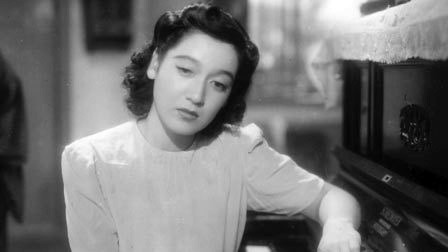
Setsuko Hara as Noriko.
The first film in the Noriko Trilogy, Late Spring may be the most touching and sad of the bunch. It is essentially a film about the relationship between a father and his beloved daughter, and the difficult decision they make, one that neither really wants. Spurred on by the unlikable aunt, the father leads Noriko to believe that he plans to remarry -- it is not true -- and it would be better for both of them if she finds a husband so he can get on with his life. She resents the decision and is devastated and deeply hurt, feeling herself shoved aside.

Hara, one of cinema's great actresses, effectively conveys the emotional pain of her perceived rejection by her father with confused and searing looks, at one point crying in despair. At times her reaction is almost painful to watch, but any viewer who has unintentionally or intentionally hurt someone they love knows that look. In that respect, Ozu has produced a remarkably honest film.

On talent alone, Hara is magnificent. Combined with rare beauty and immensely likable roles, surely she had what it took to achieve international stardom. However, she never ventured into American films, and because of a lingering hatred of anything Japanese in this country after the war, none of the Noriko films were released in the U.S. until 1972. It is just as well, considering her apparent retiring nature. Still, Setsuko Hara easily could have paved the way for other foreign actresses who shortly thereafter found success in the U.S. in the form of an Oscar: Sophia Loren (1961), Simone Signoret (1959), and Anna Magnani (1955). 

Like all of his films, Director Uzo primarily relies on a static camera, focusing on the interplay between his characters through brief conversations, usually indoors. But in one memorable scene he takes you outside and follows Noriko on a pleasant bike ride with her father's assistant and her friend, Mr. Hattori. The scene is said to be a homage to the American style of film-making, which Uzo reportedly admired.
A late spring outing near the beach. 

For a time, you think that Hattori might be the man for Noriko, and they do engage in harmless flirting, but he is already engaged. The camera follows the pair as they ride along, the wind blowing Hara's wavy hair from her face. She is beautiful, laughing and smiling, having fun. It is easy to suspect that Hattori wonders if he has picked the right girl.

By the end of the film you understand that the rouse is just as hard on the father as the daughter. Chrishu Ryu, a long-time player in Ozu films, appears clueless to his daughter's suffering at first. When she tells him she is happy, that she just want things to remain as they are and cannot conceive of being happier married, he doesn't accept it. He tells her she will find a new happiness, and that marriage is not easy and takes time, maybe years. You realize he is not oblivious to her sadness of course, and acts as he does convinced that what he is doing is in Noriko's best interest. He is willing to sacrifice his own comfort for her future.  

That Ozu never reveals Noriko's husband, though tells us that "he looks like Gary Cooper," is an intentional decision by the director. He is telling us a story of the end of one family, not the beginning of another.

The final scene is probably the most famous in any Ozu  film. Home alone after the wedding, the father sits down and begins to peel an apple. He carves a long winding piece, then pauses as it drops to the floor. He hangs his head in despair. It sounds simple, but it is a crushing moment, one where the horrifying gloom of true loneliness falls on a man, as he understands the harsh reality of his decision for the first time.


Friday, January 21, 2011

No Regrets for Our Youth (1946) -- Akira Kurosawa

The story opens in 1933 as Japan's increasingly nationalist regime moves to suppress academic freedom and student activism in the period before World War II. Yukie (Setsuko Hara) the daughter of a university law professor, soon sees her life change dramatically. Two proteges of her father (Noge and Itokawa), vie for her attentions. When the father is fired, the two join other disgruntled students in a resistant movement that the minister of education easily and quickly controls. Noge drops out of school to continue his political dissent, while Itokawa chooses a safe path and graduates, becoming a government prosecutor and member of the establishment. But the story is about the girl, and what decisions she makes to bring meaning and purpose to her life.

Dissatisfied and empty, Yukie moves to Tokyo where she secures one meaningless job after another. She eventually meets Noge there, who is a recent parolee after five years in prison for political opposition to Japan's designs for expansion and war. Now a publisher, he continues his dissident ways in secret. The two marry. He tells her that one must have no regrets in life, to pursue a course that is important. If the people of today do not understand his opposition to the government, they will in ten years. On the eve of Pearl Harbor, Noge is arrested. He later dies in jail, leaving Yukie again, unfulfilled and searching for a purpose.

Idyllic days before academic freedom was oppressed.

Viewers used to Kurosawa will find this a different film than his usual fare. Most obviously, it is centered on a woman rather than a male character. It contains no action to speak of and none of the Fordian themes of honor, loyalty, betrayal and revenge that inhabit his later films. (Kurasawa was a great admirer of John Ford and his cinematic approach to story telling.)  Like his later work, however; No Regrets is beautifully shot. The lack of a strong male protagonist allows the director to focus on character development and performance.      

Hara is remarkable. One of the world's great actresses, she is just 26 here, but demonstrates more skill and controlled emotion than just about any better known American and European actors (The only comparable ones for me are Stanwyck and Kerr). The film spans some 12 years of the character's life, and at no point does she not look or act the correct age. It is a turbulent journey of self-discovery, handled sublimely. She looks quite younger here than she did for the Noriko Trilogy roles with Yasujiro Ozu; fuller of face perhaps, with shorter hair, but still beautiful. Kurosawa uses plenty of closeups of his actress to great effect, as Hara's eyes convey an enormous range of feelings, from joy to despair.

When one thinks about her more famous "Noriko" performances: self-effacing young women still steeped in tradition; and compare them to her role as the passionate, tradition-breaking Yukie; you appreciate that Hara was a wonderfully versatile actor.     

The best scenes are in the final third, when Yukie has decided to travel alone to the country to live with Noge's parents. They live a miserable life, are old and dirt poor, and have been ostracized by the villagers for having a traitor for a son. At first they reject her, but her stubborn determination to help someone eventually wins them over. She stands alongside the old women planting rice and toiling in the fields, and you get a little appreciation of the back-breaking life that an agriculture-based existence could be in Japan in the 1940s.       
Setsuka Hara as Yukie.
Made just after the war, it is Kurasawa's first film not censured or controlled by the state. It is interesting that he includes no real mention of the conflict. It intrudes into the lives of his characters off-screen. Though there is a clear rejection on the director's part of Japan's role in the war, and of the philosophy of expansion that its jingoistic leaders embraced, he does not dwell on it. This is a more subtle, sensitive film than a lesser director might have made in his place.    

I like a film bookended by related scenes. No Regrets has one of films' finest examples. It opens with a perfectly idyllic scene. Yukie and a group of college students are on a picnic. They happily bound through a flowered meadow, step across rocks in a stream, and run through some woods to the top a hill where a panoramic view unfolds. There they collapse in the grass and rest. Gunfire is heard in the distance. Yukie walks off for a better look, saying she likes the sound. They find a body in the grass. This signifies the start of the oppressive period. Near the end of the film, Yukie revisits the spot, and sits near the same stream to watch a similar group of students. They enjoy the reinstated freedoms. It is a poignant reminder that life comes full circle and that she has come a long way.   

Saturday, January 1, 2011

Early Summer (1951) -- Yasujiro Ozu

The Mamiya family. 
Noriko (Setsuka Hara) is twenty-eight and lives with her parents, her brother and his wife, and their two sons. She is unmarried, which in post-war Japan still borders on being an old maid. Her marital status is of great concern to all, particularly her brother and parents. Times are changing, however, and Noriko is an independent woman. She works in an office and helps with the family budget. She enjoys being single and visiting with friends, both married and single. When her boss suggests she marry a 40-year old friend of his who is well established with an executive job her family urges her to accept. Though caring and devoted to her family, Noriko has other ideas.

This the the second in the "Noriko Trilogy" by Director Ozu and Hara. If the weakest of the three films it is still wonderful (the others being Late Spring 1949 and Tokyo Story 1953). It similarly is in the minimalistic style of the director, with mostly static, low angle camera shots, little action, and conversations that show a family's every day existence. They are quiet films, serene in their pace, where the focus is on family interaction over action and plot. There are scenes of eating and simple conversation, characters going to work and coming home. With these Ozu cuts to scenes of a bird cage, a tree, a moving train, or a busy Tokyo street to emphasize that each family is but a small part of life in the city. The film opens and closes with a shot of waves lapping a shore--life is constant and inevitably moves forward.

That theme is what this film is about. Noriko's choice reflects the changing culture of post-war Japan, which is increasingly being Westernized. Women are beginning to make their own choices, and are not so reliant on tradition and the wishes of parents. Marriages are becoming less arranged contracts. 

The best scene in the film is between Hara and her sister-in-law, Fumiko (Kuniko Miyake). It is near the end and Noriko has decided to reject the arranged marriage proposal, and instead, wed a long-time acquaintance, a widower with child. Fumiko loves Moriko like a sister, and needs to express her concern. She warns her about being poor. Assured by Noriko that she knows what she's doing, they share a poignant laugh. Noriko explains she wasn't comfortable about a 40-year old man still drifting around unattached. The scene ends as they run down to the sea and begin to stroll along the shore, water lapping at their feet.    

Noriko and Fumiko share quiet moment.


The scene opens with a shot of a sand dune. The camera pans slowly up and from behind we see the two women walk up the hill, stop at the top and sit down. There is an immediate cut to the front. We can still not see what they are looking at. During the conversation you get the sense that despite her worry, the slightly older woman envies Noriko a little. She admits that she herself knew nothing of marriage before she wed Noriko's brother. It is a small, honest moment between two friends that care for each other, something that Ozu captured as well as anyone. Each trilogy film contains an undercurrent of sadness. Here, both women feel the imminent change in their lives. It is disquieting, but inevitable. And the loss of another brother killed in the war haunts the family, particularly the grandmother who still hopes he will return. Still, Early Summer is much less overtly sad than the other films. The aged parents see the family broken up and dispersed, but the old couple are still together, and no doubt will see everyone again. 

Like the great John Ford, an American director he purportedly admired, Ozu has his stock company. Many of the same actors appear in the Trilogy films, most notably Hara and Chrishu Ryu, who here plays the brother. In Late Summer he is Hara's father, in Tokyo Story, her father-in-law. Ryu has an extraordinary talent to assume the age and appearance of his characters, down to an old man's shuffle. 

The supporting actors will be familiar to Ozu viewers. With little screen time they give effective performances.  

What Makes Early Summer Special:

Setsuko Hara is a joy to watch. Easily shifting character: from a mature, confident young woman, to almost a giggling schoolgirl with friends and family, or crying because her decision unintentionally hurts someone, she is a natural actress. Her smile is radiant and comforts the viewer. When Japanese woman talk in Ozu films they often sound like happy birds chirping. Hara's voice is like that, and conveys sympathy and concern. In each film she is the most likable character.   

Ozu does a great job capturing signs of Americanization in a nation bound in tradition: Noriko's business attire, a Coca Cola sign, a movie poster, a mention of a Hollywood actress.  

Inside Story:

Ryu appeared in 52 of Ozu's 54 films, certainly the greatest partnership in film history between an actor and a director.  

At the time of this writing Hara is still alive at age ninety. She retired from film in 1963, shortly after Ozu's death, still at the height of her popularity.


Thursday, October 21, 2010

Tokyo Story (1953) - Yasujiro Ozu

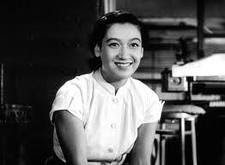
Setsuko Hara as Noriko.
An elderly couple are disappointed with a visit to Tokyo, where their children's busy lives and attitude make them feel neglected. Only their widowed daughter-in-law, Noriko (Setsuko Hara), goes out of her way to be nice. Her husband was presumed killed in the war eight years ago. The children send the parents to a resort but it proves too noisy and unpleasant, prompting the couple to cut their visit short. On the train ride home, the woman falls seriously ill, and the children are notified to come quickly.

In a simple story about family relationships, aging, and loss, Ozu creates an extraordinarily  poignant and moving film, filled with quiet moments. Conversations are short with long pauses for thought, and with but one exception, Ozu's camera is stationary, letting the languid pace of life unfold for the characters and audience. A motif of time and travel plays behind the action: a watch, trains in motion, and a tug floating down a river. The pacing serves to remind us there is a universality about how parents and their children grow apart, about how we are all affected by loneliness at one time or another, and about the expectation of death and regret afterwards. Ozu shows this all without maudlin sentimentality in a passive and minimal style that demands your attention and reflection.

Setsuko Hara gives a captivating and beautiful performance as Noriko, a kind, smiling  woman scarred by loss. Pre-war cultural norms say she remains part of her husband's family, and she has put her life on hold with his death, keeping his photo displayed on a shelf. This is a troubled soul. Yet throughout, she manages to show great compassion to all the characters in sharp contrast to the couple's own children, who act distracted and inconvenienced by the visit as they mostly ignore the parents, eventually shuffling them off to a spa to get them out of the way. One daughter even scolds her husband for buying cakes for the occasion, saying crackers are good enough for her parents. After a kindness, the old woman encourages Noriko to forget her dead husband, saying she should remarry. But Noriko is resigned to her lot in life. She works in a tire factory and her apartment is small and sparsely decorated. It is a lonely existence. When asked, "Isn’t life disappointing?" she smiles and says simply "Yes, it is," as if nothing can be done to change it.

A revealing scene occurs at the post-funeral meal. The conversation is awkward. None of the siblings express real regret to their father for his loss. One even asks for pieces of her mother's clothing as keepsakes, and they are all in a hurry to get back to their own lives. Director Ozu does not seem to be judging them so much as saying their reaction mimics real life.   

Noriko is overcome with emotion.
Several journeys are developed over the course of the film: that of the parents to and from Tokyo; the father's realization that life is forever changed; and Noriko's transition from the past to the future. This is not a happy film to watch, but it is an honest one. Hara gives one of film's all time great performances. She has a quiet dignity, but the quiver in her voice suggests a brave front. Her final conversation with the father is a catharsis; she finally admits her profound loneliness. Overcome, she buries her face in her hands. The shift is sudden but subtle. In the hands of a different director and actress, the scene might have been overdone; here it is deeply affecting. The film ends hopefully for her. En-route back to Tokyo, she holds her mother-in-law's watch, a gift from the husband; and from her expression, you can believe she is finally ready to move on.

Noriko serves as substitute for their own children. Here she treats the Hirayamas to sake in her modest apartment after a day of sight-seeing.
The supporting performances are strong, especially  Chieko Higashiyama as the old wife. She has a wonderful scene with Hara, reluctantly accepting a small gift of money, knowing the girl can ill-afford to give it. The gesture sparks genuine affection in her for the girl, and shame.  Elsewhere, the old woman tries with little success to bond with a grandchild she has never before seen, strolling along a ridge. It is another nearly speechless moment where Ozu comments on the difficulty of generations to communicate. 

The film contains little music beyond the haunting melody that opens the action and brings down the curtain. The film is notable for its use of the "tatami-mat" shot, in which the camera height is low and remains largely static throughout. The style necessitated all the sets to be constructed with ceilings.

What Makes Tokyo Story Special:
    
Often in real life, love between old couples remains largely unspoken, yet it's there in their little mannerisms and exchanged glances. The film captures that sweet reality perfectly.     

For Western audiences, one of the more interesting aspects of the film is getting a glimpse of Tokyo a few years after the war. It is economically depressed and socially repressed by Western standards, incredibly crowded and claustrophobic. The only baths are public. It is a fascinating setting and look into another culture.

Deservedly so, Tokyo StoryHara not winning as actress, and the director and film not being nominated.


Inside Story:

American audiences did not get to see the film until 1964, by which time Ozu was already dead.

This was Ozu's third pairing of Hara and Chishu Ryu, who plays the old man. Four years earlier they appeared in Late Spring, and two years earlier in Early Summer. As with this film, Ozu's style was simple story telling, as an observer of ordinary people, without camera tricks and complex plots. Hara retired from acting in 1963, just 43 years of age and shortly after Ozu's death at age 60. As of this writing, she is still alive. 

Ryu and Ozu collaborated in 52 films, surely a record for a director and actor.

Other Films of Interest by Ozu/Hara:

Late Spring (1949), Early Summer (1951), Tokyo boshoku (1957), Late Autumn (1960), and The End of Summer (1961).

•  twice named on Top Ten List of greatest films by BFI critics (Sight and Sound magazine)  

•  on Time's All-time list of Great Films