Saturday, June 11, 2011

Moby Dick (1956) - John Huston

"Call me, Ishmael." It's one of the most recognized openings of any great American novel. Director John Huston begins his film adaptation of Herman Melville's Moby Dick the same way. Narrated by Richard Basehart, who plays the young whaler, the film focuses on the adventurous pursuit of the elusive white sperm whale by an obsessed Captain Ahab (Gregory Peck) without delving too deeply into the symbolism of the book, nor the incredibly detailed aspect of the whale harvesting it portrays. It was a good decision, as the novel is heavy with complex metaphor and themes: man's place in the universe, good versus evil, the existence of god. (Writer Ray Bradbury deserves credit for editing the dense novel into a movie script.) Besides, there is adventure enough to excite any viewer.

Restless and bored with living on land, Ishmael feels drawn to the sea. The film follows him as he first encounters Queequeg, a cannibal and harpooner, in New Bedford at the Spouter Inn. They become friends and join the crew of the Pequod, a whaler whose captain is the mysterious and obsessed Ahab. The crew doesn't know it yet, but Ahab seeks revenge against Moby Dick, a great white sperm whale who has bit off Ahab's leg. The film follows the pursuit to its fateful conclusion, slightly altering Ahab's death for the better, and includes all of the most memorable scenes from the novel: Ishmael and Queequeg's first meeting, Father Mapples' rousing sermon, the strange Elijah's warning on the dock, sailing around Cape Hope in a typhoon, Queequeg's reading his future by tossing bones, spirited whale chases in longboats, and the final confrontation between man and beast.
The Pequod slips out of New Bedford Harbor.
You get a wonderful feel for a sailor's life aboard a 19th century whaler. It is hard, dirty, dangerous work for hard men. When they spot a whale and lower the boats, the crew haul hard on the oars until they are close enough for the harpooners to strike with their lances. Then the race is on, with the behemoths dragging the boats behind them, sometimes tossing the crew overboard. It is fast and furious, and Huston captures the action and the immensity of the ocean magnificently. The typhoon sequence is wonderfully intense and dramatic, leaving the viewer to wonder how men actually withstood such peril. It is one of the best such sequences in the history of film.

To give the action a contemporary look for the period, Huston and cinematographer Oswald Morris created a unique desaturated subdued pastel effect on the film stock. It works. At times it seems as if you are watching an old documentary, or looking over tintype or daguerreotype photos.

Peck, just 38 at filming, is unfairly criticized for his role. Some say he was miscast, others that he was too young. But he captures the madness of Ahab perfectly, using his deep voice to perfection. When this Ahab raises a wild eye brow and scowls at his crew as he begins to speak in the novel's signature prose, urging them onto the quest, you understand the character's magnetism and get a clear glimpse at his self-destructive maniacal nature. It takes a while for Ishmael to see the man for what he is. In one voice over he explains: "He did not feel the wind, or smell the salt air. He only stood, staring at the horizon, with the marks of some inner crucifixion and woe deep in his face."

First mate Starbuck (Leo Glenn) sees the danger in Ahab before any of the others, and in one passage touches on the novel's religious theme. He expresses his worry to two others:

Starbuck to Stubb and Flask: "It is an evil voyage, I tell thee. If Ahab has his way, neither thee nor me, nor any member of this ship's company will ever see home again."

Stubb: "Aw, come on, Mr. Starbuck, you're just plain gloomy. Moby Dick may be big, but he ain't THAT big."

Starbuck: "I do not fear Moby Dick - I fear the wrath of God."

In addition to Peck, the rest of the cast is just as effective, though Basehart is clearly too old for his role. Ishmael should be in his early 20's. Basehart was 41. It seems a strange choice, though perhaps Huston was impressed with his work in the acclaimed film, La Strada, two years earlier. Orson Welles is magnificent in a brief appearance as Father Mapples, as is Royal Dana as Elijah, whose prophecy on the dock should have warned Ishmael to find another boat.

"A day will come at sea when you'll smell land and there'll be no land, and on that day, Ahab will go to his grave, but he'll rise again, and beckon, and all save one shall follow".

Huston fills the film with little memorable touches: the camera pans across the church walls prior to Mapple's grim sermon to reveal the names of all the New Bedford men who have been lost at sea; Queequeg's face is heavily tattooed; and he changes the novel's ending to have Ahab's corpse beckon to the crew to continue the hunt. The captain has drowned and is lashed to Moby Dick's side by harpoon ropes. As the whale plows through the waves, Ahab's one loose arm flaps and appears to be calling the survivors onward. If some traditionalists decry a novel's alteration, this is one case where dramatic license improved the story.     

New York Times film critic Bosley Crowther called the film "one of the great motion pictures of our times," and lauded its "lean and violent drama."  It is Huston's most ambitious work. For his effort, the New York Film Critics named him Best Director of 1956.
Queequeg goes into a trance after reading his future in bones.
The special effects are wonderful considering the film was made in the mid-1950s. Moby Dick looks ferocious and real for the most part, even if at times it's clears that the boats are models. The musical score swells appropriately when he snaps the boats in half, sending the crews into the water where his massive tail crushes them beneath its weight.


The film ends as the novel does, with the lone survivor, Ishmael, floating half-dead on Queequeg's coffin, lamenting that he alone lives to tell the tale.


Peck as Ahab, waiting for his foe to rise.

Thursday, June 9, 2011

Late Spring (1949) -- Yasujiro Ozu

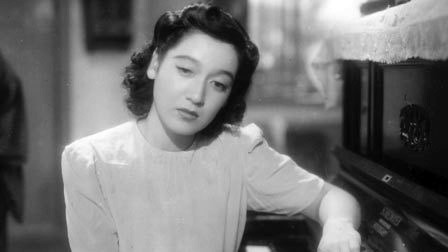
In post-war Japan, Noriko Somiya (Setsuko Hara) is 27 and still lives at home. Recently recovered from an illness contracted during the war, she is content and happy with her simple life, taking care of her widowed father. She explains to her aunt that no one understands him like she does. But the aunt and father worry that at her age, it is time for Noriko to marry and start a life of her own. They concoct a rouse to convince the girl to consider an arranged marriage.
Setsuko Hara as Noriko.
The first film in the Noriko Trilogy, Late Spring may be the most touching and sad of the bunch. It is essentially a film about the relationship between a father and his beloved daughter, and the difficult decision they make, one that neither really wants. Spurred on by the unlikable aunt, the father leads Noriko to believe that he plans to remarry -- it is not true -- and it would be better for both of them if she finds a husband so he can get on with his life. She resents the decision and is devastated and deeply hurt, feeling herself shoved aside.

Hara, one of cinema's great actresses, effectively conveys the emotional pain of her perceived rejection by her father with confused and searing looks, at one point crying in despair. At times her reaction is almost painful to watch, but any viewer who has unintentionally or intentionally hurt someone they love knows that look. In that respect, Ozu has produced a remarkably honest film.

On talent alone, Hara is magnificent. Combined with rare beauty and immensely likable roles, surely she had what it took to achieve international stardom. However, she never ventured into American films, and because of a lingering hatred of anything Japanese in this country after the war, none of the Noriko films were released in the U.S. until 1972. It is just as well, considering her apparent retiring nature. Still, Setsuko Hara easily could have paved the way for other foreign actresses who shortly thereafter found success in the U.S. in the form of an Oscar: Sophia Loren (1961), Simone Signoret (1959), and Anna Magnani (1955). 

Like all of his films, Director Uzo primarily relies on a static camera, focusing on the interplay between his characters through brief conversations, usually indoors. But in one memorable scene he takes you outside and follows Noriko on a pleasant bike ride with her father's assistant and her friend, Mr. Hattori. The scene is said to be a homage to the American style of film-making, which Uzo reportedly admired.
A late spring outing near the beach. 

For a time, you think that Hattori might be the man for Noriko, and they do engage in harmless flirting, but he is already engaged. The camera follows the pair as they ride along, the wind blowing Hara's wavy hair from her face. She is beautiful, laughing and smiling, having fun. It is easy to suspect that Hattori wonders if he has picked the right girl.

By the end of the film you understand that the rouse is just as hard on the father as the daughter. Chrishu Ryu, a long-time player in Ozu films, appears clueless to his daughter's suffering at first. When she tells him she is happy, that she just want things to remain as they are and cannot conceive of being happier married, he doesn't accept it. He tells her she will find a new happiness, and that marriage is not easy and takes time, maybe years. You realize he is not oblivious to her sadness of course, and acts as he does convinced that what he is doing is in Noriko's best interest. He is willing to sacrifice his own comfort for her future.  

That Ozu never reveals Noriko's husband, though tells us that "he looks like Gary Cooper," is an intentional decision by the director. He is telling us a story of the end of one family, not the beginning of another.

The final scene is probably the most famous in any Ozu  film. Home alone after the wedding, the father sits down and begins to peel an apple. He carves a long winding piece, then pauses as it drops to the floor. He hangs his head in despair. It sounds simple, but it is a crushing moment, one where the horrifying gloom of true loneliness falls on a man, as he understands the harsh reality of his decision for the first time.


Saturday, February 5, 2011

The Train (1964) -- John Frankenheimer


The German Army is growing more frantic as Allied forces close in on Paris in August 1944. While some army officials are busy burning documents, Colonel Von Walheim (Paul Scofield) is worried about priceless French paintings. He wants to move the masterpieces to Germany and orders the civilian railroad inspector, Paul Labiche (Burt Lancaster), to make it happen. Labiche is also a member of the French resistance. When his superiors get wind of the plan, they order him to prevent the theft. He's reluctant. During the war he has seen his small group reduced from 18 to 3 and he has little appreciation for the treasure, saying art is not worth risking the lives of his men. The museum curator explains, "But those paintings are part of France... This beauty, this vision of life, born out of France, our special vision, our trust... we hold it in trust, don't you see, for everyone? This is our pride, what we create and hold for the world. There are worse things to risk your life for than that." When Papa Boule, an old engineer, takes it upon himself to disable the train and is executed, Labiche changes his mind and concocts a clever ruse to trick the Germans.

Paul Scofield as Colonel Von Walheim.
The film opens with Walheim visiting a French museum. Frankenheimer employs two close-ups, one on a Cezanne, followed by one on Walheim and you can tell he is a man who deeply appreciates art, not for its value, though that is how he convinces his superior to give him the train, but for its beauty, a sentiment he shares with the museum curator. He informs her that he is taking the paintings. The credits roll over dramatic music, and the soldiers come in to pack crates, stenciling the names of great artists on the boxes. It is an exciting start to one of the best WWII action films ever made.  

Much of what follows comes without background music, taking advantage of the unique sounds of the railway. Shrill whistles, screeching brakes, the release of steam, and men shoveling coal into the engine boiler provide real authenticity. The workers are smeared with oil and grime. It is Frankenheimer's best paced film. He builds tension throughout and holds it for long periods interspersed with great action sequences, including a quick aerial attack on the station filmed from a high crane, and another of the train being strafed by a plane while it barrels toward the safety of a tunnel. The dramatic effect is heightened by the use of close camera angels that put you right on top of the action. Other interesting camera work twice shows Lancaster in the background, once climbing out a window and later jumping over a fence, while your eye is focused on characters in the foreground. 


Burt Lancaster as Labiche.
Lancaster gets ample opportunity to display his physicality with some difficult stunt work for a man of 51. The most famous has him sliding down a long ladder and running to catch the train. He makes no effort at a French accent but it doesn't matter; his performance relies more on action than emoting. In any case, he is determinedly convincing.

The heavy lifting on the acting front is done by Scofield in a more complicated role. A cultured man, he can be vicious and inhumane like most Hollywood Nazis. He exudes arrogance and is not above murdering a few innocent civilians. One of the few times he raises his voice is his final confrontation with Labiche. He taunts him, saying "a painting means as much to you as a string of pearls to an ape."
Frankenheimer films typically show men facing some kind of formidable crisis or under extreme pressure, often of a psychological  or emotional nature. His best involve two strong characters at odds, and his heroes aren't always conventional types. The Train is a good example. This was his third pairing with Lancaster.

What Makes The Train Special:
The film makes good use of explosives. A spectacular real crash of two engines is a highlight. But its most interesting aspect is the chess match between the two protagonists, formidable but contrasting foes. They are each determined and stubborn, but beyond that, are very different men. More than anything, the film is a fascinating dual character study.

The film has a great sense of realism, with the danger associated with being a member of the Resistance clearly evident. Besides Jeanne Moreau, none of the actors could be called beautiful. They look like real people, calloused by four years of occupation. The black and white cinematography establishes a proper feeling for the era in the tradition of Italian neo-realism like Rossellini's Open City

There are several fine supporting performances, including Michel Simon as Papa Boule and Wolfgang Preisse as a German major. Two years earlier Preisse played the German officer in the coastal bunker who first sees the invasion fleet in The Longest Day.

The Train is a big cut above other WWII thrillers of the period such as  Von Ryan's Express, The Dirty Dozen, and The Great Escape. It's a more serious look at the courage needed to combat Nazism. The film depicts just one small battle in that fight. There were hundreds of thousands that took place elsewhere.  

The Inside Story:

Frankenheimer was determined to avoid the use of special effects. All the train crashes are done with real surplus equipment and filmed on location in France. 
Original music was composed by Maurice Jarre, whose other credits include The Longest Day, Is Paris Burning?, Doctor Zhivago  and Lawrence of Arabia.

One of Lancaster's action sequences. Moments later he slides down the ladder.
Lancaster was injured on location playing golf. Frankenheimer worked his limp into the plot by having his character Labiche shot while running across a bridge.
Memorable lines:
Didont: With luck, no one will be hurt.
Labiche: No one's ever hurt. Just dead.

Didont Paul, uh, have you ever seen any of those paintings on that train? I haven't. You know, when it's over, I think maybe we should take a look, hmm?


Papa Boule: (wistfully) Renoir... I knew a girl who modeled for Renoir... She smelled of paint...

Major Awards:
  • Nominated for Best Writing Oscar (Frank Coan and Frank Davis)
Other Films by Frankenheimer:
  • Birdman of Alcatraz 1962
  • The Manchurian Candidate 1962
  • Seven Days in May 1964
  • Seconds 1966


Friday, January 21, 2011

No Regrets for Our Youth (1946) -- Akira Kurosawa

The story opens in 1933 as Japan's increasingly nationalist regime moves to suppress academic freedom and student activism in the period before World War II. Yukie (Setsuko Hara) the daughter of a university law professor, soon sees her life change dramatically. Two proteges of her father (Noge and Itokawa), vie for her attentions. When the father is fired, the two join other disgruntled students in a resistant movement that the minister of education easily and quickly controls. Noge drops out of school to continue his political dissent, while Itokawa chooses a safe path and graduates, becoming a government prosecutor and member of the establishment. But the story is about the girl, and what decisions she makes to bring meaning and purpose to her life.

Dissatisfied and empty, Yukie moves to Tokyo where she secures one meaningless job after another. She eventually meets Noge there, who is a recent parolee after five years in prison for political opposition to Japan's designs for expansion and war. Now a publisher, he continues his dissident ways in secret. The two marry. He tells her that one must have no regrets in life, to pursue a course that is important. If the people of today do not understand his opposition to the government, they will in ten years. On the eve of Pearl Harbor, Noge is arrested. He later dies in jail, leaving Yukie again, unfulfilled and searching for a purpose.

Idyllic days before academic freedom was oppressed.

Viewers used to Kurosawa will find this a different film than his usual fare. Most obviously, it is centered on a woman rather than a male character. It contains no action to speak of and none of the Fordian themes of honor, loyalty, betrayal and revenge that inhabit his later films. (Kurasawa was a great admirer of John Ford and his cinematic approach to story telling.)  Like his later work, however; No Regrets is beautifully shot. The lack of a strong male protagonist allows the director to focus on character development and performance.      

Hara is remarkable. One of the world's great actresses, she is just 26 here, but demonstrates more skill and controlled emotion than just about any better known American and European actors (The only comparable ones for me are Stanwyck and Kerr). The film spans some 12 years of the character's life, and at no point does she not look or act the correct age. It is a turbulent journey of self-discovery, handled sublimely. She looks quite younger here than she did for the Noriko Trilogy roles with Yasujiro Ozu; fuller of face perhaps, with shorter hair, but still beautiful. Kurosawa uses plenty of closeups of his actress to great effect, as Hara's eyes convey an enormous range of feelings, from joy to despair.

When one thinks about her more famous "Noriko" performances: self-effacing young women still steeped in tradition; and compare them to her role as the passionate, tradition-breaking Yukie; you appreciate that Hara was a wonderfully versatile actor.     

The best scenes are in the final third, when Yukie has decided to travel alone to the country to live with Noge's parents. They live a miserable life, are old and dirt poor, and have been ostracized by the villagers for having a traitor for a son. At first they reject her, but her stubborn determination to help someone eventually wins them over. She stands alongside the old women planting rice and toiling in the fields, and you get a little appreciation of the back-breaking life that an agriculture-based existence could be in Japan in the 1940s.       
Setsuka Hara as Yukie.
Made just after the war, it is Kurasawa's first film not censured or controlled by the state. It is interesting that he includes no real mention of the conflict. It intrudes into the lives of his characters off-screen. Though there is a clear rejection on the director's part of Japan's role in the war, and of the philosophy of expansion that its jingoistic leaders embraced, he does not dwell on it. This is a more subtle, sensitive film than a lesser director might have made in his place.    

I like a film bookended by related scenes. No Regrets has one of films' finest examples. It opens with a perfectly idyllic scene. Yukie and a group of college students are on a picnic. They happily bound through a flowered meadow, step across rocks in a stream, and run through some woods to the top a hill where a panoramic view unfolds. There they collapse in the grass and rest. Gunfire is heard in the distance. Yukie walks off for a better look, saying she likes the sound. They find a body in the grass. This signifies the start of the oppressive period. Near the end of the film, Yukie revisits the spot, and sits near the same stream to watch a similar group of students. They enjoy the reinstated freedoms. It is a poignant reminder that life comes full circle and that she has come a long way.   

Friday, January 14, 2011

Great Expectations (1946) -- David Lean

Young Pip (Tony Wager) is an orphan living with his cantankerous sister and kind uncle, Joe Gargery (Bernard Miles). Pip has no aspirations beyond hoping to one day become a blacksmith like Joe, for whom he serves as apprentice. One night Pip encounters a menacing escaped convict on the marsh, Magwitch (Finlay Currie). Scared out of his wits, Pip steals some food for the man, who shortly is recaptured and taken away. About the same time, Pip makes the acquaintance of a strange old woman, Miss Havisham (Marita Hunt). She is wealthy and arrogant and introduces the boy to her beautiful niece, Estella (Jean Simmons). Pip is infatuated, but rebuked. She tells him he is course and common. He soon comes into some money, thanks to a mysterious benefactor, and Pip (now, John Mills) goes off to London and high society with great expectations to make a name for himself as a gentleman.  
Pip visits his parents' grave.
This is arguably the best adaption of any Charles Dickens' novel to screen, Dickens' most accessible work. The only other film of similar stature is Director Lean's own Oliver Twist, filmed two years later, with some of the same cast and crew. Here, Lean faithfully captures the mood of the novel's time and place, especially Havisham's ivy-covered and cobwebbed-ridden mansion, the murky marshland, and the teeming streets of London. Filmed in black and white, it is stunningly beautiful. And populated by some of Dickens' most fascinating and colorful characters, it is a delight. Currie as Magwitch, and Francis Sullivan as the irrepressible lawyer, Mr. Jaggers, are impressive and memorable. 

The film starts with a dramatic scene, its best. Pip comes to a churchyard to lay flowers at his parents' grave. The wind howls eerily and the trees creak ominously. Pip first meets the desperate convict here. It is a masterful achievement by Lean and art director Wilfred Shingleton; who together create the perfect atmosphere. Magwitch, starving, filthy, and bound by leg irons, looks exactly as a young boy's imagination would picture such a monster. He suddenly looms up and threatens the terrified boy: "Keep still, you young devil, or I'll slit your throat!" He tells Pip to bring him some food and tools. If he doesn't, he'll "have his liver and heart out!" Currie is wonderful. The set decoration includes tilted headstones, a period church in the background, and naked tree branches that remind one of skeleton arms.   

A horrible encounter with Magwitch.
There are moments of fine humor in the film. Mr. Jaggers, who serves as the intermediary between Pip and his secret benefactor, is bound to silence. Jaggers has his own language, deliberate and formal. He cannot tell Pip who saved him from a working life of poverty, and without being too direct, he cleverly advises the young man, scolds him when necessary, and generally makes sure he is taken care of. There is a peripheral character named the "Aged P." No longer able to hear, his son communicates with his father by nodding. It is silly, but funny.

Miss Havisham is one of film's most macabre characters. Certainly mad, she is a dowager in a rotting wedding dress. Jilted at the alter years earlier, she hasn't let the sunlight enter her mansion since. The table is still set for the wedding feast with a moldy cake as centerpiece. Even the mice won't touch it. 
 
Inside the Havisham Mansion.

What Makes Great Expectations Special:

This is simply one of the most visually rich films ever made. No scene is neglected. Of course, Lean had the wonderful source novel as grist for the mill. For example, Mr. Jaggers keeps death masks of clients he has lost to the gallows on his office walls.

Like all Dickens novels, the story is dense and complicated. Characters in the first act reappear later. Magwitch is one, and his second coming is dramatic and changes the course of the film. Lean, an accomplished editor before he turned to directing, knew how to trim it down without losing any of Dickens' unique flavor and atmosphere, or his biting social commentary. Everything is resolved in the end, of course.   

Lean's mastery of direction shows up in little scenes, like the one where Jaggers asks Pip to look out his office window. The Point of View is Pip's--he sees a plaza below packed with rowdies come to watch a multiple hanging. The POV shifts to Pip's face for his reaction. We hear the crowd quiet as the camera moves in for a close-up. Suddenly there is a rousing cheer and Pip cringes. The execution appears off screen, but we know exactly what happened. 

Inside Story:

Alex Guinness made his speaking film debut as Pip's friend and roommate, Herbert Pocket. He would go on to work with Director Lean five more times, most notably as Fagin in Oliver Twist (1948) and winning the Oscar for his role as Colonel Nicholson in The Bridge on the River Kwai (1957).

Lean would go on to international fame as a director of grand epics, like the aforementioned Kwai, Lawrence of Arabia, Doctor Zhivago, Ryan's Daughter, and Passage to India. But it is his early work, including the two Dickens' classics, that may be his greatest achievements. 

John Mills, who plays the older Pip was 38 when the film was produced. He does a fine job, but he is too old for the role, which requires someone a good ten years younger. It is the only significant distracting aspect of the film.

Jean Simmons at 17 is quite beautiful. It is too bad her role is such a short one.

Major Awards:
  • Won Oscars for Best Art Direction/Set Decoration, and Best Black & White Cinematography.
  • Nominated for Oscars for Director, Picture, and Writing.
  • In a 1999 poll it was named the 5th best British film by the British Film Institute.
Other Early Films by Lean:
  • Brief Encounter 1945
  • Blithe Spirit 1945
  • Oliver Twist 1948
  • Summertime 1955    

Saturday, January 8, 2011

Touch of Evil (1958) - Orson Welles

Orson Welles as the seedy Captain Quinlan.
Mexican narcotics officer Mike Vargas (Charlton Heston) is soon scheduled to testify in a trial against a notorious Mexican crime family, the Grandis. In the meantime, while on his honeymoon, he gets embroiled in corruption in a Texas border town when a car-bombing kills an American developer. Because it's clear the explosive was planted on the Mexican side of the border, Vargas joins the investigation. Hank Quinlan (Orson Welles), the American police captain, thinks he knows who did it, and to prove it, he's not above planting evidence to secure a conviction. "I never framed anyone," he says, "...unless they're guilty." Vargas is shocked by such unsavory police methods and threatens to out Quinlan. To protect his own reputation and pressure Vargas to back off, Quinlan joins forces with Uncle Joe Grandi (Akim Tamiroff).

Welles employs his characteristic camera magic--extended takes, deep focused darkened scenes with jarring angles, and unsettling close-ups, in this, the last of the classic American film noirs, a genre that petered out before 1960. It is a marvelously seedy atmospheric setting, where it's hard to tell the criminals from the cops. In the repulsive Quinlan, Welles creates one of noir's most memorable characters. Thirty years on the job and the murder of his wife has turned him into a man almost diseased by the fifth that cakes his soul. "I'm always thinking of her, drunk or sober," he admits. "What else is there to think about, except my job, my dirty job?" Obese and crude, he hasn’t shaved in days and looks to have slept in his clothes. You imagine he stinks.

Joe Grandi Shrinks in fear. 
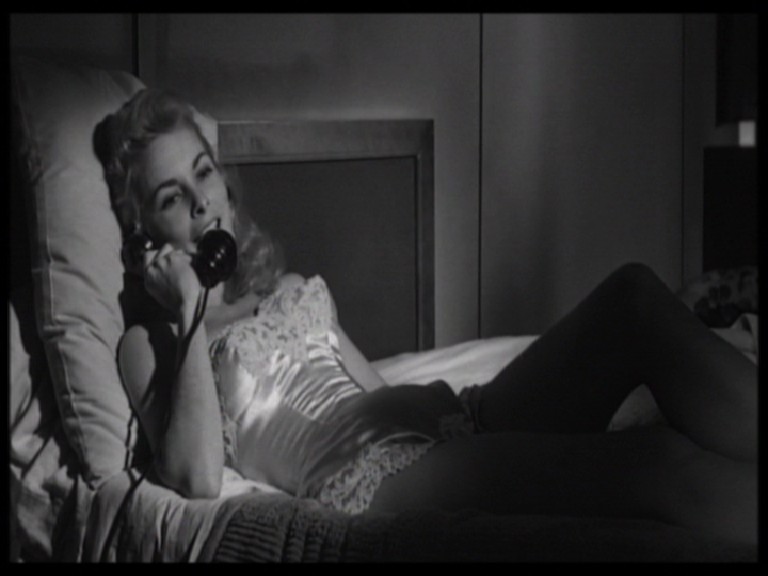
In a film full of great sequences, the most critically acclaimed is the audacious three-minute plus opening high crane tracking shot that sets up the car explosion. Cars, street vendors, and pedestrians crisscross in front of and behind Vargas and his wife Susan (Janet Leigh) as they walk down the street and pass through a border inspection station. Complicated and reliant on perfect timing, it is a magnificent technical achievement. Two other memorable scenes both involve Janet Leigh. In the first, Susanthought to be safely tucked away in an isolated American motelis overpowered by creepy Grandi gang members, including Mercedes McCambridge in a cameo. She leers at the struggling girl with glee, saying, "I want to watch." Later, with Susan drugged and half-naked on a bed in a downtown hotel, Quinlan and a perfectly terrified Joe Grandi have a tense and pivotal encounter. Quinlan, drunk and sleep-deprived, shows his cruelty and desperation in an effort to protect himself.

Quinlan: "Come on, read my future for me.
Tanya: "You haven't got any."
Quinlan: "Hmm? What do you mean?"
Tanya: Your future's all used up."
The film is all about betrayal. There are four: Quinlan has long-since abandoned the police code of honor and he double-crosses Uncle Joe; Vargas resorts to unethical tactics to trap the big man; and most disturbing, Quinlan's right-hand-man, deputy Menzies, helps him do it. Joseph Calleia plays the loyal Menzies in a great performance. The captain once saved his life by taking a bullet meant for him. When finally forced to see his idol as he really is, corrupt and a killer, Menzies is sick with anguish. He loves the man.        

Janet Leigh thinks she's safe in a motel.
Henry Mancini wrote a wildly effective jazzy/swing score and two terrific supporting roles add to the unsettling nature of the film. Dennis Weaver plays a weirdly nervous hotel night clerk, and Marlene Dietrich is an out-of-place gypsy fortune teller, Tanya, who may have had a fling with Quinlan years ago. Illustrating the depth of his decline, he has become so fat she doesn’t recognize him, saying, "lay off the candy bars." Dietrich has the wonderful last line in the film.  

What Makes Touch of Evil Special:

Welles perfectly captured the visual style of Noir and produced a film significantly more entertaining than his consensus masterpiece, Citizen Kane.

There are lots of little touches thrown in, unnoticed except through repeated viewings. When Quinlan throttles Grandi, hoping to frame Susan for murder, he forgets his cane. He passes through the door, where a sign hangs reminding occupants not to leave anything behind. At one point a Grandi thug throws acid at Vargas. He misses but splashes a poster of the stripper killed in the opening car explosion. In another scene Uncle Joe loses his toupee.

The power of the film lies in Welles' ability to make a morally degenerate character almost sympathetic. Sure Quinlan's methods are as crooked as the criminals he chases, but the man's hunches on the guilty are right on the mark. Something happened to him in the past that we don’t get to see, but you sense he was a good man once upon a time. And betrayal is never pretty, no matter who the target.
  
Inside Story:

The film was famously re-edited by the studio against Welles' ardent wishes, deleting several minutes and reshooting some scenes. Welles didn't want credits shown or background music to interfere with the famous opening tracking shot.

Joseph Calleia played El Sordo in 1944's For Whom the Bells Tolls, which also starred Akim Tamiroff as the guerrilla band leader, Pablo.

Director of photography, Russell Metty, also shot 1961's The Misfits and 1960's Spartacus, for which he won an Academy Award.   

A box office bust in the U.S. upon its initial release, it was lauded elsewhere, named best film at the 1958 Brussels World Fair by critics/judges Francois Truffaut and Jean-Luc Godard, who'd later direct Breathless and The 400 Blows, respectively.


The Famed Opening Sequence:

Saturday, January 1, 2011

Early Summer (1951) -- Yasujiro Ozu

The Mamiya family. 
Noriko (Setsuka Hara) is twenty-eight and lives with her parents, her brother and his wife, and their two sons. She is unmarried, which in post-war Japan still borders on being an old maid. Her marital status is of great concern to all, particularly her brother and parents. Times are changing, however, and Noriko is an independent woman. She works in an office and helps with the family budget. She enjoys being single and visiting with friends, both married and single. When her boss suggests she marry a 40-year old friend of his who is well established with an executive job her family urges her to accept. Though caring and devoted to her family, Noriko has other ideas.

This the the second in the "Noriko Trilogy" by Director Ozu and Hara. If the weakest of the three films it is still wonderful (the others being Late Spring 1949 and Tokyo Story 1953). It similarly is in the minimalistic style of the director, with mostly static, low angle camera shots, little action, and conversations that show a family's every day existence. They are quiet films, serene in their pace, where the focus is on family interaction over action and plot. There are scenes of eating and simple conversation, characters going to work and coming home. With these Ozu cuts to scenes of a bird cage, a tree, a moving train, or a busy Tokyo street to emphasize that each family is but a small part of life in the city. The film opens and closes with a shot of waves lapping a shore--life is constant and inevitably moves forward.

That theme is what this film is about. Noriko's choice reflects the changing culture of post-war Japan, which is increasingly being Westernized. Women are beginning to make their own choices, and are not so reliant on tradition and the wishes of parents. Marriages are becoming less arranged contracts. 

The best scene in the film is between Hara and her sister-in-law, Fumiko (Kuniko Miyake). It is near the end and Noriko has decided to reject the arranged marriage proposal, and instead, wed a long-time acquaintance, a widower with child. Fumiko loves Moriko like a sister, and needs to express her concern. She warns her about being poor. Assured by Noriko that she knows what she's doing, they share a poignant laugh. Noriko explains she wasn't comfortable about a 40-year old man still drifting around unattached. The scene ends as they run down to the sea and begin to stroll along the shore, water lapping at their feet.    

Noriko and Fumiko share quiet moment.


The scene opens with a shot of a sand dune. The camera pans slowly up and from behind we see the two women walk up the hill, stop at the top and sit down. There is an immediate cut to the front. We can still not see what they are looking at. During the conversation you get the sense that despite her worry, the slightly older woman envies Noriko a little. She admits that she herself knew nothing of marriage before she wed Noriko's brother. It is a small, honest moment between two friends that care for each other, something that Ozu captured as well as anyone. Each trilogy film contains an undercurrent of sadness. Here, both women feel the imminent change in their lives. It is disquieting, but inevitable. And the loss of another brother killed in the war haunts the family, particularly the grandmother who still hopes he will return. Still, Early Summer is much less overtly sad than the other films. The aged parents see the family broken up and dispersed, but the old couple are still together, and no doubt will see everyone again. 

Like the great John Ford, an American director he purportedly admired, Ozu has his stock company. Many of the same actors appear in the Trilogy films, most notably Hara and Chrishu Ryu, who here plays the brother. In Late Summer he is Hara's father, in Tokyo Story, her father-in-law. Ryu has an extraordinary talent to assume the age and appearance of his characters, down to an old man's shuffle. 

The supporting actors will be familiar to Ozu viewers. With little screen time they give effective performances.  

What Makes Early Summer Special:

Setsuko Hara is a joy to watch. Easily shifting character: from a mature, confident young woman, to almost a giggling schoolgirl with friends and family, or crying because her decision unintentionally hurts someone, she is a natural actress. Her smile is radiant and comforts the viewer. When Japanese woman talk in Ozu films they often sound like happy birds chirping. Hara's voice is like that, and conveys sympathy and concern. In each film she is the most likable character.   

Ozu does a great job capturing signs of Americanization in a nation bound in tradition: Noriko's business attire, a Coca Cola sign, a movie poster, a mention of a Hollywood actress.  

Inside Story:

Ryu appeared in 52 of Ozu's 54 films, certainly the greatest partnership in film history between an actor and a director.  

At the time of this writing Hara is still alive at age ninety. She retired from film in 1963, shortly after Ozu's death, still at the height of her popularity.