Saturday, July 2, 2011

Favorite Films of the 1940s

It's silly to try to pick a top ten favorites from the 1940s, as more top quality films were produced that decade than any other. You certainly cannot pick a definitive list, as it is more than likely to change depending on your mood. One could easily name five each from just Hitchcock and John Ford and you'd have an outstanding selection. Or five each from Humphrey Bogart and Edgar G. Robinson. Or ten film noirs, a genre that came into its own during the decade. In any case, no-one can deny that for classic film lovers, it is a phenomenal period. Here are ten of mine, listed in chronological order. A few actors have multiple appearances: Claude Rains, Dana Andrews, Ingrid Bergman, Teresa Wright, and Joseph Cotten. And noirs do comprise five or six of my favorites, depending on how you define the term.

1. Casablanca - 1942

Michael Curtiz's masterpiece has one of the most quotable scripts and outstanding casts of all time. Bogart plays the cynical Rick, still in love with Ilsa, played by a beautiful Ingrid Bergman. She and husband, an important Czech freedom fighter, are in the North African city looking to escape the Nazi's. Claude Rains, Sidney Greenstreet, Peter Lorre - what could be better. "Round up the usual suspects."

2. Shadow of a Doubt - 1943
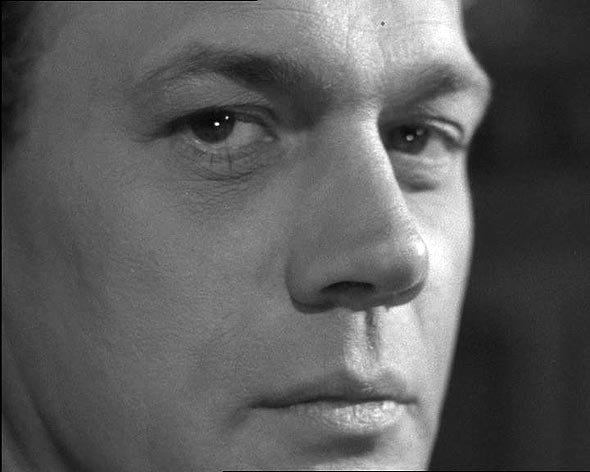
Joseph Cotten best career performance as Teresa Wright's uncle Charlie, the Merry Widow Murderer. He's on the run from police and looking for cover. He gives a chilling speech at dinner about "silly, useless wives," that waste money and are "horrible, faded, fat, greedy women." One of Hitchcock's best, it shows that evil can raise its ugly head anywhere, even in quaint, quiet towns like Santa Rosa.

3. Double Indemnity - 1944

Insurance agent Fred MacMurray is ensnared by Barbara Stanwyck, whose Phyllis Dietrichson is sexy and conniving and spots a sap when she sees one. She wants her husband dead and Walter Neff's just the man to do it. A clever script based on a Raymond Chandler novel, the film deserved its 7 Oscar nominations. Neff provides the voice-over. "Yes, I killed him. I killed him for money - and a woman - and I didn't get the money and I didn't get the woman. Pretty, isn't it?" One of Billy Wilder's best.

4. Laura - 1946

Someone killed Laura Hunt and police detective Dana Andrews heads the investigation in one of director Otto Preminger's best. Along the way he falls in love with the dead woman's portrait. Clifton Webb plays a newspaper columnist and the girl's acerbic mentor, Waldo Lydecker. He received a well-deserved Oscar nomination for supporting actor. One of his best lines: "I don't use a pen. I write with a goose quill dipped in venom."

5. Notorious - 1946

Cary Grant and Ingrid Bergman team up as U.S. agents in Buenos Aires to spy on a group Nazis. The plot involves uranium, but that's not important in this Hitchcock story of intrigue. One of Cary Grant's first serious roles, his performance is outstanding as a man who ignore his heart for his duty. In love with Ingrid, he nevertheless sends her into harms way. Claude Rains plays a seemingly respectable businessman, caught unawares by the woman he too, loves. It relies less on action than on the emotional and mental anguish the stars undergo. A brilliant film.     

6. Great Expectations - 1946

Pip, a poor orphan, has a mysterious benefactor who enables him to journey to London to become a gentleman. David Lean is known for directing some of the world's most successful epics: Bridge on the River Kwai, Lawrence of Arabia, Doctor Zhivago, etc. But it is his smaller, more intimate films from the 1940s that are my favorites. This film is the finest film adaptation of a Dickens' novel. Lean and his actors bring to life the book's memorable characters: the convict Magwich, the attorney Mr. Jaggers, and an old woman stuck in the past, Miss Havisham.

7. The Best Years of Our Lives - 1946

Belongs among the handful of greatest American films ever produced. William Wyler's masterpiece, it is as near a perfect film as you can get. Superior script, acting, and direction. No other "coming home" comes close to its realism and ability to affect the viewer as we follow three likable men home from WWII.  Several scenes stick with you: the emotional meeting between Dana Andrews and Best Actor winner, Fredric March, in Butch's Bar as March tells Andrews to leave his daughter alone (Teresa Wright); Andrews' father reading his son's medal citation; March coming home to surprise his wife (Myrna Loy); Andrews in the cockpit of an abandoned bomber. Wyler's other best of the decade were The Heiress and The Letter.

8. Black Narcissus - 1947

A group of nuns arrive at a convent high in the Himalayas, where the rarefied air does something to westerners. Deborah Kerr stars and her performance as Sister Clodah is terrific. She has her hands full with her own crisis of faith, and the odd behavior of her nuns, especially Sister Ruth, played chillingly by Kathleen Byron. One of directors Powell and Pressburger's impressive output in the decade, which included The Red Shoes, A Matter of Life and Death, I Know Where I'm Going, and Life and Death of Colonel Blimp. P&P films have luscious cinematography and highly interesting stories.

9. Out of the Past - 1947

Perhaps the definitive film noir. All the requisite components of the genre are here: lots of shadows and lighting; a story that you know will have a dark end for someone; a cynical hero in Robert Mitchum, an amoral detective who gets in way over his head; and a gorgeous femme fatale in Jane Greer, the woman who plays Mitchum like a sap. He knows it too, saying in one voice over, "How big a chump can you be? I was finding out." Kirk Douglas in an early role provides support.

10. The Third Man - 1949

Director Carol Reed's marvelous look at intrigue in post-war Vienna. Joseph Cotten is a down-and-out writer of pulp Westerns named Holly Martins. He's looking to land a job with his old friend, Harry Lime, but arrives too late, learning that Lime is dead, recently struck down by a hit-and-run driver. When accounts of the death don't quite agree, Martins gets suspicious and starts poking around, attracted in large part by Alida Valli, Lime's lover, Anna Schmidt. Vienna is not what it seems. The black market flourishes in the bombed-out streets and Lime's old friends, odd and mysterious, seem to be keeping a secret. This is one of the most atmospheric films ever made, infused with a bizarre zither music and some of the best black and white cinematography ever recorded. It contains one of film's most shocking appearances and a spectacular chase through the city's old sewers.

Just Missing:

The Treasure of Sierra Madre - 1948

She Wore a Yellow Ribbon - 1949

The Ox Bow Incident - 1943


The Life and Death of Colonel Blimp - 1943

Late Spring - 1949

Key Largo - 1948

Friday, July 1, 2011

The Sand Pebbles (1966) - Robert Wise

A seaman looks across the gangplank at a U.S. gunboat, the San Pablo. Commissioned during the Spanish-American war, it has seen better days. The Navy vessel patrols the Yangtze River in China. It is 1926. A machinist mate first class, the man is a transfer, having been seen as a hard case and maverick by his previous skipper. He wants just one thing--to be left alone. When he enters the engine room after boarding he looks around, smiles, and places a hand on the machinery. "Hello, Engine;" he says. "I'm Jake Holman." Holman is played by Steve McQueen, who gives the most sensitive performance of his career, showing considerably more range than he's usually credited for. He is a quiet man, hard to get to know, and someone you immediately sense carries old hurts inside. He is more comfortable with machinery than people.

Jake Holman reports to the San Pablo.

The crew members call themselves sand pebbles. For the most part they are a sorry bunch, often relying on paid help from Chinese coolies to do their work. And the work is pure drudgery, hot and unrewarding. They spend their days in boredom, and their nights drinking and whoring in the saloons, all the while looking with disdain on the local populace. They are like a lot of men who live in close quarters with little to do and with scant prospects for the future; they are just doing their time and growing ever more slack in their duties, long past the time they felt any pride in wearing a uniform. Holman is destined to stir things up, and amidst the volatile political climate of the country, which is rapidly shaking off its feudal heritage and imperialistic chains, he and the crew will find themselves swept up by something they have little control over. Communist forces start to gain power and threaten to oust all foreigners from the country, and the ship is sent to collect a group of missionaries at the China Light Mission from anti-foreign mobs. Naive and blind to the historic revolution brewing, the missionaries believe god and reason will protect them.

There is a lot in this film to admire: McQueen's acting; the stunning cinematography of Joseph MacDonald, which captures both the exquisite beauty of China and the squalor of its cities; Jerry Goldsmith's lush score; and several fine action sequences. Director Wise was fresh off two enormous successes: West Side Story and The Sound of Music. This was a big departure from those. That he managed to distill a complex story as well as he did is quite an achievement. The source novel by Richard McKenna, his only novel, appeared in 1962. At nearly 600 pages it goes into greater detail about the turmoil affecting the country as nationalism grows. Still, the film is a good half-hour too long. One wonders if Wise was trying to produce an "epic" along the lines of David Lean with Lawrence of Arabia and Doctor Zhivago.


Wise retained the most important parts of the novel, including the budding love affair between Jake and Shirley Eckert (pretty Candice Bergen, just twenty years old at the time). Shirley is a young missionary who manages to touch Jake's heart, cracking his tough exterior. There are a couple of nice scenes between the two as they get to know one another, floating on a serene inlet in a row boat, and Jake trying to toss a stone onto a statue of an elephant. Good luck is said to follow those who succeed. He does, but happiness will prove to be elusive. Both actors convey innocence. McQueen is particularly unassuming here and likable, far different than his typical macho persona.

Holman is an immensely likable character, one that most male viewers could relate to. At the core, he is a traditional American--a loner you can trust to do his job, unobtrusive up to a point; but when incited will give you his all, even if it means sacrificing his own safety for a bigger cause. That he will do this without fully understanding why, makes him that much more attractive and admirable. Wise and McQueen capture these traits beautifully in the last scene, with Holman wounded and under attack. "What happened? he asks himself.
    

Another love affair drags the movie down, that between Jake's friend Frenchie (Richard Attenbourgh) and Maily, a girl forced into prostitution. Although sensitively done, Wise would have been better off to jettison it.

The action sequences include a thrilling attack on a Chinese river blockade by the San Pablo, its crew finally showing some pride, and the chase and murder of Jake's other friend, Po-han (Mako). Po-han is a lovable character, who Jake takes under his wing as his assistant. Po-han struggles with the English language but wants to learn. His lessons are quite funny. His death, at the hands of Chinese rebels, is the most shocking scene in the film, savage and bloody. Jake watches from the deck of the San Pablo as the insurgents capture his friend and string him up on a pole, where the leader commences to slice his chest and stomach with a large knife. The captain, unwilling to incite an international  incident over a coolie, refuses to interfere. McQueen plays the scene perfectly, furious and full of anguish.
The river blockade battle.

There is another tense scene, a violent boxing match involving Po-han and a racist crew mate of Jake's that looks all too real. The sailor is played by Simon Oakland, who towers over the smaller man and out-weights him by a hundred pounds. Wise stages it expertly. The cigarette smoke hangs in the air, the audience drinks and noisily exhorts their betting favorite on, and the fighters exhaust themselves in blood and sweat.

McQueen earned his only Oscar nomination for the film (losing to Paul Scofield in A Man for All Seasons), and the film eight nominations in all. It won none, perhaps indicating that the day of big road-show movies had passed. Both the film and the director were nominated, Wise for the third time. He'd already won two.

Richard Crenna plays the gunboat's captain, a man trying hard to maintain his dignity and the ship's discipline. His confidence is low and at one point he contemplates suicide. He is excellent. His character is the real dramatic center of the film as far as history goes--he represents the tradition of the U.S. Navy, far from home and trying to maintain a foothold in a rapidly changing nation, one that violently resents the Navy's presence. Internal forces are about to explode as the march of history brings American imperialism in China to an end.

Richard Crenna as Captain Collins.
Other Films by Robert Wise:
  • Born to Kill 1947
  • Run Silent Run Deep 1958
  • West Side Story 1961
  • The Haunting 1963
  • The Sound of Music 1965
Other Films by Steve McQueen:   

  • The Great Escape 1963
  • Love and the Proper Stranger 1963
  • The Cincinnati Kid 1965
  • Bullitt 1968
  • Papillon 1973

Monday, June 20, 2011

Favorite Films of the 1950s

The 1950s was a spectacular decade of films. Here are ten of my favorites in chronological order. Maybe not the ten best of the decade, though some certainly are by most people's measure.

It marked the last decade for Bogart, who did some of his best work, and for Gary Cooper. Marlon Brando was at the top of his game, and it was perhaps the best decade for Westerns. Two make my list, but it was a rich genre. Cooper won his second Oscar with High Noon; Anthony Mann and Jimmy Stewart produced five terrific collaborations, including Winchester '73 and The Naked Spur; and Budd Boetticher and Randolph Scott combined for several classics.

Hitchcock continued his impressive run and peaked commercially in the decade with several classic suspense films. I include just one, and omit Strangers on a Train, Rear Window and North by Northwest.

Other directorial achievements of note included came from Nicholas Ray, Billy Wilder, and the great John Ford, but other fine films of theirs are omitted.

Foreign directors continued to make wonderful films, even if some weren't shown in America. I include just two here and must omit several worthy ones. De Sica's Umberto D is the best film to ever feature a dog, and Fellini made two poignant films with his wife, Giulietta Masina: La Strada and Nights of Cabiria. Jules Dassin's Rififi is a tight noir that paved the way for heist films, and Henri-Georges Clouzot gave us the Hitchcockian Diabolique and Wages of Fear.

1. In a Lonely Place 1950

Humphrey Bogart's best performance in Director Nicholas Ray's best film. Is he a murderer or not? Gloria Grahame plays his confused lover, trying to help him overcome his inner demons. From the pulp novel by Dorothy Hughes, it contains a memorable last scene. "I was born when she kissed me. I died when she left me. I lived a few weeks while she loved me."

2. Sunset Boulevard 1951

Billy Wilder's scathing look at Hollywood follows the weird affair of a has-been movie star, Norma Desmond (Gloria Swanson), with struggling writer Joe Gillis (William Holden). Swanson gives one of film's iconic performances. "Mr. DeMille. I'm ready for my closeup."

3. Tokyo Story 1953

The third of Director Yasujiro Ozo's "Noriko Trilogy," packs an emotional wallop. Setsuko Hara is the generous daughter-in-law in a family whose children are too busy to bother with its aging parents. Now considered on the short list of greatest films ever made, it was not released in the United States until 1972.

4. Shane 1953

One of the most authentic Westerns, it is George Stevens' best film and Alan Ladd's signature role as a retired gunfighter who helps farmer Joe Starett (Van Heflin) fight off cattlemen in a range war. Shot against the beautiful Grand Tetons it is Jean Arthur's last film and includes one menacing bad guy in Jack Palance as Jack Wilson.

5 On the Waterfront 1954

Marlon Brando as dock worker Terry Malloy comes up against the brutal union led by Lee J. Cobb. Brando won a well-deserved Best Actor Oscar in that year's Best Film. The most memorable scene takes place inside a taxi between brothers Brando and Rod Steiger. "I coulda been a contender."

6. The Searchers 1956

John Ford and John Wayne's best collaboration and cinematographer Winton Hoch's masterpiece. Inexplicably neglected at that year's Oscars, it is now on the short list of greatest Westerns. Wayne is a brutally racist Ethan Edwards out to rescue his abducted niece. A great final shot of Wayne in the doorway.

7. Sweet Smell of Success 1957

Easily Tony Curtis' best performance. He is Sidney Falco, a sleazy sycophantic press agent. Burt Lancaster plays the powerful columnist J.J. Hunsecker. Filmed in glorious black and white, New York City never looked more grittier. Ernest Lehman co-wrote the memorable script. "Match me, Sidney."

8. The Bridge on the River Kwai 1957

Director David Lean's first epic, and maybe his best. Alex Guinness gives his signature Oscar-winning performance as a rigid British colonel who helps the Japanese build a bridge. His counterpart is Sessue Hayakara as the Japanese colonel, facing Hari Kari if the bridge isn't completed on time. William Holden leads the commando raid to stop them. With a rousing climax, it deservedly captured that year's Best Film.

9. Vertigo 1958

Alfred Hitchcock's most complex film. Jimmy Stewart is a retired detective afraid of heights and obsessed with a dead woman. The twist, revealed mid-stream, is stunning the first time you see it. A magnificent score by Bernard Hermann, impeccable editing by George Tomasi, and a memorable title sequence by Saul Bass make it one of the most satisfying film experiences.

10. The Cranes are Flying


One of the first Russian films produced after the death of Stalin that deviated from the state's imposed mandate to champion Russia as a military victor, the film tells the story of a beautiful young couple separated by the war. Tatyana Samojlova, as Veronika, promises to wait for Boris, who finds himself on the Eastern front. The film depicts war as ugly and devastating and won that year's Golden Palm at the Cannes Film festival.

Just Misses:

Early Summer 1951 with Setuko Hara.

Moby Dick 1956 with Gregory Peck.

Touch of Evil 1958 with Orson Welles.

Room at the Top 1959 with Simone Signoret and Lawrence Harvey.
 

Friday, June 17, 2011

The Prime of Miss Jean Brodie (1969) - Ronald Neame

Jean Brodie (Maggie Smith) teaches at a private girls school in Edinburgh, Scotland. It is 1932. Her 14-year old students are impressionable, and she is unconventional and eccentric, telling the girls that she is in her prime. "Little girls! I am in the business of putting old heads on young shoulders, and all my pupils are the creme de la creme. Give me a girl at an impressionable age and she is mine for life."
Miss Brodie and her class.

It is a somewhat stodgy school, with school head mistress, Miss Mackay (Celia Johnson), expecting Brodie to adhere to strict traditional teaching methods and standards. But Brodie is a free spirit and prefers to mold the girls with tales of her time in Italy, and lessons in culture, art and politics, instead of cold arithmetic and science. She has a socialist bent and even admires Mussolini. Her favorite students are known as "Brodie's girls." They sometimes lunch together on the grass outside where she leads them in free discussions of sex and love. The girls worship her, but Mackay naturally sees her as a dangerous rebel who fosters unconventional thinking in the minds of young girls. When Brodie encourages one shy girl, Mary McGregor, to follow her heart, it leads to tragedy when she runs away to join her brother and Franco's forces in Spain. Sandy (Pamela Franklin), one of Brodie's girls, is more perceptive than most. She begins to question whether the teacher they all idolize is past her prime and perhaps not the best role model.

The shy Mary MacGregor gets some poor advice.
Sandy with Miss Brodie.
Maggie Smith is terrific as the complex Brodie, giving one of the best performances of the 1960s. The character is introduced in a splendid opening scene, riding her bike through the narrow, teeming streets of Edinburgh on her way to the school. Her hair is red and she's wearing a purple dress. The rest of the screen is mostly drab shades of grey, and that's largely true for the rest of the film too. Brodie is meant to stand out. And as soon as she speaks, you realize she is different, ostensibly supremely confident, with a rather high opinion of herself. This is a facade, however. Brodie is uncertain in love--having two lovers--and is more talk than substance, choosing to live vicariously through her students. Smith captures the character's vulnerability and hidden emotion. When one of her lovers, the married art instructor Teddy Lloyd, (at the time her real husband), confronts her about her inability to commit, she reacts defensively, trying to mask her insecurity.

The best scene in the film is a highly charged confrontation between Smith and Johnson. The head mistress thinks she finally has the goods on Brodie to force a resignation, but Brodie cleverly outwits her. Johnson leads a solid supporting cast. She is probably best known for her Oscar nominated role as a unrequited lover in David Lean's 1945 film, Brief Encounter. Pamela Franklin debuted in 1960 in The Innocents.

For the most part, Director Neame closely follows the fine source novel by Muriel Spark. He wisely deviates in the time-jumping aspect of the novel, using a straight chronological approach instead, making the film more easy to follow. And in the film, Brodie learns which of her girls betrays her; in the novel she does not.

The melody of the familiar theme song by poet Rod McKuen provides a melancholy background to the quiet scenes of the film. McKuen was the most popular poet of the time, if not the deepest. Listening to it now, more than forty years after the film's release, brings you immediately back to the late 60s and all the turmoil of that time. The British singer Oliver took the song to #2 on the charts.

Jean, Jean, roses are red
All the leaves have gone green
And the clouds are so low
You can touch them, and so
Come out to the meadow, Jean

Jean, Jean, you're young and alive
Come out of your half-dreamed dream
And run, if you will, to the top of the hill
Open your arms, bonnie Jean.


Director Neame was once a collaborator with David Lean and served as producer on Lean's two adaptations of Dickens's: Great Expectations and Oliver Twist.

Awards:
  • Best Actress Oscar and BAFTA (Smith)
  • Best Supporting Actress BAFTA (Johnson)
  • Film nominated for the Palme d'Or at Cannes
  • Best Supporting Actress nomination BAFTA (Franklin)

Sunday, June 12, 2011

The Searchers (1956) - John Ford

Confederate veteran Ethan Edwards (John Wayne) arrives unannounced at his brother Aaron's Texas homestead just when Captain Clayton (Ward Bond) of the Texas Rangers comes looking for men to chase some Indians who have stolen cattle from a nearby ranch. Ethan goes along, leaving Aaron behind with his wife, Martha, and two daughters. It's a trick; the Indians have drawn them away from the ranches to raid those left behind. By the time the men return it is too late—Aaron and Martha are dead and the two girls captured. Ethan (and his nephew, Martin Pawley) begins a five-year search to rescue the girls and extract revenge against Chief Scar. But as the search lingers his motivation changes as he realizes the one surviving child, Debbie, has been assimilated into the Indian way of life.

John Wayne, always a better actor than given credit for, gives a towering performance as Ethan Edwards and The Searchers is John Ford's most majestic Western. Set against the beautiful stark sandstone mesas and buttes of Monument Valley and the snowy Rocky Mountains, it shows Ford's extraordinary eye for visuals. One particularly beautiful shot occurs with the two men on horseback in a growth of willows with flakes of snow swirling. Marty wonders if they'll ever find Debbie. Edwards, a relentless pursuer, utters a famous line: "We'll find 'em. Just as sure as the turnin' of the earth." A lesser director might have rejected the scene since it only serves to deepen your understanding of the character, rather than move the action forward. 

John Wayne as Ethan Edwards.
Edwards is a tragic hero. Complicated, flawed, and mysterious, he doesn't say where he's been since the war ended three years ago, only that he didn't surrender. He may have drifted, perhaps he is wanted. In any case, he is driven by an intense hatred of Indians, sparked by the death of his mother by Comanches sixteen years earlier. (When little Debbie hides in the cemetery near the start of the film, this information appears on face of one of the headstones). Dark, moody, and violent, he shoots the eyes out of a dead Comanche so the corpse can't enter the spirit world, and he indiscriminately kills buffalo so the Indians won't have enough food.

The character of Martin, 1/8 Indian, serves as a counterpoint to his uncle. In a twist of sterotypes, Ford presents the half-breed as a Christian, and the white man as a savage. Their relationship at times is strained. His could not have been an easy role to play, but Wayne is convincing as a man undergoing a deep personal struggle. The character is tragic, because though he largely succeeds in conquering his inner demons and ultimately changes for the better, he finds himself no closer to contentment.   

Ford rarely employs close-ups, but two show Wayne at moments of great emotion: the first when the posse realizes they will never get back to the ranch in time, and the second when Edwards inspects a group of recaptured white girls. Both shots effectively so Wayne deeply immersed in the role. Age 49 at the time of filming and still a vigorous man, he fills the character with intensity and credibility, and the screen with his presence.

Ford infused the film with his usual moments of comedy, here sometimes over-the-top when involving the character of Charlie McCorry, Martin's competition as a suitor for young Laurie (Vera Miles). Intended to give the audience relief from moments of intense action, the comedy detracts from an otherwise wonderful film.

The best action sequence involves a mad dash to the river by the ranger squad with Indians hot on their trail. Once across the men dig in. Using fallen mesquite trees for scant cover they exchange gunfire with the enemy, who makes a failed charge across the water, whooping and banishing their weapons. 

Max Steiner did the score, which includes rousing songs and a lovely, memorable theme (Ethan Returns). Steiner was a 24-time Oscar nominee, though not for this.
As sure as the turning of the earth.
Chief Scar
What Makes The  Searchers  Special

Little moments transform the film from a good Western to a sublime one. Ford was never big on dialog. One of the best scenes takes place as the posse hurries to leave. Clayton gulps down a cup of coffee and eats a donut; behind his back, Martha presents Ethan his blanket, newly washed and pressed. They embrace and kiss, and by the look on Clayton's face, you can tell he suspects more than innocent affection between in-laws. This knowledge makes Edwards' later close-up that much more affecting. Some critics interpret the scene as proof that Martha and Ethan were once lovers. If so, it is conceivable that Debbie is their daughter, which makes Ethan's ensuing pursuit of the girl and desire to kill her that much more sordid.

The last shot is another terrific moment. Ethan has finally returned from his long quest. Debbie (Natalie Wood) is safe and Martin is reunited with Laurie. They enter the cabin, happy and relieved, while Ethan remains outside, framed in the doorway, still an outcast from society.  

Besides Bond, plenty of Ford's stock company of actors make an appearance: John Qualen, Harry Carey Jr., Ken Curtis, Hank Worden.    

Winton Hoch's cinematography is stunningly gorgeous. He also collaborated with Ford and Wayne on 1949's She Wore a Yellow Ribbon.     

Inside Story

The famous last shot is a tribute by Wayne to Harry Carey, whom he called the greatest Western actor. Carey started in films in the silent era and with Wayne several times, including 1941's Sheppard of the Hills, 1947's Angel and the Badman, and 1948's Red River. You recognize Carey as the President of the Senate in Mr. Smith Goes to Washington. His son, Harry Carey Jr., and his wife, who plays Laurie's mother, Mrs. Jorgenson, are in The Searchers.

Wayne and John Ford were one of the most successful partnerships in the history of Hollywood. They made 14 films together. Of those, Ford won the Best Director Oscar for 1953's The Quiet Man and was nominated for 1939's Stagecoach. 

Though the film was critically acclaimed, it received no Oscar consideration. Various major newspapers called it "distinguished," "remarkable," a "Homeric odyssey," an "astonishing wealth of minute detail and honest, strikingly natural charasterizations," "a rip-shorting Western, as brashly entertaining as they come," and said Wayne was "uncommonly commanding." Maybe the Academy thought it has honored the director enough.

Perhaps the film appeared a decade too early. It could easily fit alongside The Wild Bunch as a revisionist Western of the highest order.


Major Awards:


•   Nominated for Best Director by the Director's
Guild of America


•   National Film Registry 1989         


Saturday, June 11, 2011

Moby Dick (1956) - John Huston

"Call me, Ishmael." It's one of the most recognized openings of any great American novel. Director John Huston begins his film adaptation of Herman Melville's Moby Dick the same way. Narrated by Richard Basehart, who plays the young whaler, the film focuses on the adventurous pursuit of the elusive white sperm whale by an obsessed Captain Ahab (Gregory Peck) without delving too deeply into the symbolism of the book, nor the incredibly detailed aspect of the whale harvesting it portrays. It was a good decision, as the novel is heavy with complex metaphor and themes: man's place in the universe, good versus evil, the existence of god. (Writer Ray Bradbury deserves credit for editing the dense novel into a movie script.) Besides, there is adventure enough to excite any viewer.

Restless and bored with living on land, Ishmael feels drawn to the sea. The film follows him as he first encounters Queequeg, a cannibal and harpooner, in New Bedford at the Spouter Inn. They become friends and join the crew of the Pequod, a whaler whose captain is the mysterious and obsessed Ahab. The crew doesn't know it yet, but Ahab seeks revenge against Moby Dick, a great white sperm whale who has bit off Ahab's leg. The film follows the pursuit to its fateful conclusion, slightly altering Ahab's death for the better, and includes all of the most memorable scenes from the novel: Ishmael and Queequeg's first meeting, Father Mapples' rousing sermon, the strange Elijah's warning on the dock, sailing around Cape Hope in a typhoon, Queequeg's reading his future by tossing bones, spirited whale chases in longboats, and the final confrontation between man and beast.
The Pequod slips out of New Bedford Harbor.
You get a wonderful feel for a sailor's life aboard a 19th century whaler. It is hard, dirty, dangerous work for hard men. When they spot a whale and lower the boats, the crew haul hard on the oars until they are close enough for the harpooners to strike with their lances. Then the race is on, with the behemoths dragging the boats behind them, sometimes tossing the crew overboard. It is fast and furious, and Huston captures the action and the immensity of the ocean magnificently. The typhoon sequence is wonderfully intense and dramatic, leaving the viewer to wonder how men actually withstood such peril. It is one of the best such sequences in the history of film.

To give the action a contemporary look for the period, Huston and cinematographer Oswald Morris created a unique desaturated subdued pastel effect on the film stock. It works. At times it seems as if you are watching an old documentary, or looking over tintype or daguerreotype photos.

Peck, just 38 at filming, is unfairly criticized for his role. Some say he was miscast, others that he was too young. But he captures the madness of Ahab perfectly, using his deep voice to perfection. When this Ahab raises a wild eye brow and scowls at his crew as he begins to speak in the novel's signature prose, urging them onto the quest, you understand the character's magnetism and get a clear glimpse at his self-destructive maniacal nature. It takes a while for Ishmael to see the man for what he is. In one voice over he explains: "He did not feel the wind, or smell the salt air. He only stood, staring at the horizon, with the marks of some inner crucifixion and woe deep in his face."

First mate Starbuck (Leo Glenn) sees the danger in Ahab before any of the others, and in one passage touches on the novel's religious theme. He expresses his worry to two others:

Starbuck to Stubb and Flask: "It is an evil voyage, I tell thee. If Ahab has his way, neither thee nor me, nor any member of this ship's company will ever see home again."

Stubb: "Aw, come on, Mr. Starbuck, you're just plain gloomy. Moby Dick may be big, but he ain't THAT big."

Starbuck: "I do not fear Moby Dick - I fear the wrath of God."

In addition to Peck, the rest of the cast is just as effective, though Basehart is clearly too old for his role. Ishmael should be in his early 20's. Basehart was 41. It seems a strange choice, though perhaps Huston was impressed with his work in the acclaimed film, La Strada, two years earlier. Orson Welles is magnificent in a brief appearance as Father Mapples, as is Royal Dana as Elijah, whose prophecy on the dock should have warned Ishmael to find another boat.

"A day will come at sea when you'll smell land and there'll be no land, and on that day, Ahab will go to his grave, but he'll rise again, and beckon, and all save one shall follow".

Huston fills the film with little memorable touches: the camera pans across the church walls prior to Mapple's grim sermon to reveal the names of all the New Bedford men who have been lost at sea; Queequeg's face is heavily tattooed; and he changes the novel's ending to have Ahab's corpse beckon to the crew to continue the hunt. The captain has drowned and is lashed to Moby Dick's side by harpoon ropes. As the whale plows through the waves, Ahab's one loose arm flaps and appears to be calling the survivors onward. If some traditionalists decry a novel's alteration, this is one case where dramatic license improved the story.     

New York Times film critic Bosley Crowther called the film "one of the great motion pictures of our times," and lauded its "lean and violent drama."  It is Huston's most ambitious work. For his effort, the New York Film Critics named him Best Director of 1956.
Queequeg goes into a trance after reading his future in bones.
The special effects are wonderful considering the film was made in the mid-1950s. Moby Dick looks ferocious and real for the most part, even if at times it's clears that the boats are models. The musical score swells appropriately when he snaps the boats in half, sending the crews into the water where his massive tail crushes them beneath its weight.


The film ends as the novel does, with the lone survivor, Ishmael, floating half-dead on Queequeg's coffin, lamenting that he alone lives to tell the tale.


Peck as Ahab, waiting for his foe to rise.

Thursday, June 9, 2011

Late Spring (1949) -- Yasujiro Ozu

In post-war Japan, Noriko Somiya (Setsuko Hara) is 27 and still lives at home. Recently recovered from an illness contracted during the war, she is content and happy with her simple life, taking care of her widowed father. She explains to her aunt that no one understands him like she does. But the aunt and father worry that at her age, it is time for Noriko to marry and start a life of her own. They concoct a rouse to convince the girl to consider an arranged marriage.
Setsuko Hara as Noriko.
The first film in the Noriko Trilogy, Late Spring may be the most touching and sad of the bunch. It is essentially a film about the relationship between a father and his beloved daughter, and the difficult decision they make, one that neither really wants. Spurred on by the unlikable aunt, the father leads Noriko to believe that he plans to remarry -- it is not true -- and it would be better for both of them if she finds a husband so he can get on with his life. She resents the decision and is devastated and deeply hurt, feeling herself shoved aside.

Hara, one of cinema's great actresses, effectively conveys the emotional pain of her perceived rejection by her father with confused and searing looks, at one point crying in despair. At times her reaction is almost painful to watch, but any viewer who has unintentionally or intentionally hurt someone they love knows that look. In that respect, Ozu has produced a remarkably honest film.

On talent alone, Hara is magnificent. Combined with rare beauty and immensely likable roles, surely she had what it took to achieve international stardom. However, she never ventured into American films, and because of a lingering hatred of anything Japanese in this country after the war, none of the Noriko films were released in the U.S. until 1972. It is just as well, considering her apparent retiring nature. Still, Setsuko Hara easily could have paved the way for other foreign actresses who shortly thereafter found success in the U.S. in the form of an Oscar: Sophia Loren (1961), Simone Signoret (1959), and Anna Magnani (1955). 

Like all of his films, Director Uzo primarily relies on a static camera, focusing on the interplay between his characters through brief conversations, usually indoors. But in one memorable scene he takes you outside and follows Noriko on a pleasant bike ride with her father's assistant and her friend, Mr. Hattori. The scene is said to be a homage to the American style of film-making, which Uzo reportedly admired.
A late spring outing near the beach. 

For a time, you think that Hattori might be the man for Noriko, and they do engage in harmless flirting, but he is already engaged. The camera follows the pair as they ride along, the wind blowing Hara's wavy hair from her face. She is beautiful, laughing and smiling, having fun. It is easy to suspect that Hattori wonders if he has picked the right girl.

By the end of the film you understand that the rouse is just as hard on the father as the daughter. Chrishu Ryu, a long-time player in Ozu films, appears clueless to his daughter's suffering at first. When she tells him she is happy, that she just want things to remain as they are and cannot conceive of being happier married, he doesn't accept it. He tells her she will find a new happiness, and that marriage is not easy and takes time, maybe years. You realize he is not oblivious to her sadness of course, and acts as he does convinced that what he is doing is in Noriko's best interest. He is willing to sacrifice his own comfort for her future.  

That Ozu never reveals Noriko's husband, though tells us that "he looks like Gary Cooper," is an intentional decision by the director. He is telling us a story of the end of one family, not the beginning of another.

The final scene is probably the most famous in any Ozu  film. Home alone after the wedding, the father sits down and begins to peel an apple. He carves a long winding piece, then pauses as it drops to the floor. He hangs his head in despair. It sounds simple, but it is a crushing moment, one where the horrifying gloom of true loneliness falls on a man, as he understands the harsh reality of his decision for the first time.