Sunday, December 4, 2011

Psycho (1960) -- Alfred Hitchcock

An iconic image from Psycho.
Marion Crane (Janet Leigh) loves Sam Loomis (John Gavin), a recent divorcee with all of his money tied up in alimony and a hardware store. Marion lives in Phoenix and works in a real estate office while Sam lives in Fairvale, California. The couple must sneak an hour together here or there during Marion's lunch breaks to meet at a downtown hotel when Sam visits. Fed up with the arrangement, Marion makes a rash decision and takes $40,000 from her employer and skips town, planning to pay off Sam's mortgage so they can start a new life together. Tiring after a long drive and worried about road conditions, she stops at the Bates Motel as she nears her destination. There she meets the owner, Norman (Anthony Perkins), a strange young man who practices taxidermy and is not who or what he seems. 

Mother! Oh God, mother! Blood! Blood!
Director Alfred Hitchcock shocked movie audiences with his tale of a mentally disturbed man fixated on his mother. It took the suspense genre to a new level and changed women's bathing habits. All slasher movies since are derived from this seminal work, rightly considered a masterpiece of horror and suspense. It is not possible today to fully appreciate how revolutionary this film was in 1960. It is an unconventional one, divided into two distinct parts: the tale of Marion Crane's crime and punishment, and the tale of Norman.

The film starts with a high view over downtown Phoenix. The camera slowly pulls into a hotel window where Marion and Sam have just made love. Hitchcock cleverly uses the color of Marion's undergarments to symbolize her nature; here, still a "good" woman, she wears a white brassiere and slip. Later, after her theft, she has lost the veneer of honesty and appears in a black brassiere. The tryst with Sam establishes that Marion is unhappy and frustrated. Later, back at work, she feigns a headache. Her employer sends her home, but on the way, asks her to make a bank deposit. The temptation is too great. She steals the money and heads for Sam.

A wonderfully tense sequence follows where Marion, beset by paranoia, encounters a motorcycle cop. He finds her napping on the side of the road. It's a routine check, but because she acts nervous, he grows suspicious. He watches her later as she exchanges her car at a used-car lot, paying cash without haggling with the surprised dealer, even refusing to take the new car for a test drive. Longtime Hitchcock collaborator, Bernard Herrmann, overscores much of the driving sequence with tense strings, similar to that used for the opening credits. It's unnerving, allowing the audience to share Marion's mood of disquiet and guilt. Hitchcock famously had a fear of the police in real life, and he hides the officer behind a pair of dark glasses to give him an ominous look.    

Mort Mills as the highway patrol officer.

Marion drives into the night but runs into fatigue and a rainstorm; somehow she has gotten off the main road. She pulls into a roadside motel, planning to sleep a while before continuing on. The place is run by Norman Bates (Anthony Perkins), a man in his late 20s. She rents a room and he invites her to the office for a bite to eat. Marion overhears an ugly argument between Norman and his mother, who seems a dominating, complaining nag, a suffocating burden for Norman to bear. For his part, Norman seems a pathetic beaten-down weakling who's put his life on hold to care for his ailing mother. When asked if he has any friends, he replies, "Well, a man's best friend is his mother."

The two share an odd conversation, surrounded by Norman's stuffed birds, talking about the traps people get into, and we get the first hint that Norman is a little off. He's quick to anger for one thing. Marion realizes her life is not so difficult in comparison, and she comes to believe she's made a terrible mistake. She decides that tomorrow she will return to Phoenix to accept the consequences of her actions.


While their conversation gives plenty of clues that Norman may be unstable, because it is so innocent and because he appears so harmless, Marion doesn't quite see him for who he is.  

Norman: It's not like my mother is a maniac or a raving thing. She just goes a little mad sometimes. We all go a little mad sometimes. Haven't you?
Marion: Yes. Sometimes just one time can be enough.

Marion: Wouldn't it be better if you put her... someplace.
Norman: You mean an institution? A madhouse?
Marion: No, I didn't mean it like...
Norman: [suddenly angry] People always call a madhouse "someplace", don't they? "Put her in someplace!"
Marion: I'm sorry. I didn't mean to sound so uncaring.
Norman: What do you know about caring? Have you ever seen the inside of one of those places? The laughing, and the tears, and those cruel eyes studying you? My mother there?
[subdued tone]
Norman: Oh, but she's harmless. She's as harmless as one of those stuffed birds.
Marion: I tried to mean well.
Norman: People always mean well. They cluck their thick tongues, and shake their heads and suggest, oh, so very delicately!

The most famous scene in Hitchcock's entire canon soon follows, a masterpiece of editing and sound. George Tomasini served as editor. He knew what he was doing and would collaborate with Hitchcock on nine films, including Vertigo and most recently, North by Northwest. Hitchcock lets the viewer's imagination do the work here, a daring choice by the director. It works beautifully. 


Arbogast. Hired by Marion's sister, Lila (Vera Miles), to investigate Marion's disappearance, he stops at the Bates Motel. Arbogast grows suspicious upon questioning Norman, who acts peculiar and evasive. Watch Perkins' eyes and gestures during the interrogation. He's still popping that snack, but now he's a bundle of nerves. He stutters, trying his best to act nonchalant, but the detective keeps tripping him up.

Already jolted by one shocking death, the audience soon gets another. Convinced that the man is hiding something, Arbogast sneaks into the Bates house with the intention of questioning the mother, whose silhouette he believes he caught a glimpse of below. It's wonderfully suspenseful. He slowly ascends the stairs, careful to keep quiet, looking about to make sure Norman isn't about. Suddenly, in a high shot above the action, a figure darts out of a room onto the landing, clad in an old woman's robe. It holds a knife high overhead. Down it comes. The camera cuts to the detective's face as he stumbles backward, struggling desperately to keep his balance down the stairs. It bears a large gash and utter astonishment. Herrmann's frightening score adds immensely to the mood of the scene.

Arbogast is victim number two. 

At this point you might wonder where Hitchcock is taking you. Psycho contains considerably more graphic violence than any of his previous work. Of course, that's one reason it is so shocking upon first viewing.

Arbogast's death proves to be Norman's undoing as it brings Sam and Lila to the scene, where they unravel the mystery in a famous encounter in the basement of the Bates' home. There's a spooky exchange with a local sheriff when they are told that Norman's mother died ten years ago. Some critics don't like the denouncement/explanation by a psychologist at the end of the film, but it sets up the terrific final shot of Norman in jail. Thanks to the voice-over and Perkins' creepy smile, you know he's come completely unhinged.


He wouldn't hurt a fly!

The film earned 4 Oscar nominations, including Best Director, Best Set Direction, Best Cinematography, and Best Supporting Actress (Leigh). It won none, though Leigh did take home a Golden Globe for her work. It was named to the National Film Registry in 1992.

Arguably Hitchock's best work, it is certainly his most shocking. With superb pacing, the mystery is unraveled slowly to keep the suspense high. For anyone lucky enough to have seen it upon its initial release, it surely burnt a permanent scar into their brain.   

Thursday, December 1, 2011

The Maltese Falcon (1941) -- John Huston

An attractive woman, Ruth Wonderly, (Mary Astor), comes to the offices of Spade (Humphrey Bogart) and Archer, a private detective agency in San Francisco, with what looks like a routine case--she wants them to locate her sister. Wonderly claims the sister is involved with a man named Thursby, whom she plans to meet that night in an attempt to bribe him to abandoned the girl. Archer volunteers to track Thursby, hoping that he will lead them to the missing girl. When both Archer and Thursby are killed that night, the case takes on an ominous tone, and the next morning Spade is visited by a strange little man looking for a long-lost statue of a falcon. Is there a connection? Spade soon finds himself dealing with three unscrupulous adventurers competing for the priceless falcon as he tries to uncover the truth about the death of his partner.

Humphrey Bogart as Sam Spade

Filmed twice before, Director John Huston's version of mystery writer Dashiell Hammett's The Maltese Falcon, makes the first two efforts pale in comparison. It is simply one of the best films of its genre, and the film that solidified Bogart's stardom. Many consider it one of the first Film Noirs, but I don't classify it as such. Yes, it has a femme fatale, but you never seriously believe that Bogart as the protagonist is in real danger or in trouble. And it lacks the shadowy photography that I associate with the best noirs. Still, it set the bar high for entertaining detective films that followed for the next fifteen years or so.

It's hard to find fault with the film. Precise direction, a genre-defining script, stellar cinematography, and one of the best ensemble casts ever assembled; it's a great story of intrigue. Bogart may star, but the memorable collection of eccentric villains is what makes this so much fun to watch. Sydney Greenstreet (in his first film) plays the rotund Kasper Gutman; Lorre is the effeminate Joel Cairo; and Astor the beautiful femme fatale. A dedicated bunch--Gutman has been chasing the falcon for 17 years--they are more dangerous than they appear. Still, the group seems slightly out of their element, and we can't help but like them for it. Of course, Spade will outwit them all by the end.

The film opens with a screen card that provides the backstory:
In 1539 the Knight Templars of Malta, paid tribute to Charles V of Spain, by sending him a Golden Falcon encrusted from beak to claw with rarest jewels——but pirates seized the galley carrying this priceless token and the fate of the Maltese Falcon remains a mystery to this day——[
The character of Joel Cairo is a long way from Lorre's infamous child molester, Hans Bekert, in Fritz Lang's 1931's M. This is one of his first American films that became well known. Impeccably dressed and smelling of gardenia, Cairo pulls a gun on Spade, intending to search the detective's office for the Falcon. Spade easily disarms the smaller man, telling him "when you're slapped, you'll take it and like it." It's through Cairo and Miss Wonderly, whom Spade has learned is really Brigid O'Shaughnessy, that we meet the "Fat Man," Kasper Gutman. It is now clear that three people are after the elusive statue, and that O'Shaughnessy's first story was a bogus one. 

Gutman employs an inept underling, Wilmer (Elisha Cook Jr.), who thinks he is a tough guy. Spade's interaction with this character is one of the joys of the film--he continually gets the upper hand of the punk. Cook is one of those frequent character actors who enhances every film he's in, seemingly without effort. His best decade is the 1940's where roles included Lawrence Tierney's sidekick in the brutal Born to Kill, and again with Bogart in The Big Sleep. But his most memorable performance is as a stubborn Southern homesteader gunned down by Jack Palance in 1953's Shane.  Here he plays Gutman's muscle, and not so subtle "boy." Wilmer does Gutman's dirty work, and is in fact a murderer, but he is no match for a professional like Spade, The detective is dismissive, calling him a gunsel, slang for homosexual.   

The mountainous Kasper Gutman

One of the best scenes in the film occurs when Spade first meets with the mountainous man. Director Huston keeps his camera low when Gutman is on screen to emphasize the man's immense size. (Greenstreet's weight topped 350 pounds). Greenstreet's performance exudes a cultured menace, with a deep guttural laugh and confidence. He and the detective verbally spar with one another, and though Spade doesn't have the whole story, he now understands that the falcon is priceless and worth considerably more than Cairo first intimated. Spade hints that he possesses the bird and storms out of the room when Gutman is evasive. In the hallway outside Spade breaks into a broad smile, pleased with his performance. At this point he also guesses that one of these suspicious characters is responsible for Archer's murder, though he doesn't know which, and because the police consider him a suspect--they know he has had an affair with Archer's wife--Spade hopes to entice the culprit to reveal himself , using the falcon as bait.   


Peter Lorre as Joel Cairo.

At a second meeting Gutman spikes Spade's drink, leaving him unconscious. When he wakes, he finds a newspaper clipping noting the arrival in town of a ship, the La Paloma.  He hurries to the dock but finds the ship ablaze. Back at his office, a dying man staggers in clutching a bundle wrapped in newspaper. It is the falcon and a search of the man's wallet reveals him to be the captain of the La Paloma. The captain is played by the director's father, Walter Huston   

A final confrontation occurs between all the players. Gutman and Cairo have joined forces. In a long tense scene Gutman offers Spade $10,000 for the falcon. Spade agrees, provided they give him a fall guy for the police--he needs someone to pin the murders on to deflect attention from himself. Gutman reluctantly offers up Wilmer. Spade instructs his secretary to bring him the falcon. Upon inspection, it's discovered to be a fake.

The direction in this scene is terrific and a highlight of the film. At nearly twenty minutes it is extraordinarily riveting. Huston lets the camera in turn capture the reaction of each adventurer as a knife reveals nothing beneath its outer coating of black paint; Gutman sputters, looking like he's about to have a stroke as Cairo berates him for letting the real bird slip through their hands. When the two leave to continue their pursuit of the statue, Spade calls the police and tells them where to pick up the pair. He then confronts Brigid, telling her he knows she killed Archer to implicate Thursby, her unwanted accomplice. Brigid, shocked that Spade would turn her over to the police, tries to work her wiles on the up-till-then plaint detective--there is a strong suggestion that the two have become lovers. But Spade follows the private eye's code, telling her "You killed Miles and you're going over for it."


The falcon isn't what it seems. 

Director Huston penned the sharp screenplay. He gives each villain ample screen time to develop their character, and.has paced the film with wonderful dialog. Here's a sample:

Spade: We didn't exactly believe your story, Miss O'Shaughnessy. We believed your $200. I mean, you paid us more than if you had been telling us the truth, and enough more to make it all right.

Wilmer: Keep on riding me and they're gonna be picking iron out of your liver. 
Spade: The cheaper the crook, the gaudier the patter.

Gutman: You're a close-mouthed man?
Spade: Nah, I like to talk.
Gutman: Better and better. I distrust a close-mouthed man. He generally picks the wrong time to talk and says the wrong things. Talking's something you can't do judiciously, unless you keep in practice.


Spade: I hope they don't hang you, precious, by that sweet neck. Yes, angel, I'm gonna send you over. The chances are you'll get off with life. That means if you're a good girl, you'll be out in 20 years. I'll be waiting for you. If they hang you, I'll always remember you.
 
The stuff that dreams are made of.

The film was among the first named to the Library of Congress' National Registry in 1989. Oscar nominations included for Best Picture (it lost to John Ford's How Green Was My Valley), Best Script, and Best Supporting Actor (Greenstreet). As a testament to its popular longevity, it is likely the most famous role of several of its performers: Greenstreet, Lorre, and Astor. As for Bogart, his signature role came just one year later, as Rick in Casablanca, the first film in which he received an Oscar nomination.

Author Hammett says of his character:
Spade has no original. He is a dream man in the sense that he is what most of the private detectives I worked with would like to have been and in their cockier moments thought they approached. For your private detective does not — or did not ten years ago when he was my colleague — want to be an erudite solver of riddles in the Sherlock Holmes manner; he wants to be a hard and shifty fellow, able to take care of himself in any situation, able to get the best of anybody he comes in contact with, whether criminal, innocent by-stander or client.


Friday, November 11, 2011

The Life and Death of Colonel Blimp (1943) by Powell and Pressburger

Clive Wynne-Candy's dedication and commitment to the British Army is displayed in several incidents over a forty-year career, from the Boer War in Africa in 1902 through the beginning of World War II. Along the way, he befriends a German officer, Theo Kretschmar-Schuldorff, whom he meets while on a diplomatic mission to Berlin, and three women who bear an uncanny resemblance to each other.

Directors Michael Powell and Emeric Pressburger's warm-hearted ode to the British military is a wonderfully inventive film, bearing their signature style: keen use of vivid color, witty dialog, and memorable, likable characters. Told in flashback, Blimp starts in 1942 as portly, walrus-mustachioed, old Major General Candy (Roger Livesy) is enjoying a nap at his London club. War games are scheduled to commence at midnight as part of a training exercise for the Home Guard, but an ambitious young officer wants to get a jump on things by "capturing" the commanding general beforehand. His unit raids the officers' club that afternoon, catching the old man asleep after a steam bath, wearing nothing but a towel. Candy, red as a boiled lobster and sweating profusely, is flabbergasted at the officer's effrontery. He wrestles the much younger man into the Swedish pool. When Candy emerges at the other end, it is 1902, and the pudgy general is a dashing, young colonel, as clever a use of any flashback you will ever see.

"But the war starts at midnight!"

As the story continues Clive Candy is back in England for some R&R, having seen duty in Africa during the Boer War. When he hears that a German officer he knew there is spreading malicious lies and attributing atrocities against the natives by the British, Candy goes to Berlin to confront the culprit. Here he meets an English schoolteacher, Edith Hunter (Deborah Kerr in the first of three roles). Together they go to a beer house where an amusing confrontation with the propagandist results in Candy insulting the entire German Army. The military code of the day demands satisfaction in the form of a duel. The German officers draw lots and Candy finds himself up against Theo Kretschmar-Schuldorff (Anton Walbrook). Both men are wounded fencing, Candy above the lip, causing him to grow a mustache to hide the scar. Over the course of the film it grows bigger and bigger. The two soldiers become friends as they recuperate together in the hospital, attended to by the beautiful Miss Hunter. Theo only knows two phrases in English: "very much," and "not very much."

Clive Candy and Edith Hunter in Berlin.


En garde!


The dueling scene is quite interesting as it reveals the protocol of such engagements: a neutral referee, in this case, a Swiss officer; the seconds; the choice of weapons. All the accompanying participants bear their own dueling scars on their cheeks. The tension builds slowly, then the duelists take their positions. We don't get to see the actual combat; however, as the camera pulls out a window to Edith, waiting patiently in a hansom cab, but we soon learn the results. In fact, there is no on-screen violence at all in the film.

Theo falls in love with Miss Hunter, who stays behind in Berlin to marry him, while Candy returns to England, realizing too late that he too loves the girl. Livesy does a fine job revealing the character's loneliness and distress. He has the army to occupy his thoughts, but he will admit later in the film that he never managed to get over Edith, his ideal woman. It's a poignant reminder to us all that an opportunity not taken, seldom comes around again.

In a clever sequence to connote the passage of time, separate animal trophy heads appear on Candy's wall following gunshots to show how he diverted his attention during this period. Today, organizations like PETA would be aghast at the technique, but circa 1940, it was an acceptable approach in film. We next pick up the story in November 1918, amidst the battle-scarred landscape of the Western Front in World War I. Whereas before, the film's action was bathed in brilliant color, the scenes here are washed in browns and ashen to denote the tragedy and dehumanizing nature of war. 

This sequence better than any other in the film shows Candy's antiquated ideas about war. His is an out-dated code of honor, where soldiers act like gentlemen. He expects prisoners to respond honestly when interrogated. I'm not sure this was ever the case, but the directors get their point across: Candy is fast becoming an anachronistic fool when it comes to modern warfare. His life is about to change when he meets a Red Cross nurse, Barbara Wynne (Kerr, again), who he'll marry upon his return to England after the armistice.

The WWI outdoor scenes are done on a soundstage, with the backdrops and sky clearly paintings. Still, it is cleverly done--a jeep and motor cycle with side car even ride through mud and puddles.

Candy on the Western Front.


The film jumps to World War II. Both men's wives have long since passed away. Theo hopes to emigrate to England to escape the Nazi party, which he abhors. Candy vouches for his friend's character, enabling him to receive asylum. The best acted scene in the film takes place here as Walbrook explains to a government official his reasons for coming to England. The camera doesn't move, and in a long soliloquy, Theo laments his wife's death, and the fate of his children, who have joined the Nazi party. He is a man defeated by life and feeling alone and useless. Walbrook speaks in a low monotone, his eyes vacant and sad. You understand that his mind has taken him somewhere else, far away into past. This sympathetic portrayal by the directors understandably garnered Winston Churchill's ire. Amidst war, and with the terror of the London Blitz still fresh, he wanted no German portrayed favorably.

Theo: You know that, after the war, we had very bad years in Germany. We got poorer and poorer. Every day retired officers or schoolteachers were caught shoplifting. Money lost its value, the price of everything rose except of human beings. We read in the newspapers that the after-war years were bad everywhere, that crime was increasing and that honest citizens were having a hard job to put the gangsters in jail. Well in Germany, the gangsters finally succeeded in putting the honest citizens in jail.
Anton Walbrook as Theo.

Despite Churchill's reservations, the film served as fine propaganda. Theo voices the film's main message to British audiences when in a later scene he gently scolds his old friend, telling Clive he's not realistic about Hitler's intentions. To defeat the Nazis, he says, Britain must fight just as dirty as the enemy. Referring to the First World War:
Theo: I don't think you won it. We lost it--but you lost something, too. You forgot to learn the moral. Because victory was yours, you failed to learn your lesson twenty years ago and now you have to pay the school fees again. Some of you will learn quicker than the others, some of you will never learn it - because you've been educated to be a gentleman and a sportsman, in peace and in war. But Clive!
At this point, Candy, too old to actively serve, keeps his hand in the new war effort in a leadership position in the Home Guard. His driver is Angela Cannon (Kerr, again).

It's easy to see that the camera loves Kerr, and the directors give her plenty of closeups. She is quite lovely. Just 22 at the time of filming, it is a wonderful performance, requiring three different accents. Kerr's first of six Oscar nominations for Best Actress wouldn't come for another six years, but her work here was worthy of consideration for a supporting award, but she was passed over. A greater omission, however, would occur three years later when the Academy neglected her outstanding work in her second Powell and Pressburger film, Black Narcissus.

One of the film's pleasures is its costumes. Kerr as Edith wears elegant Victorian-era attire: colorful dresses with fur collars, hats with exotic plumes and feathers, lace facings; and in one scene her wide-brimmed hat bears a stuffed black bird. Her spectacular red hair is curled and pushed up on her head. As Angela she wears smart khaki. And both Livesy and Walbrook look magnificent in their pre-WWI uniforms, festooned with medals, red piping, epaulets, capes and helmets.

Kerr as Edith Hunter.

Kerr as Barbara Wynne.


Kerr as Angela "Johnny" Cannon.

There script contains several moments of witty dialog, usually involving Candy. Here's just one example:

Candy: The Kaiser spoke - and the Prince of Wales spoke ...
Edith: Spoke about what?
Candy: Nobody could remember.
Livesy would star in two future Powell and Pressberger films: I Know Where I'm Going and A Matter of Life and Death. But the role of Clive Candy would be his career best. Both he and Walbrook "age" wonderfully in the film, capturing the mannerisms and walks of old men. And the transitional makeup for both characters is perfect. 

Powell and Pressberger would do better work later, more challenging and more powerful, but Blimp is a wonderfully fun film, and the first to really showcase the lovely Kerr.

The Home Guard:

The Home Guard was a defense organization of the British Army comprised of nearly 1.5 million volunteers, mostly men unfit or too old for regular military service. It was initially formed to act as a secondary force in case of German invasion to the British Isles.  Following the London Blitz (September 1940 to May 1941), the threat of invasion subsided, allowing The Home Guard to relieve  regular army personnel for duties in France and elsewhere. It took over guarding airfields and factories. Initially ill-equipped, it eventually received arms and uniforms as depicted in the Blimp film. It effectively lasted from about May, 1940 until the end of 1944.

Friday, November 4, 2011

Johnny Guitar (1954) - Nicholas Ray

Two women vie for dominance on the frontier. Vienna (Joan Crawford) is a sharp businesswoman who has built a gambling house and saloon in anticipation of the railroad coming. Townsfolk and cattlemen, led by a jealous rival, Emma Small (Mercedes McCambridge), want her gone from the territory. When a gang of outlaws hold up a stagecoach and kill Emma's brother, Emma and a posse come to Vienna's place looking for the Dancin' Kid, who they target as the culprit, and who may have once shared Vienna's bed.

Given the rest of his canon, it might seem strange that director Nicholas Ray would make a Western. Best known for noirs like They Live by Night, In a Lonely Place, On Dangerous Ground, and urban dramas like Rebel Without a Cause, Ray seemed out of his element here. Maybe that's why Johnny Guitar is such an unusual film, one over which few people seem ambivalent. For some it's a classic, for others it's so far removed from the traditional Western form it's a mess, riddled with over-the-top performances and cringe-worthy dialog. I suspect it may be one of those films that takes a while to warm up to, requiring more than one viewing to form a solid opinion. For me, something about it is dreamlike and mesmerising, as if formed one night in the director's sleep, and the movie is Ray's attempt to translate the murky story into a very stylized film.

We are introduced to Vienna in one of the first scenes as Emma and a group of men come to threaten her. Crawford appears at the top of the stairs, all in black except for a bluish string tie and flaming red lipstick. A gun belt is slung at her waist. She is not frightened, saying "Down there I sell whiskey and cards. All you can buy up these stairs is a bullet in the head. Now which do you want?"

Joan Crawford as Vienna.
It's not positively clear what prompts Emma to so fiercely hate Vienna. Vienna suggests she wants the Kid for herself (though some critics of the film like to promote the silly idea she lusts after Vienna). Judging by how she later reacts when the Kid dances with her, Vienna is likely right, but Emma also considers Vienna a threat to her own financial interests in town. In any case, this unconventional Western pits two strong-willed women against one another instead of the usual male protagonists. Emma has a strange hold over the men in the posse, who defer too easily her lead. She either wields considerable financial power in the community, or is just too troublesome to oppose. Hell-bent on running Vienna out of town, she calls her a "railroad tramp," and warns that the railroad means squatters, farmers, thousands of new people from the east, and ranchers who will fence in the open range. McCambridge is a hard ball of mean energy, taking the character to a maniacal pitch. She vows to kill Vienna, and you know the two will eventually clash with deadly results. For the moment, Vienna stands them down.

Ray has made both women similar in appearance in certain scenes, with short black hair and that dark red lipstick. Perhaps he is implying that the characters represent the dual personality in all of us, good and evil.

Sterling Hayden is Johnny Logan, now going by the name of Johnny Guitar, trying to break with a violent past. Vienna once loved him but he ran out of her life five years earlier, afraid to settle down. She tells him her love for him is now just ashes. Though a woman scorned who still bears scars, she's invited Johnny back to help her build a new town. No one quite knows what to make of him. Why would a gunfighter of repute hang up his guns for a musical instrument? 

The Dancin' Kid (Steve Brodie) arrives with his gang (including Ernest Borgnine), charging the atmosphere even more. Johnny makes a dramatic appearance, catching a shot glass before it rolls off the bar. He diffuses the tension when he plays a lively tune and the Kid grabs Emma to dance. If any scene defines the strangeness of Johnny Guitar, it's this one. The tension has built steadily; we expect an eruption, possibly with gun play. Instead, a group of supposedly tough cowboys stand about glaring at one another while the biggest man strums his guitar and the supposedly most dangerous man waltzes. A weird exchange takes place between Johnny and the Kid as they size each other up.

Kid: I didn't get your name stranger.
Johnny: Guitar. Johnny Guitar.
Kid: You call that a name?
Johnny: Care to try and change it?


The Dancin' Kid struts his stuff with Emma.

The posse gives Vienna and the Kid an ultimatum--leave town within 48 hours. They and the Kid soon, leaving Vienna alone with Johnny. It's soon evident that they still love one another, despite the following melodramatic exchange:

Johnny: How many men have you forgotten?
Vienna: As many women as you've remembered.
Johnny: Don't go away.
Vienna: I haven't moved.
Johnny: Tell me something nice.
Vienna: Sure, what do you want to hear?
Johnny: Lie to me. Tell me all these years you've waited. Tell me.
Vienna: [without feeling] All those years I've waited.
Johnny: Tell me you'd a-died if I hadn't come back.
Vienna: [without feeling] I woulda died if you hadn't come back.
Johnny: Tell me you still love me like I love you.
Vienna: [without feeling] I still love you like you love me.
Johnny: [bitterly] Thanks. Thanks a lot.


Johnny Guitar and Vienna.

The best action sequence comes when the posse returns a second time to Vienna's, this after the Dancin' Kid and his gang have robbed the bank. Vienna happened to be there at the time and is guilty by association. She's is wearing white now, calmly playing the piano. Convinced she's working with the Kid, they arrest her and take her out to hang. Emma seizes the opportunity to shoot down a chandelier, starting a blaze which consumes the saloon in a fiery conflagration.

The film, awash in vivid, almost garish colors, reflects Ray's attempt to infuse the film with passion. The visual boldness is one of its most memorable features.  In this scene the color is fantastic, the bright orange flames engulfing the building in the background, contrasting with McCambridge standing out front. Her gleeful reaction as she admires her work is wonderful fun to watch. The character is pure evil, thinking she's finally got the best of Vienna. Reportedly, in real life the two actresses felt contempt for one another, so it's easy to believe that McCambridge incorporated such feelings into her terrific performance.  

The Wrath of Emma Smalls.

The posse, propelled into action by Emma, goes so far as to drop a noose around Vienna's neck. But the men have no stomach for killing a woman and they finally resist Emma's rabid pleas, forcing her own hand. Johnny comes to the rescue just in time. Vienna leads them to the Kid's hideout, with the posse close on their heels. The dramatic, inevitable shootout follows with Vienna facing off with her nemeses, Emma.

Crawford in one of her many primary color costumes.

The end finds Johnny and Vienna holding each other in their arms as Peggy Lee's haunting rendition of the theme song plays over the curtain. Lee wrote the lyrics.

Play the guitar, play it again, my Johnny
Maybe you're cold, but you're so warm inside
I was always a fool for my Johnny
For the one they call Johnny Guitar

Play it again, Johnny Guitar

Whether you go, whether you stay, I love you
What if you're cruel, you can be kind I know
There was never a man like my Johnny
Like the one they call Johnny Guitar

Frequent Western supporting players Ward Bond, Borgnine, Royal Dana, John Carradine, Paul Fix and Frank Ferguson add color to the cast. Victor Young scored the film. The cinematography was handled by Harry Stradling, a 14-time Oscar nominee and 2-time winner. Among his most successful films are Streetcar Named Desire and My Fair Lady.

Johnny: There's only two things in this world that a 'real man' needs: a cup of coffee and a good smoke.

Tuesday, November 1, 2011

The Lady Vanishes (1937) - Alfred Hitchcock

Iris Henderson (Margaret Lockwood), a young socialite on vacation in Mandrika, a fictional European country, is on her way back to England to be married. Waiting to board a train, she strikes up a friendship with elderly Mrs. Froy, another English woman, who later helps Iris after she is injured by a falling flowerpot. On board, Iris awakes from a nap to find that Mrs. Froy has mysteriously disappeared, and none of the other passengers admit to having remembered seeing her. A psychiatrist on the train wonders if the head blow has affected Iris, but she is convinced something sinister is afoot. Gilbert (Michael Redgrave), a musician she previously encountered and found irritating, offers his help. He doubts her story but is attracted to the girl. Hitchcock's penultimate British film before relocating to America in 1940, The Lady Vanishes is one of the best of his early canon. Characteristically, innocent people get caught up in intrigue.

Where's Mrs. Froy?
But it is an odd film, one that isn't quite so easily categorized. It starts with most of the cast gathered together at a crowded inn, snowed in over night, waiting for tomorrow's train. Comedy dominates this segment, the first twenty minutes or so, leaving those used to Hitchcock's more traditional suspense productions scratching their heads, wondering if indeed this is a Hitchcock film.
Hitchcock, like another director he admired, John Ford, often infused comedy into his films, however serious they might be. The Lady Vanishes has more than usual. The dialog during the inn sequence and throughout the film, co-written by Sidney Gilliat and Frank Launder, is wonderfully witty and shows off the personality of the characters. Because it is so entertaining, we don't mind waiting for the suspense payoff, sure to come later. Among the passengers will be two friends, Caldicott and Chalmers. They are worried they won't get back to England in time for an important cricket match. Delightfully droll and intensely focused on their task, they'll feign ignorance of Mrs. Froy's existence for fear that the train will be stopped for a search, delaying their journey. In one funny moment, they use sugar cubes to replicate the players on a cricket field.

Caldicott and Chalmers: two cricket enthusiasts. 
Here's a snippet of dialog between the two earlier:

Caldicott: [because the hotel is full, Charters and Caldicott have been forced to share the maid's room] They might at least have given us one each?
Charters: What?
Caldicott: The room at least.

We are also introduced to Iris, Gilbert and Mrs. Froy at the inn. Iris and Gilbert have an immediate dislike for one another. Gilbert sizes Iris up as a spoiled rich girl, while she finds him a contemptible bore. (Somehow we know these two are destined to fall in love). The tone of the film turns abruptly as Mrs. Froy stands at a second story window listening intently to a man serenading her from below. Just as he completes the tune, and unseen by Mrs. Froy, the shadow of hands reach out and he is strangled. More violence follows the next morning as everyone gathers outside to board the train. Iris stands next to Mrs. Froy and an unknown hand pushes a flowerpot out a window. It falls, just missing Mrs. Froy, but striking Iris on the head. Seemingly a freak accident, nothing more. Iris is woozy as Mrs. Froy helps her aboard.

The lovely Margaret Lockwood

Later, Froy has disappeared and Iris grows frantic, wondering what happened to her new friend. No-one appears to believe her story. The audience knows she is telling the truth, and true to director Hitchcock, we identify with the main character, sharing Iris' confusion. She suspects (we know) that everyone is lying. Our attraction to Iris is enhanced by Lockwood's fine performance and beauty. Hitchcock would famously move on to blond actresses in the fifties and sixties, but Lockwood is a stunning brunette.

Redgrave, Dame May Whitty (Mrs. Froy), and Lockwood.

Hitchcock used a successful formula for his male protagonist. Redgrave as Gilbert gets most of the funny lines. He's reminiscent of Robert Donat's character, Hannay, in the superior The 39 Steps, filmed three years earlier. It's easy to believe that Iris would eventually find him charming, and one of the film's endearing aspect is how the characters grow in fondness for one another.

Gilbert: Can I help?
Iris: Only by going away.
Gilbert: No, no, no, no. My father always taught me, never desert a lady in trouble. He even carried that as far as marrying Mother.

Gilbert: What was she wearing? Scotch tweeds wasn't it?
Iris: Oatmeal tweeds.
Gilbert: I knew it had something to do with porridge.

Dr. Hartz: And I am Dr. Egon Hartz; you may have heard of me.
Gilbert: Not the brain surgeon?
Hartz: Yes, the same.
Gilbert: Yes, you flew over to England the other day and operated on one of our cabinet ministers.
Hartz: Oh, yes.
Gilbert: Tell me, did you find anything?

While on the train they meet a psychiatrist, Dr. Hartz. While suave and clearly intelligent, Hartz seems too dismissive of Iris's story. The discovery of a tea package wrapper, convinces Gilbert that Iris is telling the truth and something is indeed awry. They conduct a more thorough search of the train. A funny fight scene takes place in the baggage compartment between Gilbert, Iris, and a swarthy Italian magician, who we later learn is in cahoots with Hartz.

A mysterious patient. 
Hitchcock devised a clever "hiding place" for Mrs. FroyHartz is trying to stop her. Like a lot of the director's set pieces, it has since been copied by others. 

The mystery is quickly cleared up with some bright deducing by Gilbert. A somewhat silly shootout takes place in the woods, the train momentarily stopped and beset by soldiers/police in uniform, and Mrs. Froy makes an implausible escape out a window while the others fend off the enemy. It is not a particularly exciting action sequence, but may have been considered so seventy years ago. The tune Mrs. Froy heard at the beginning of the film is reintroduced as Hitchcock ties up the loose ends.

If not on par with his later American films, The Lady Vanishes is a fine film, whose charms include an anachronistic model sequence for the opening scene, some quirky characters, and a terrific blend of suspense and  humor. The director makes his trademark cameo near the end, walking through Victoria Station.

The Hitchcock cameo in The Lady Vanishes.


Tuesday, October 11, 2011

The Bride of Frankenstein (1935) -- James Whale

The villagers think that they have killed the monster that was terrorizing the countryside, having trapped it and his creator, Victor Frankenstein, in a grain mill, which was burnt to the ground. However, both monster and creator survived the inferno. While recovering from the incident, Dr. Frankenstein receives an unwelcome visitor in the strange Dr. Pretorios. He comes with a ghastly proposition for Frankenstein and will force his cooperation through blackmail -- create a female version of the monster.

The Bride of Frankenstein is justly considered one of the best sequels in the history of film. Coming just four years after the sensational Frankenstein, producer Carl Laemmle Jr. was able to gather the most important principals from the earlier hit: director James Whale and actors Colin Clive and Boris Karloff. Dwight Frye is along as the dwarf assistant, though in this one his name is Karl instead of Fritz. And because Whale used even better craftsmen for some of the other crew members for the production, the result surpasses the original.

Elsa Lanchester as the Bride.

While the first film is loosely based on Mary Shelley's 19th Century horror novel, Bride is an entirely original story. Director Whale cleverly starts it in the Shelley drawing room. A storm rages outside. Shelley friend, Lord Byron, is talking with Mary and Percey about her book. Scenes from the first film play over their conversation to remind viewers what took place. Mary explains that her book was a moral lesson: punishment for mortal man who attempts to act like God. Prompted, she tells the two that there is more to the story. From there, the film is the visual representation of her tale.

Picking up where the first film left off, the exultant crowd of villages, complete with pitch forks and rakes, disperses from the wreckage of the torched mill. One man and woman stay behind, the parents of the girl the monster threw in the lake in the first film. It's a poor decision as the monster is alive. It soon dispatches both. The woman's death is particularly effective. She reaches to grab a hand she thinks is her husband's, who has fallen through the weakened floorboards to where the monster has gone into hiding. After drowning the husband, the monster is climbing out. It's quite a surprise.

Among the new elements are a terrifically eerie score by Franz Waxman, and highly effective performances by Una O'Conner as a nervous villager, and Ernest Thesiger as the disturbingly unhinged Pretorious. O'Conner has a memorable cackle when she believes the monster is dead, and a signature scream when she first sees him alive. 

Thesiger as Pretorius, the mad scientist. 
Thesiger looks and acts the part. His introduction is a creepy one, and reminiscent of how Director William Friedken introduced Max von Sydow in 1973's The Exorcist. The door opens to reveal a somewhat emaciated figure, clouded in mist. In one scene he sits in a crypt eating his dinner, talking to a skull he has propped on a coffin. Pretorius is an old acquaintance of Frankenstein's from the university. We don't know their whole background together, but apparently they were once colleagues of some sort. Pretorius reveals that he was kicked out of the university so we know there is something wrong with him. He has been conducting some weird experiments of his own and wants Frankenstein's help to create a woman. Crazy enough to think the two creations might procreate, he raises a glass of wine and offers a toast: "To a new world of gods and monsters!" Frankenstein is appalled, but intrigued.

Later, when Frankenstein tries to back out of the deal, Pretorius secures his help by having the monster steal the wife.

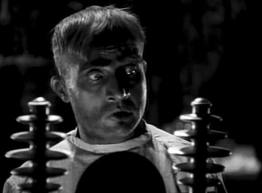
The set direction and sound in the scientists' laboratories might be the aspect that lingers most from watching both films. Bride's is the superior of the two, however, with its elaborate winch sequence and giant kites. Electricity pulsates and hums along large electrodes and diffusers. Smoke and sparks explode and snap. Whale interjects the action with some wonderful closeups of the actors. Rarely has black and white cinematography played such an important part in setting the mood of a scene.    


The director makes sure we sympathize with the monster. Karloff as the monster cries when he sees his ugly reflection and is made a Christ-like figure when captured by the villagers. And at the end of the film, we'll see him make the supreme sacrifice.


The faux crucifixion scene.

Before the big laboratory scene we see the monster wandering in the woods. He meets and befriends a blind man, the first person to show him any compassion. The message here, if obvious, is still essential: real beauty is under the surface. The monster only wants peace. He's violent because that's the only way he knows how to react. To emphasize the point that the monster is more human than some of his pursuers, Whale has a tear role down his cheek as he listens to the blind man's violin. (The scene was later famously parodied by Mel Brooks in his comedy Young Frankenstein.)

A good action sequence follows the monster's capture. He's been hauled into jail like an animal trophy, and secured with heavy chains. He yanks the heavy chains out of the concrete and breaks down a door, sending the villagers running for their lives. The jail, as well as Frankenstein's castle, and the cemetery are wonderful Gothic settings. And pre-dating Film Noir, shadows and sharp angles fill the frame.


Karl is a dutiful assistant, a thankless role if ever there was one considering his scant screen time. He helps steal a corpse for the scientists' experiment and gets to kill a girl to secure a fresh heart. His best line comes at the height of the lightning storm: "The kites! The kites! Get 'em ready! He wants the kites!" The actor Dwight Frey was a staple of Universal's 1930 horror classics, his most famous role as the loony Renfield in the 1931 classic, Dracula. One wishes he had a larger role here.
 
A trusty assisant. 

The Bride (Elsa Lanchester) doesn't make her memorable appearance until almost the last scene. The buildup has been nicely paced and the payoff is one of film's great introductions, a biological abomination wapped tight as a mummy and held together by large safety pins. Pretorius removes some gauze from her face to reveal her eyes, open and alert, (Waxman overscores it with a marvelously screaming note), and Dr. Frankenstein again gets to marvel, "She's Alive! Alive!" She bears the same facial scars as her predecessor. Many viewers will remember the Bride's crazy hair, piled ridiculously high with a zig zag running up one side, but it's the bird-like movements of her head that most fascinate.

What follows is the most poignant scene in any of the early Universal horror classics. When the monster first sees the Bride his face looks on in happy wonderment. He tries to hold her hand, and for a moment the two might be any couple sitting on a park bench. Alas it is not to be. She hisses in disgust and screams at the sight of her intended mate. She too finds him hideous. Not only are the creators punished (here, Pretorius), but the created as well. Once rejected by one as repulsive as he, the monster knows he can never find happiness. He says he would rather be dead.

Yet inexplicably, he somehow finds pity on Dr. Frankenstein and allows him to escape before destroying himself and the rest by bringing the castle down on their heads. In this final act, he shows far greater compassion than any of the humans in the film. 

One woman's reaction to a blind date.


Clive is wonderful as the tortured Dr. Frankenstein. Racked with guilt over his earlier creation, he has blood on his hands. I suspect his escape was a conscious decision by the studio to keep the character alive in case there was another sequel. There would be, but Clive wouldn't be available. The actor suffered from tuberculosis and drank himself to death in 1937.

If the film has a flaw, it is Whale's decision to have the monster speak, something it did not do in the original. Frankenstein says little but utter "Gooood," "Baaaad," and "Friendddd," to convey his feelings. Perhaps it is because the effect has been so parodied over the years, but the words sound cartoonish today. Karloff was a good enough actor that his emotions were evident without speech.

Here's a trailer for the film:

Wednesday, October 5, 2011

The Man Who Shot Liberty Valance (1962) - John Ford

Ransom Stoddard's introduction to the Wild West. 
This scene never appeared in the final cut.  
Colorado is on the cusp of statehood, a place where a man with ambition can make something of himself. Ranse Stoddard (James Stewart) is such a man. He has come west with his law books and idealism, hoping to help bring law and order to the territory. But it is still the Wild West, and Stoddard's stagecoach is waylaid by three outlaws, one the infamous Liberty Valance (Lee Marvin). When Stoddard protests, Valance whips him savagely, leaving him on the trail to die. He is rescued by Tom Doniphon (John Wayne), a local rancher, and his reliable servant, Pompey (Woody Strode ), who take him into Shinbone where he is nursed back to health by Hallie (Vera Miles), the girl Doniphon hopes to marry.

Stoddard befriends Dutton Peabody (Edmund O'Brien), the publisher/editor of the local newspaper, the Shinbone Star. Peabody is one of Shinbone's leading citizens and a vocal proponent for statehood. He writes a harsh editorial decrying Valance and his ilk, men who continue to terrorize the town and are an impetus to progress. Valance seeks revenge by ransacking the newspaper office and lashing the newspaperman with his whip. Stoddard, though no hand with a gun, challenges the drunken outlaw to a fight. The outcome will change the lives of each character, and create a legend.

This is John Ford's last great Western, and in some ways his most resonating. It contains the most memorable line of any of his films: "This is the West, sir. When the legend becomes fact, print the legend." It is an acute and accurate statement on how history comes into being. Over time, facts blur, or are intentionally hidden, and what we think happened may be only partially correct, or totally wrong for that matter.

Ford cleverly tells the story as a flashback. It begins with Stoddard, now a state senator, returning to Shinbone decades after the events of the story. He has come with his wife, Hallie, to attend the funeral of an old friend, Tom Doniphon. When asked by a reporter who Doniphon was, Stoddard tells the tale.

A poignant scene takes place as Hallie visits Doniphon's ranch outside of town where she digs up a cactus rose. The ranch house is a burnt out shell. We will later learn why. On retuning to town she and her husband go to the undertaker. In a nice touch, Ford has Hallie stop abruptly and take a set back on seeing the plain wooden coffin. When Rance looks inside, he admonishes the undertaker for stealing the boots. It's an intriguing beginning, one that compels the viewer to wonder who Doniphon was and what his death has to do with the senator.

Lee Marvin as the dangerous Liberty Valance.


Wayne is the commanding presence in the film. In his familiar cadence, he tells Stoddard that Valance "is the toughest man south of the Picketwire ... next to me."  Marvin is truly menacing as the villain. The two have a tense confrontation in a restaurant when Valance trips Stoddard, working as a waiter and dishwasher. A plate of steak and potatoes crashes to the floor. Like all bullies, Valance backs down when challenged. Doniphon is the only one in town with courage to stand up to the outlaw, and it's clear Valance fears him.

Valance: You lookin' for trouble, Doniphon?
Doniphon: You aim to help me find some?


Edmund O'Brien has fun as the dour editor, who's too smart and reckless for his own good. He drinks too much and sets himself up for a beating from Valance. O'Brien more or less recreated the character six years later in Sam Peckinpah's brilliant The Wild Bunch.

There are no silly fistfights here similar to that Ford injected into The Searchers, but he does not altogether neglect his usual dose of humor, putting into the script.

Peabody: [during voting for the territorial convention] I'll have the usual, Jack.
Barman: The bar is closed, Mister Editor, during voting.
Peabody: Bar's closed?
Doniphon: You can blame your lawyer friend. He says that's one of the "Fundamental laws of democracy." No exception.
Peabody: No exceptions for the working press? Why, that's carrying democracy much too far!

Like all Ford films, the supporting cast is terrific and familiar. John Quinlan as a Scandinavian, craggy-faced John Pennich as a bartender, John Carradine, and Andy Devine as the timid sheriff are from Ford's often-used stock company. Marvin's henchmen are Lee Van Cleef and Strother Martin.

Valance and his gang.

Vera Miles is lovely as Hallie. She pines for Tom, but he has trouble adequately expressing his love. The best he can do is give her a cactus flower, but it clear by his mannerisms and long looks that he loves her. Ranse's arrival and demeanor presents a clear contrast. Tom represents the past, a West still violent and unrefined. Ranse, intelligent and considerably more cultured, represents the future. As Ranse's star begins to rise, Hallie latches on. The relationship between these three characters is a sad one. Ranse knows of Tom's feelings for the girl. Moreover, he is indebted to the man for saving his life, not once, but as it will turn out, twice. It is hard to like this character. Were it not for the fact he's finally the one to challenge Valance, he borders on contemptible, both for not stepping aside when it comes to Hallie, and for living a lie. Whether by intent or happenstance (probably the latter), it's easy to interpret the Ranse character as a statement by Ford that politicians can't be trusted; they put career advancement ahead of integrity.

Ranse finds out that Hallie placed a cactus rose on Tom's coffin, returning the gift Tom had given her many years earlier, shown in the flashback. Perhaps Tom was her true love after all and you and Ranse wonder if Hallie doesn't think she made the wrong choice. The ticket-taker then compliments the senator, saying: "Nothing's too good for the man who shot Liberty Valance." A hint of shame passes over Ranse's face. We never find out if Hallie knows the truth.          

Director Ford always had a fine human touch. It's one aspect of his films that make them so enjoyable and touching: Ward Bond's drink of coffee in The Searchers; Dick Foran's serenade and the noncoms' dance sequence in Fort Apache, the gift of a watch in She Wore a Yellow Ribbon, the barn-raising and dance in My Darling Clementine. Ford loved the romance and tradition of the Old West. The cactus rose appearing on Tom's coffin is another such subtle moment. We never see Hallie place it there.  

A second flashback is embedded in Stoddard's story, which reveals what really happened the night Valance was gunned down.


Doniphon cues Stoddard in on who really shot Liberty Valance. 

The story here is so good, both visually and in the performances, that you don't notice, or at least don't mind so much, that most of it was shot on a Hollywood sound stage rather than on location. Ford nearly single-handily is responsible for elevating the Western film to its iconic status, in large part by setting his action in majestic, panoramic vistas. Nine of his westerns feature the beautiful Monument Valley as a backdrop. (He would spectacularly return to the location once more after this film with 1964's Cheyenne Autumn.) Still, one or two outdoor moments would have enhanced the film, perhaps just a brief shot of Valance and his men crossing the river at dusk, on their way into Shinbone.

Besides the unexciting set, the only flaw in the film is Stewart; 52 at the time of filming, he is about 25 years too old for his character. It's particularly glaring since he's supposed to be a recent law graduate, with no legal experience. Of course, the same might be said of Wayne, but there's considerably more leeway with his character; a strong rancher would have needed to live in the Wild West a while before gaining his level of confidence and reputation. The 32-year difference between Wayne and Miles then doesn't seem quite so disturbing.

Ford rarely did much movement with the camera, letting the scene and characters tell the story. But in one instance here he employs a closeup. As Valance prepares to whip the prone Stoddard, the camera pulls in tight. Stoddard drops from the frame. We see Valance from the waist up inflict several strikes. Only later do we see the bloody effects. Another director might have been more gratuitous. Ford lets the viewer's imagination paint the scene. Ford understood the value of understatement.

And the decision to film in black and white was a wise one, even if forced on the director for financial reasons or to create a younger look for the leads. It gives the film an appropriate feel and mood. Edith Head designed the costumes, something you rarely notice in a Western. She was nominated for an Oscar, and the Duke does look terrific in spats and a ten-gallon hat.

Director John Ford with his two stars.

William Clothier handled the cinematography. A skilled cameraman, particularly with the Western genre, he was a long-time collaborator with Wayne, having been nominated for an Oscar for The Alamo. He'd work with Ford again on Cheyenne Autumn and earn a second nomination.

Ford was 68 when he made this film, an age when most successful directors had already hung up their megaphone. It was an extraordinary effort.

Pop singer Gene Pitney released a catchy song in 1962 based on the film. You can listen to it below. The film was named to the National Registry in 2007.