Showing posts with label Barbara Stanwyck. Show all posts

Wednesday, December 19, 2012

Two for Christmas

Christmas is nigh, and in recognition of the holidays I list two favorite Christmas films: We're No Angels (Michael Curtiz, 1955) and Remember the Night (Mitchell Leisen, 1940). Neither would likely come to mind first for most folks if asked their favorite holiday movie, but for me both capture the best spirit of the season beautifully well and feature great casts.

Humphrey Bogart escapes from Devils' Island in We're No Angels, accompanied by two friends and fellow cons: Peter Ustinov and Aldo Ray. It's a silly, fairly unrealistic plot to be sure. But because the cast looks like it's having so much fun, and the characters are so charming, this is an easy film to enjoy. Ustinov is particularly good, looking ridiculous in a low cut shirt with tie and white collar. He delivers his lines with great facial expressions.

Three convicts eavesdrop on the Ducotets. 

Bogart is Joseph, an embezzler; Ustinov is Jules, a master safe-cracker; and Ray is Albert, a murderer, but despite their resumes they are completely harmless. A fourth companion, a poisonous viper named Adolph is carried around by Albert in a little box. We never see the reptile but his presence plays an important part in the story.

The criminals talk a tough game, and muscular Ray looks like someone who could easily turn menacing, but they have tender hearts. Intending to rob and perhaps throttle a local vendor and his family if needed, the trio alter their plans when they discover the family is financially challenged; and thanks to a greedy uncle, may be ousted from their post.


The cast is terrific and familiar. One of the film's best aspects is that some play against type. Leo G. Carroll, often professionally adept in his roles, is the benign but inept vendor, Felix Ducotel. Seeing how he operates his business, it's no wonder he's not making a profit. Too passive with customers and a terrible bookkeeper. Bogart and Ray didn't delve into comedy too often, but here both are funny. The exchanges between the three criminals is wonderful. French writer Albert Husson's stage play served as the basis for the witty screenplay. Here's a few samples:

Joseph: We came here to rob them and that's what we're gonna do - beat their heads in, gouge their eyes out, slash their throats. Soon as we wash the dishes. 

Joseph: I'm going to buy them their Christmas turkey.
Albert: "Buy"? Do you really mean "buy"?
Joseph: Yes, buy! In the Spirit of Christmas. The hard part's going to be stealing the money to pay for it. 
Jules: [on opening the petty cash box] You'll have to forgive me, it's been a while since I've done this [closes eyes]. And I'm used to doing it in the dark.
 
Basil Rathbone as the uncle is a despicably arrogant man and Scrooge figure, even down to his nightcap. He treats everyone with contempt.

What's in that box?

Christmas comes into play as the three cons interject themselves into the lives of the Ducotels, treating them like an adoptive family. Against their own best interests, they help the family through a few crisis, while taking it upon themselves to decorate the garden for the holiday and produce a delicious turkey dinner. Off screen they steal the bird, and some flowers and a tree from the grounds of the governor's residence. There's a funny scene where Bogart comes into the room with the turkey stuffed under his shirt, feathers flying.

Joan Bennett, 45 at time of shooting, looks lovely as Amelie Ducotel, the wife. Best known for two great Fritz Lange film noirs made tens years earlier (Scarlett Street and The Woman in the Window), Bennett also has a nice singing voice. Her rendition of Sentimental Moments is a highlight. Maybe the silliest aspect of the entire film is believing Amelie ended up with such a fuddy duddy as Felix.


In Remember the Night, Barbara Stanwyck is shoplifter Lee Leander. She gets a Christmas weekend reprieve from jail thanks to the kind intercession of a by-the-book New York City prosecutor, John Sargent (Fred MacMurray). Sargent reluctantly invites her on an across-the-country trip to visit his mother over the holiday. Naturally the two eventually strike up a romance, and the film follows their respective journeys: Lee's to finding a better life and understanding she has it within herself to be a good person; and John's to discovering there are better things in life than blind dedication to one's work.


This is a sweet film, sentimental and at times quite moving. It's fun to see what a cross country car trip looked like before freeways existed. Lots of unpaved roads and podunk towns where local lawmen display rubeness as clear as a badge. A humorous encounter with a county sheriff occurs and thanks to Lee's quick thinking, they manage to elude jail. Stanwyck's stop at her unloving mother's house is sad and crushing as her parent wants nothing to do with her. Sargent steps in for support and thus begins the mutual feelings between the two travelers. Intending to pick his prisoner up on the way back, John instead takes her along to his Indiana home.

Beulah Bondi (the homespun mom) and Elizabeth Patterson play elderly sisters, whose interaction is cute and affectionate. The son's annual visit is the highlight of their year. Both women are smitten by Lee, but once mother learns her background, she cautions Lee from getting involved with her upstanding son. Theirs is a delightful home, full of love and caring. The film portrays a different, more innocent time, certainly, where communities held barn dances, families gathered together to sing in parlors and small-town familiarity existed. The elderly sister lets Lee wear her wedding dress for the dance, helping fit into the corset as she reminisces about a long, lost love, and Stanwyck is touched by her kindness.

She's nearly overcome with emotion in another scene, the film's best. Sterling Holloway (the unmistakable voice of Disney's Winnie the Pooh and the snake Kaa from The Jungle Book) is handyman Willie Simms. His rendition of  A Perfect Day is sublime. Stanwyck plays the piano. She's happy for the first time in a long time and when she sees the love within this family, her empty life is all too clear.


A perfect day.
Preston Sturges wrote the screenplay, one of the last before he would move to the director's chair and find great success on his own. Like the scrips that followed, this one is funny and sweet. One year later Sturges would collaborate with Stanwyck for one of their best films: The Lady Eve.  

You have to like a cow scene, and this film has two, including a delightful milking attempt by the city-bound Stanwyck. The actress must have liked the doe-eyed animals because she shares the screen with another bovine five years later, in Christmas in Connecticut.

The film ends back in New York, Lee wanting to start anew by pleading guilty. She'll go to jail, but you know when she gets out, John will be waiting.

Merry Christmas.

Friday, April 6, 2012

Sorry, Wrong Number (1948) - Anatole Litvak

Bedridden and alone for the evening, Leona Stevenson tries to call her husband, Henry, at the office, but the lines get crossed and she overhears a disturbing phone conversation between some men planning a murder of an unidentified woman. The details are sketchy, but the crime will occur that night at 11:15. Already nervous at her husband's absence, she grows increasingly unnerved as she soon hears more troubling news from a old flame of Henry's and from a mysterious Mr. Evans who tells her that Henry has been stealing from her father's company.

A claustrophobic film noir, Sorry, Wrong Number's action takes place nearly in real time with the exception of flashbacks that effectively provide the back story and reveal what's behind that mysterious phone call. It's soon apparent that Leona (Barbara Stanwyck) is a bit of a dominating shrew who keeps her husband, Henry (Burt Lancaster), firmly under her thumb. Like her excessively doting father who owns a big drug company and for which Henry is buried as a lowly vice president in charge of accounts, she works hard to neuter her husband. An apparent heart condition gives her a ready excuse, and she suffers an attack to manipulate Henry whenever he begins to chafe at the suffocating life he's found himself in and shows a little independence.

Stanwyck does a wonderful job to make you dislike her overbearing character with just little gestures: she doesn't allow Henry to enjoy a glass of champagne at their wedding reception, and turns away when he tries to kiss her on the deck of their cruise liner at the start of their honeymoon. Her attacks of illness seem overly dramatic and too convenient. By the end of the film, however, you are likely to feel differently toward the woman. An unsettling feeling of dread builds as she unravels as 11:15 approaches. If you don't quite sympathize with her plight, you can empathize with her when she is gripped by real terror. She is no longer irritatingly petulant, but a helpless person, crying and unglued as she hears the tell-tale click of the extension phone downstairs, maybe the first "someone is in the house!" horror moment on film. A fabulously versatile actress, Stanwyck is one of the genre's most accomplished performers. Her character's arc here is perfect. For her performance, she earned the last of her four Oscar nominations.

Barbara Stanwyck grows increasingly desperate. 
Her behavior is not all Leona's fault, of course. Since her mother died in childbirth, her rich father has spoiled her rotten. At one point a doctor tells Henry that her attacks are real enough, but psycho-somatic, or self-induced. Panic has a way of doing that--she believes she's really ill. But that little bit of information sends Henry over the edge. He's already involved in a scheme to slowly pilfer a bit of drugs, fence the stolen goods through the mob, and accumulate enough money to break away from the father-in-law. For help, he's recruited Waldo Evans (Harold Vermilyea), a unassuming chemist with the company. When Henry tries to cut out the middle man, the mob comes calling in the form of the menacing William Conrad, who demands an IOU to produce $200,000, suggesting that Henry's sick wife's life insurance might be an option.

If ever a couple was a poor match, it's Leona and Henry. He's far too weak for Leona, and from the poor side of the tracks. The only apparent attraction for Leona is that he's handsome. But he also represents a way for her to put some distance between herself and her father. In one flashback, Leona tells her friend, Sally Hunt, that she usually gets what she wants. Well, she inexplicably wants Henry, and takes him from the girl. Even Henry finds it odd, asking "What does a dame like you want with a guy like me?"

This would be the only time the two stars were paired in a film. Stanwyck, of course, was a great star, and Lancaster not yet hitting his stride. She seems in full control in their brief scenes together, which works perfectly for the characters and story, though it likely reflects their relative skills as actors at that point in their careers. While she shines throughout, Lancaster is merely adequate. His best scene comes at the end, on the phone with his frantic wife, when he gets to show some emotion, realizing what he has set in motion.

An unlikely and unbalanced pairing.

But the best moment in the film features noir at its best. Mr. Evans calls the Stevenson residence. He's been trying to reach Henry all day. He appears shaded so you can't see his features. He tells Leona to pass along some important information: 1) he has burnt down a house on Long Island (presumably to destroy evidence) and escaped; 2) Mr. Moreno (Conrad) has been arrested, so there's no need to follow through on the IOU; 3) Evans is presently at the location in Manhattan but will be leaving soon; and 4) if Henry needs to contact him later, he might try Bowery 2-1000. When Leona presses him about Henry's whereabouts, Evans tells her he doesn't know but perhaps Henry is already at that number.

It's a confusing phone call, one that fuels Leona's anxiety. Earlier that evening, she had had one from Sally Hunt, who's husband works for the DA. Apparently Henry is in a bit of trouble and the police are on to him. Upon hanging up with Evans, Leona immediately calls the number he gave her. Her fingers shake uncontrollably as she dials. The voice at the other end tells her she has reached the city morgue. Franz Waxman wrote the film's effective score, which keeps the tension going nicely throughout. The morgue line brings an appropriately dramatic flourish.  As Leona collapses on the bed, the camera pulls out of the room through the window and pans down to the ground floor where the silhouette of a man appears on the wall. It is nearly 11:15.

The final scene is a chilling one. Henry calls. An hysterical Leona passes along Mr. Evans' information. Henry is stunned. Standing outside the phone booth, police wait to make an arrest. He hears his wife scream.

The film has a lot more going for it. Stanwyck's terrific wardrobe is thanks to designer Edith Head, who had thirteen separate credits for 1948 alone. Even Leona's night gown looks expensive. But it is the several fur-collared numbers, fancy hats, and big jewels that she wears in flashbacks that look great and tell you plenty about the character.

The astounding coincidences of Leona's accidentally overhearing the initial phone call and of Sally Hunt being married to a law enforcement official who's investigating Henry aside, Sorry, Wrong Number is great.

Director Litvak deftly captured the right mood of desperation and inevitability in the story. He had Louise Fletcher's 1943 acclaimed radio program to work with, starring the great Agnes Moorehead. A link follows here: Radio Play 

Besides Sorry, Wrong Number, Litvak had an even bigger hit that year, The Snake Pit with Olivia de Havilland. For that he was nominated for best director and de Havilland competed with Stanwyck for Best Actress. Neither actress won, losing to Jane Wyman for Johnny Belinda, and John Huston took the director statue for The Treasure of Sierra Madre.

Sunday, March 11, 2012

Double Indemnity (1944) -- Billy Wilder

Walter Neff is an insurance salesman with Pacific All-Risk. A routine stop at the Dietrichson's to secure renewals on some automobile policies sends him down a slippery slope, where lust leads to murder, and murder takes him on a trolley ride all the way to the end of the line. It's a one-way trip and the last stop is the cemetery.


Double Indemnity is justifiably considered one of the great film noirs. Billy Wilder, having already found great success as a Hollywood writer, was just getting his feet wet as a director. This, only his third effort, placed him immediately in the ranks of America's top film-makers. A ground-breaking film, it has spawned decades of copiers, but no one made adultery and murder more fun for an audience than Wilder did here.

The film opens with an intriguing sequence--a car driving late at night and slightly erratic in downtown Los Angeles. It pulls to a curb in front of a tall office building. A man eases himself slowly out, supporting himself on the door for a moment. He is apparently hurt in some fashion. A night watchman opens the door, commenting that he looks all-in. The man's name is Walter Neff (Fred MacMurray). He makes his way to his office, where he drops exhausted into his desk chair. A cold sweat beads his forehead and for the first time we see the dark stain of blood on his shoulder. he's been shot. He switches on a dictaphone and begins to speak, confessing to a murder. His last lines grab you and capture the essence of all noir: "Yes, I killed him. I killed him for money -- and a woman -- and I didn't get the money and I didn't get the woman. Pretty, isn't it?"

Walter Neff can't resist that ankle necklace.
It's a daring start by director Wilder--he's already revealed that his star is a murderer. And it stands to reason that he will likely be caught given his condition and the strict morality code of the day. What remains for the audience to discover is who is the woman, why doesn't Neff get her, and who shot him? It's a clever way to engage us and create tension, wondering how the story will unfold. (Wilder liked the technique of revealing up-front what is essentially the end of his film so well, he used it again, effectively in Sunset Boulevard six years years later.)

The rest of the film unfolds through flashback, interjected with voice-over narration and occasional returns to the office and the dictaphone. It begins with Neff arriving at the Dietrichson's. Mr. isn't home but the wife is, and Neff is immediately smitten. Phyllis (Barbara Stanwyck), in perhaps the most seductive entrance in all the genre, appears at the top of the stairs, wearing nothing but a bath towel and high-heeled bedroom slippers decorated with pom-poms.

After dressing she comes down and Neff explains the purpose of his visit, but he's got his eye on her leg and his mind's not on insurance. The script (by Wilder and Raymond Chandler) jazzes up the source novel by pulp crime writer James Cain with snappy dialog. When the two antagonists get together it is laced with plenty of double entendres. The most memorable exchange takes place during their first meeting:

Neff: I wish you'd tell me what's engraved on that anklet.
Phyllis: Just my name.
Neff: As for instance?
Phyllis: Phyllis.
Neff: Phyllis, huh. I think I like that.
Phyllis: But you're not sure.
Neff: I'd have to drive it around the block a couple of times.
Phyllis: (Standing up.) Mr. Neff, why don't you drop by tomorrow evening around 8:30? He'll be in then.
Neff: Who?
Phyllis: My husband. You were anxious to talk to him, weren't you?
Neff: Yeah, I was. But I'm sort of getting over the idea, if you know what I mean.
Phyllis: There's a speed limit in this state, Mr. Neff, 45 miles an hour.
Neff: How fast was I going, Officer?
Phyllis: I'd say around 90.
Neff: Suppose you get down off your motorcycle and give me a ticket.
Phyllis: Suppose I let you off with a warning this time.
Neff: Suppose it doesn't take.
Phyllis: Suppose I have to whack you over the knuckles.
Neff: Suppose I bust out crying and put my head on your shoulder.
Phyllis: Suppose you try putting it on my husband's shoulder.
Neff: That tears it... (He takes his hat and briefcase after his advances are coldly rebuffed.) 8:30 tomorrow evening, then.
Phyllis: That's what I suggested.
Neff: You'll be here too?
Phyllis: I guess so. I usually am.
Neff: Same chair, same perfume, same anklet?
Phyllis: I wonder if I know what you mean.
Neff: (Opening the entrance door.) I wonder if you wonder.

Stanwyck as Phyllis Dietrichson, a dangerous blond bombshell.

Much has been made of Phyllis being an iconic femme fatale, perhaps the iconic femme fatale character in all of cinema. She is certainly devious, and a tempting seductress for a man like Walter Neff, who's attracted to her borderline trashy looks and honeysuckle perfume. It doesn't take her long to size him up. She's an experienced predator and Neff is an easy mark. She plays hard to get just long enough while flaunting her sexuality, then turns on the vulnerability. It's a dangerous combination.

Because of the opening scene, the audience knows before Neff that this woman is bad news, or at least it's reasonable to assume so. He'll catch up to speed in the next scene.  

She invites him to return to the house the next afternoon. The husband is conveniently away. They get comfortable on the couch. Walter, with lust in his mind, may not be the sharpest man, but when she asks if his company offers accident insurance and if can she buy some without her husband knowing, a red flag goes up. Suspicious she's contemplating murder, Neff tells her she won't get away with it and leaves. Wilder lets you know what the character is thinking in a voice-over:
"So I let her have it, straight between the eyes. She didn't fool me for a minute, not this time. I knew I had ahold of a red hot poker, and the time to drop it was before it burned my hand off."
But Neff is weak. When Phyllis turns up at his apartment that night to ostensibly apologize, she's wearing a tight angora sweater. He grabs her and kisses her, telling her that he is crazy about her. A shift back to the present with Neff and the dictaphone allows Neff to admit that what happens next isn't solely the result of being seduced by Phyllis. He's long wondered if he was smart enough to "crook the game," fraud the insurance company with a perfect crime.

Back to the apartment we find the couple still on the couch. Walter is reclined, having a cigarette. Phyllis is fixing her lipstick. The implication is clear--they have just made love. Walter tells her he will come up with a fool-proof plan to do away with her husband. A $50,000 accident policy with a double indemnity clause (paying twice the face amount for an accidental death) will yield them $100,000. The pact, and their fates, are sealed.

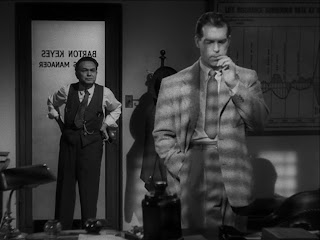
Phyllis provides the spark, but it is Walter who masterminds the crime. If throughout the film we feel some sympathy for the sap, it's also clear he is no innocent bystander. Several scenes depict him in what became a classic noir motif; shadowy venetian blind slats cross his face and body, suggesting prison bars. This is just one of the effective uses of shadow featured in one of the darkest of all noirs. Stanwyck gets the treatment too, and has a wonderfully dark scene at the end when she waits for Walter to arrive at her house. The lights are off and she fires up a cigarette. The smoke slowly wafts up as Miklos Rozsa's terrific score helps create a sense of ominous dread.


Another memorable scene takes place at Jerry's Market as the two co-conspirators surreptitiously talk over the plan as they reach for canned goods. Phyllis hides behind sun glasses. Filmed mostly on location, at least for the exteriors, L.A. provides a great setting for the action, one of the most entertaining aspects of classic films. Besides the 1940s wardrobe, we get the big period automobiles. There's a nice, atmospheric shot of the Hollywood Bowl from a wooded hillside.

The plan is all Walter's, and on the surface it's a fine one. They execute it well enough, knocking the unsuspecting husband off in a classic murder scene, with Neff hiding in the back seat of the car as Phyllis drives her husband to the train station. Director Wilder stages it all meticulously and with great suspense. Never showing the actual strangulation, the camera instead focuses on Stanwyck's face. A slight smile of satisfaction creases her lips, erasing any remaining doubt of the audience that the woman is anything but cold and wicked.

The sequence involves an impersonation, the placement of the body on the train tracks, and a tense moment when the getaway car fails to start. Walter has established his alibi. It all starts to unravel when his boss, Barton Keyes (Edward G. Robinson), a veteran claims examiner, starts to listen to his intuition. Convinced the death could not have been suicide based on statistics, and a highly unlikely accident, he concocts a murder scenario that remarkably mirrors what actually happened.

Walter and Phyllis dump the body.

As good as Stanwyck and MacMurray are--she received an Oscar nomination as Best Actress--it's Robinson's performance that most resonates and the character you most care about. He's completely believable and perfect as the slightly gruff, obsessive professional, whose passion is to protect the company and see his protege, Walter, get ahead. He's shrewd and can smell a phony claim a mile away. The two characters have a couple of terrific scenes together, masking their affection for one another in office banter. Keyes is always patting his vest pocket, looking for a match to light his cigar. Walter always produces one, lighting it with a flick of his thumb. In the film's last scene, the ritual is reversed.

"Closer than that, Walter."


For Stanwyck's character, Wilder famously had her don a blond wig. The wig, the anklet, and the sun glasses collectively help define Phyllis and demonstrate Wilder's skill at using little things to make one of his characters physically memorable. (Other examples in his canon are Jack Lemmon's bowler in The Apartment and William Holden's cigar in Stalag 17). She wears a lot of makeup too, suggestive of a less than high-class background, but a woman who knows how to flirt to get a man hot. Stanwyck fans won't find her unattractive, and the look works perfectly for Neff, a man not used to attention from a sexy woman.

Stanwyck could play anything, and do it damned well. Maybe that's why she never got a competitive Oscar. Academy voters likely took her for granted. If Phyllis Dietrichson isn't her best performance, it's right up there. Certainly, it is her most memorable one.

An important subplot with Phyllis' step-daughter and her boyfriend, a man named Nino Zachetti, comes into play. Zarchetti comes within a hair's width of being framed for murder, and Phyllis' unsavory past peaks Keyes' interest.

One of the best scenes takes place as Keyes comes to visit Walter at his apartment. Worrying about the case is causing him indigestion. He relates that he's starting to think that the "wide-eyed dame," as the beneficiary, may have murdered her husband. Phyllis arrives in the hallway as the two men talk and hides behind the open door when Keyes leaves for the elevator. Walter feels her presence, and for a moment, the audience gets to share his fear that Keyes will discover his relationship with the widow.


A narrow escape.

As Keyes closes in on the truth, the pressure ratchets up on the two lovers, and double-crosses make their ugly appearance. As Keyes so adroitly observes: "Murder is never perfect. It always comes apart sooner or later. When two people are involved, it's usually sooner." By film's end we are back in the insurance office, with Walter finishing up his story. It ends as all noirs do. No crime goes unpunished.

In all, the film nabbed 7 Academy Award nominations, including Best Picture; Best Director--the first of 8 for Wilder in this capacity; Best Actress--the third of four for Stanwyck; Best Cinematography; and Best Music--one of 15 career nods for Miklos Rozsa. Incredibly, it won none.

1944 was a terrific year for film noir. Besides Double Indemnity, there was Laura; Murder, My Sweet; and Woman in the Window. Joseph LaShelle's camera work for Laura went head-to-head with John Seitz for Double Indemnity and won. Director Wilder used both men during his career. Here's a list of their Wilder films:

Seitz: Double Indemnity, The Lost Weekend, and Sunset Boulevard.
LaShelle: The Apartment, Irma la Douce, and The Fortune Cookie

Author James Cain.


Wednesday, October 27, 2010

Film Noir - An American Art Form

Hollywood directors unleashed a new type of film on American audiences in the 1940s, raw, realistic, and black to the core.

As American an art form as jazz, Film Noir sprung out of the national angst surrounding World War II. And like the syncopated rhythmic music developed by black and Creole musicians and first heard on the streets of New Orleans at the turn of the 20th Century, noir films blended existing artistic motifs and slapped in generous doses of improvisation and cynicism to become a new cinematic language or genre that would affect film-makers across the globe.

Its heyday was an approximate fifteen-year stretch starting in the early 1940s. The term film noir, meaning "black film," was coined by French critic Nino Frank in 1946 as applied to Hollywood movies of the period. Its roots can be found in American crime novels of the Depression era and German Expressionist cinema of the 1920s.

Though the visual style might vary, its most consistent characteristic was stark, distinctive high-contrast lighting in black-and-white photography, laden with deep shadows and menace. Its citizens were mostly low-rungers: desperate small-time hoods, beat cops, waitresses, lonely saps and loners, and most famously, femme fatales, gals out to move up a rung or two, anyway they could. Along the way the audience is sure to get a good hard look at society's underbelly.


Sunglasses can't disguise Barbara Stanwyk's duplicitous Phyllis Dietrichson.


In Billy Wilder's Double Indemnity (1944), smitten agent Walter Neff (Fred MacMurray), finds himself in over his head when he joins Phyllis Dietrichson (Barbara Stanwyck) in a plot to kill her neglecting husband to defraud the insurance agency. Stanwyck embodied the cool, calculating femme fatale role as well as any actress. Based on James Cain's hard-boiled crime novel, it ends badly for both of them. Neff never had a chance, saying at the end, "I killed him for money--and a woman--and I didn't get the money and I didn't get the girl. Pretty isn't it?"


Noir icon and champion chump, Robert Mitchum, falls in love with the wrong woman in Jacques Tourneur's Out of the Past (1947), a tale of a detective unable to escape a past mistake. He has a choice, but he can't help turning his back on the good, sensible girl who loves him. Featuring Jane Greer as the twisted object of his affections, and Kirk Douglas as his gangster nemesis, the film contains characteristic voice-over dialog. Some of the best reveals the depths of Mitchum's obsession. "I went to Pablo's that night. I knew I'd go there every night until she showed up. I knew she knew it. I sat there and I drank bourbon and I shut my eyes, but I didn't think of a joint on 56th Street. I knew where I was and what I was doing. What a sucker I was."

Mitchum had bad luck with cars in noirs. When Greer's character realizes he is driving them toward a police barricade, she shoots him dead before police machine gunfire shatters the windshield. Six years later, in director Otto Preminger's Angel Face, dreamy but dangerous Jean Simmons backs him up over a cliff.

Mitchum wasn't the only sap to fall victim to an enticing beauty. Edward G. Robinson starred in two films by German-born director Fritz Lang: The Woman in the Window (1944) and Scarlett Street (1945). In each he is mild-mannered, middle-aged, and a little dumpy. If it occurs to him that it is odd that the beautiful Joan Bennett seems attracted to him, he pushes it out of his mind--he is infatuated. Both films have the relationship leading to run-ins with Dan Duryea and murder. Duryea, a fixture in many noirs, had a sniveling demeanor and could curl his lip in a sneer with the best of them.

Edward G. Robinson can't resist the beautiful Joan Bennett.

The quintessential heist movie is The Asphalt Jungle (1950). Directed by John Houston and set in Cincinnati, it features a band of small-time crooks, more pathetic than sinister. These are just guys looking for a break in life: Doc Reidenschneider (Sam Jaffe), the recently paroled mastermind hoping for one last big score; Dix Handley (Sterling Hayden), the muscle with a dream of owning a horse farm; Louie Ciavelli (Anthony Caruso), the safe cracker whose wife and kids live in a cramped tenement; and Gus (James Whitmore), the getaway car driver who owns a greasy-spoon.


Noir crime doesn't pay and you can often expect a double-cross. The band comes up against one when, after securing the gems, their fence, dishonest attorney Alonzo Emmerich (Louis Calhern), fails to deliver the payout as promised. Shots are fired and the band disperses to their respective fates: arrest, suicide, and death.

The Asphalt Jungle inspired numerous copy-cats, and to demonstrate its influence overseas, director Jules Dassin produced the similarly constructed Rififi, a stylish 1955 French thriller.    


Comely Marilyn Monroe was introduced to America in The Asphalt Jungle.
    
Director Henry Hathaway pushed the violence envelope to a sick level to show that something stank in post-war American society. If we had defeated Hitler and Tojo in Europe and Asia, we had still failed to eradicate corruption, poverty, and malaise in our own cities. In Kiss of Death (1947) Richard Widmark burst onto screens as Tommy Udo, one of Noir's most demented characters. In one memorable scene, he laughs maniacally as he lashes a woman to her wheelchair and sends her bouncing down a flight of stairs, first taunting her, "You know what I do to squealers? I let 'em have it in the belly, so they can roll around for a long time thinkin' it over. You're worse than him, tellin' me he's comin' back. Ya lyin' old hag!"


Tommy Udo helps a lady down the stairs.


Udo wasn't the only psychopath loitering in movie houses that year. Robert Wise's Born to Kill showed that depravity wasn't restricted to the low and middle class. It featured Lawrence Tierney as the appropriately named Sam Wild, a man without a conscious or morals, and whose liaison with a wealthy socialite out to grab her sister's money is no bargain for either. Claire Trevor played the woman, who one character describes as "the coldest iceberg of a woman I ever saw, and the rottenest inside. I've seen plenty, too. I wouldn't trade places with you if they sliced me into little pieces."


Lawrence Tierney and Claire Trevor form an unholy alliance in Born to Kill.

Ten years later we had made little progress in fixing our problems. They might be covered in a veneer of shiny new refrigerators, green suburbs, cars with power-steering (Chrysler's Hydraguide), and that most sought-after creature comfort, television; but they were alive and well.

No film shined a light under the veneer with better acuity and sharpness than Sweet Smell of Success (1958) by Alexander Mackendrick. The story plays out in the tony clubs and restaurants of Broadway and Times Square, and on the dark, crowded, and wet streets of New York. It's a wonderfully shot film by famed cameraman James Wong Howe in gritty black and white, helped immensely by Elmer Bernstein's tense jazz score--you can almost smell the cigarette smoke and garbage cans, and feel hot sweat running down people's backs in the jostling street venders and crowds. It is a fascinating look at how the media can peddle scandal and insinuation to titillate readers. You can't help but peek.

"Match me, Sidney."


Tony Curtis and Burt Lancaster star, Curtis as Sidney Falco, a lapdog press agent who "wants to get way up high, where it's always balmy;" and Lancaster as powerful columnist J. J. Hunsecker. Their relationship, rotten and symbiotic, is the heart of the film.

Happiness is an elusive dream in Film Noir. The genre attracted some of the best Hollywood directors and actors. Film-maker Nicholas Ray fashioned a tense drama from Dorothy Hughes' pulp novel, In a Lonely Place (1950), where the dark soul of a man in on view in all its ugliness. The requisite atmospheric lighting and shadows are here, along with melodramatic music and as flawed a protagonist as ever trod the genre. Dixon Steele (Humphrey Bogart) is a paranoid writer, beset by inner demons and a wild temper. When falsely accused of murder and hounded by the police, he slowly unravels and cracks under the pressure until he risks losing the woman he loves. He sees it happening and that makes his inability to control his emotions and behavior that much more affecting. 


"I was born when she kissed me.  I died when she left me.  I lived a few weeks when she loved me."


Like most noirs, you know it won't end happily. The final scene is gripping as Steele confronts Laura Grey (Gloria Grahame) in her apartment, believing she has betrayed him. He finally goes too far and Bogart sags a broken man. You can't help but feel sorry for him. He came so close.

Noir characters often face moral conflicts. In Otto Preminger's Where the Sidewalk Ends (1950) police Mark Dixon (Dana Andrews) lets his penchant for excessive use-of-force box him in a corner. His victim, a low-life hood, doesn't matter, but Dixon's plan to cover up a likely manslaughter charge goes awry when his actions put an innocent man under suspicion. That he happens to be the father of the girl Dixon has fallen in love with makes matters even more difficult. Does he confess the crime, face expulsion from the police force and jail time, or keep quiet and win the girl of his dreams? The dilemma leaves the officer at a loss. His lament, "Where the devil am I? I keep coming and going," mirrored the state of confusion America sometime found itself in in dealing with societal woes in the post-war era.


Preminger had earlier cast Andrews as a policeman in Laura (1944), one of the genre's most celebrated efforts. Here, while investigating the killing of Laura (Gene Tierney), Andrews falls in love with the girl's memory, helped along by her striking painting. In a surprise twist, Laura turns up alive. It is an innocent friend who was murdered by mistake.


Dana Andrews has a strange attraction to a portrait of a dead girl.


Noir films petered out at the end of the 1950s as film-makers and American audiences grew tired of the genre. Westerns had taken over on TV, and technicolor epics were the new darlings of cinema. One of the last noirs was one of the best, Orson Welles' sordid Touch of Evil (1958), which depicted corruption in a Texas border town.


Welles played Hank Quinlan, a corpulent policeman not above planting evidence to secure a conviction. "I've never framed anyone," he says, "...unless they're guilty."

Welles infused his film with his signature camera magic: Extended takes, jarring angles, and uncomfortable close-ups. Like the genre itself, Quinlan comes to an abrupt end, floating in a pool of fetid water. It is a fine and fitting death.

In Touch of Evil Uncle Joe Grande is no match for Hank Quinlan.