Showing posts with label Ingrid Bergman. Show all posts

Saturday, July 2, 2011

Favorite Films of the 1940s

It's silly to try to pick a top ten favorites from the 1940s, as more top quality films were produced that decade than any other. You certainly cannot pick a definitive list, as it is more than likely to change depending on your mood. One could easily name five each from just Hitchcock and John Ford and you'd have an outstanding selection. Or five each from Humphrey Bogart and Edgar G. Robinson. Or ten film noirs, a genre that came into its own during the decade. In any case, no-one can deny that for classic film lovers, it is a phenomenal period. Here are ten of mine, listed in chronological order. A few actors have multiple appearances: Claude Rains, Dana Andrews, Ingrid Bergman, Teresa Wright, and Joseph Cotten. And noirs do comprise five or six of my favorites, depending on how you define the term.

1. Casablanca - 1942

Michael Curtiz's masterpiece has one of the most quotable scripts and outstanding casts of all time. Bogart plays the cynical Rick, still in love with Ilsa, played by a beautiful Ingrid Bergman. She and husband, an important Czech freedom fighter, are in the North African city looking to escape the Nazi's. Claude Rains, Sidney Greenstreet, Peter Lorre - what could be better. "Round up the usual suspects."

2. Shadow of a Doubt - 1943
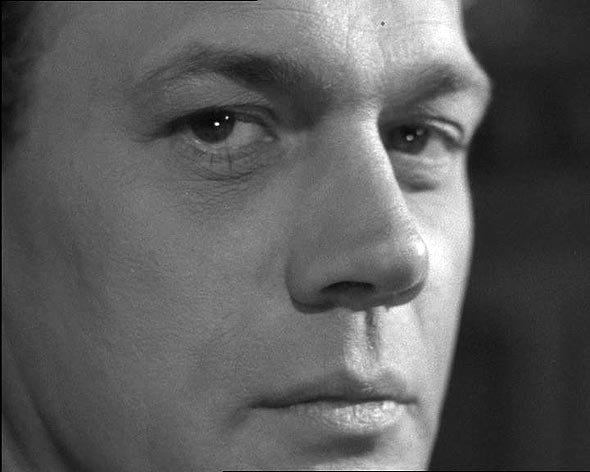
Joseph Cotten best career performance as Teresa Wright's uncle Charlie, the Merry Widow Murderer. He's on the run from police and looking for cover. He gives a chilling speech at dinner about "silly, useless wives," that waste money and are "horrible, faded, fat, greedy women." One of Hitchcock's best, it shows that evil can raise its ugly head anywhere, even in quaint, quiet towns like Santa Rosa.

3. Double Indemnity - 1944

Insurance agent Fred MacMurray is ensnared by Barbara Stanwyck, whose Phyllis Dietrichson is sexy and conniving and spots a sap when she sees one. She wants her husband dead and Walter Neff's just the man to do it. A clever script based on a Raymond Chandler novel, the film deserved its 7 Oscar nominations. Neff provides the voice-over. "Yes, I killed him. I killed him for money - and a woman - and I didn't get the money and I didn't get the woman. Pretty, isn't it?" One of Billy Wilder's best.

4. Laura - 1946

Someone killed Laura Hunt and police detective Dana Andrews heads the investigation in one of director Otto Preminger's best. Along the way he falls in love with the dead woman's portrait. Clifton Webb plays a newspaper columnist and the girl's acerbic mentor, Waldo Lydecker. He received a well-deserved Oscar nomination for supporting actor. One of his best lines: "I don't use a pen. I write with a goose quill dipped in venom."

5. Notorious - 1946

Cary Grant and Ingrid Bergman team up as U.S. agents in Buenos Aires to spy on a group Nazis. The plot involves uranium, but that's not important in this Hitchcock story of intrigue. One of Cary Grant's first serious roles, his performance is outstanding as a man who ignore his heart for his duty. In love with Ingrid, he nevertheless sends her into harms way. Claude Rains plays a seemingly respectable businessman, caught unawares by the woman he too, loves. It relies less on action than on the emotional and mental anguish the stars undergo. A brilliant film.     

6. Great Expectations - 1946

Pip, a poor orphan, has a mysterious benefactor who enables him to journey to London to become a gentleman. David Lean is known for directing some of the world's most successful epics: Bridge on the River Kwai, Lawrence of Arabia, Doctor Zhivago, etc. But it is his smaller, more intimate films from the 1940s that are my favorites. This film is the finest film adaptation of a Dickens' novel. Lean and his actors bring to life the book's memorable characters: the convict Magwich, the attorney Mr. Jaggers, and an old woman stuck in the past, Miss Havisham.

7. The Best Years of Our Lives - 1946

Belongs among the handful of greatest American films ever produced. William Wyler's masterpiece, it is as near a perfect film as you can get. Superior script, acting, and direction. No other "coming home" comes close to its realism and ability to affect the viewer as we follow three likable men home from WWII.  Several scenes stick with you: the emotional meeting between Dana Andrews and Best Actor winner, Fredric March, in Butch's Bar as March tells Andrews to leave his daughter alone (Teresa Wright); Andrews' father reading his son's medal citation; March coming home to surprise his wife (Myrna Loy); Andrews in the cockpit of an abandoned bomber. Wyler's other best of the decade were The Heiress and The Letter.

8. Black Narcissus - 1947

A group of nuns arrive at a convent high in the Himalayas, where the rarefied air does something to westerners. Deborah Kerr stars and her performance as Sister Clodah is terrific. She has her hands full with her own crisis of faith, and the odd behavior of her nuns, especially Sister Ruth, played chillingly by Kathleen Byron. One of directors Powell and Pressburger's impressive output in the decade, which included The Red Shoes, A Matter of Life and Death, I Know Where I'm Going, and Life and Death of Colonel Blimp. P&P films have luscious cinematography and highly interesting stories.

9. Out of the Past - 1947

Perhaps the definitive film noir. All the requisite components of the genre are here: lots of shadows and lighting; a story that you know will have a dark end for someone; a cynical hero in Robert Mitchum, an amoral detective who gets in way over his head; and a gorgeous femme fatale in Jane Greer, the woman who plays Mitchum like a sap. He knows it too, saying in one voice over, "How big a chump can you be? I was finding out." Kirk Douglas in an early role provides support.

10. The Third Man - 1949

Director Carol Reed's marvelous look at intrigue in post-war Vienna. Joseph Cotten is a down-and-out writer of pulp Westerns named Holly Martins. He's looking to land a job with his old friend, Harry Lime, but arrives too late, learning that Lime is dead, recently struck down by a hit-and-run driver. When accounts of the death don't quite agree, Martins gets suspicious and starts poking around, attracted in large part by Alida Valli, Lime's lover, Anna Schmidt. Vienna is not what it seems. The black market flourishes in the bombed-out streets and Lime's old friends, odd and mysterious, seem to be keeping a secret. This is one of the most atmospheric films ever made, infused with a bizarre zither music and some of the best black and white cinematography ever recorded. It contains one of film's most shocking appearances and a spectacular chase through the city's old sewers.

Just Missing:

The Treasure of Sierra Madre - 1948

She Wore a Yellow Ribbon - 1949

The Ox Bow Incident - 1943


The Life and Death of Colonel Blimp - 1943

Late Spring - 1949

Key Largo - 1948

Saturday, December 4, 2010

Casablanca (1942) -- Michael Curtiz

A brooding Rick asks pianist Sam to play As Time Goes By.
It is December 1941 and the German tentacles of domination have reached North Africa. Rick Blaine (Humphrey Bogart), an exiled American and former freedom fighter, owns the most popular nightclub in Casablanca. On the surface Rick is as cynical as they come, saying he sticks his neck out for nobody, but at heart he is idealistic. The Moroccan city is governed by the Vichy French and is a jumping off point for refugees looking to flee Europe. The black market flourishes. Rick comes into possession of two letters of transit, tickets to America that many would die for. When Victor Laszlo (Paul Henreid), an important Czech Resistance leader arrives with his wife Ilsa (Ingrid Bergman), Rick must confront painful memories—he and Elsa were once lovers. She broke his heart in Paris with no explanation. Major Strasser (Conrad Veidt), a high-ranking Gestapo official who hopes to detain Laszlo, orders the local police to keep the man under observation, but Captain Renault (Claude Rains), an unscrupulous police captain and friend of Rick's, will go where the wind blows.

Director Curtiz fashioned a memorable and tightly plotted film. Working with brothers Julius and Philip Epstein's wonderful script, as good an ensemble cast ever gathered, and a top-notch cameraman, it's no wonder the film works so well. Each scene propels the action forward and is packed with crackling dialog. Famous quotable lines include: "Here's looking at you kid," "I think this is be the beginning of a beautiful friendship," "We'll always have Paris," and "I came to Casablanca for the waters."           

Bogart as the embittered Rick Blaine
Bogart's transformation from the thug he often played in 1930 gangster films to the cool cynic persona he's best known for today, and first displayed two years earlier in The Maltese Falcon, is complete in the character of Rick, looking great in a white tux or trench coat and fedora. It's a marvelous performance. He holds the film together. No-one ever delivered bitterness and hurt better. Ilsa's arrival opens old wounds; he says "Tell me, who was it you left me for? Was it Lazlo, or were there others in between or... aren't you the kind that tells?" The character is easy for anyone to relate to who has loved and lost. And that's part of the film's charm too; it sews a love story into the fabric of an adventure thriller, where a common looking man can win the beautiful girl, even if it's for but a brief period.    
[about Rick] Strasser: You give him credit for too much cleverness. My impression was that he's just another blundering American.
Renault: We mustn't underestimate "American blundering". I was with them when they "blundered" into Berlin in 1918.
Rick's club is the site for most of the action, a perfect setting for intrigue, but the best scene occurs at the end at the airport, shrouded in heavy fog. The five main characters converge and it is not until the final moment that Curtiz lets the audience find out how it will turn out, and what kind of men Rick and Renault really are. Great moments at Rick's include the rousing rendition of  La Marseillaise to drown out  the German anthem, the rigged Roulette game, Renault's gambling payoff, Rick's drunken brooding, and Dooley Wilson's piano.
Bergman, convincingly conflicted, is stunningly lit in black and white, while Veidt is coldly reptilian and condescending. Rarely do you want a villain to get his just deserts more. 

The supporting  actors are all terrific, starting with Claude Rains as the shifty and amusing Renault, Rick's brother in arms. They both despise the Nazis. Always a solid performer, Rains nearly steals the show with some of the best lines. Portly Sidney Greenstreet owns the Blue Parrott, Rick's competition, and Peter Lorre is sufficiently sleazy as the parasitic Ugarte, who preys on desperate people trying to escape the city.

And it has that most romantic song, penned by Herman Hupfeld in 1931.

What Makes Casablanca Special:

At its core the film has a theme to rally around: the good guys against the evil oppressor. The Nazis, personified by the menacing Major Strasser, must be stopped, or in this case, out-foxed. This is patriotism without it being in-your-face. When Rick tells Elsa that the problems of three little people don't amount to a hill of beans, we understand and like to think that we too, possess such a noble character. It makes us feel good about ourselves and our country. That the message is delivered by such charismatic and memorable actors, is icing on the cake.      

Bogart and Bergman embrace after Ilsa tried to force him to give her the letters of transit.
There are certainly films technically superior to Casablanca, more ground-breaking, or with better acting or cinematography; but for pure entertainment, nothing tops the film. And that's what most people want out of a movie, escapism and enjoyment. On that level, it's one of the best film ever made. 


Inside Story:
  
Conrad Veidt was a staunch anti-Nazi who fled Germany in 1933 after Hitler came to power. He became a British citizen in 1939 and donated a portion of his film earnings to the British war effort. He died one year after making Casablanca, just fifty years old. 

Arthur Edison excelled at black and white cinematography. He handled the cameras on two other classic films, 1930's All Quiet on the Western Front, for which he received an Oscar nomination, and The Maltese Falcon.  


Round up the usual suspects.

Curtiz'sCasablanca was Yankee Doodle Dandy, another that garnered Oscar nominations for Picture, Director, and Actor. Bogart lost but James Cagney won.

The film opened in November 1942, less than a year after the United States' entrance into WWII. The timing was right. By then, Nazis were justifiably vilified everywhere outside the Axis, and any film that demonized them had a good chance of success. The New York Times was impressed. It said the film "makes the spine tingle and the heart take a leap." As Time Goes By first appeared in a 1932 Broadway show, Everybody's Welcome.

Major Awards:
  • Nominated for eight Academy Awards, it won for Best Picture, Best Director, and screenplay.
  • Bogart and Rains were nominated for acting, Arthur Edison for cinematography, and Max Stiener for music.
  • Selected by the National Registry in 1989 as one of 25 landmark films.
Other films by Curtiz:
  • The Sea Wolf 1947
  • Yankee Doodle Dandy 1942
  • Passage to Marseille 1945
  • Mildred Pierce 1945
  • White Christmas 1954

Tuesday, October 26, 2010

Notorious (1947) - Alfred Hitchcock

Grant and Bergman embrace.
U.S. government agent T.R. Devlin (Cary Grant) and his superior (Louis Calhern as Captain Prescott) want to know what a group of Nazi scientists and businessmen are up to in Argentina. To find out they recruit Alicia Huberman (Ingrid Bergman), the beautiful American daughter of a convicted German spy, to seduce Alexander Sebastian (Claude Rains), a man who once loved her and was an old friend of her father's. Sebastian is one of the Germans' chief financiers. Even though Alicia has a reputation of being wild and promiscuous, she is reluctant—she is no patriot and she harbors ill will toward post-war America, which she believes drove her father to suicide. She relents however, after falling in love with Devlin. He loves her too but won't tell her; he is too wrapped up in duty and the importance of their mission. Sebastian falls prey to Alicia, but when he discovers she is a spy who threatens their plans, and indeed his own safety, his ruthless mother provides a deadly solution.

Grant's Devlin is Hitchcock's most conflicted hero, and one difficult to root for. Suave, witty, and handsome, he can also be rude and nasty. Deeply in love with the woman he has endangered, it is Grant's most serious role. His barely controlled emotion in several scenes with Bergman are some the best acting of his long career. When Alicia comes to tell Prescott she'll act as spy, she all but begs Devlin to tell her not too. His mouth tightens and he leaves the room. Later, during one of their clandestine rendezvous she tells him that he can add Sebastian's name to her list of playmates. He is more visibly angry, his voice projecting disgust, but it is not with Alicia, but rather with himself. She is merely following orders.

Devlin proves Grant a considerably more versatile actor than his common persona suggests. He never played anyone quite like it before or since. One thinks of Cary Grant as a likable rouge, but Devlin is hardly a character to elicit our sympathy. That role belongs to one of the villains of the film, Sebastian, and that's one of aspects film that makes the film so interesting. Claude Rains—a consistently great supporting actor—makes us feel sorry for him, a Nazi! He is trusting and vulnerable. He genuinely loves Alicia, and unlike Devlin, openly admits it. His shock at her duplicity is painful to watch.

Notorious is slight on action but full of suspense as one should expect from Hitchcock. Grant is convincing as the agent who can keep his cool when needed. No one wore a suit better and it's no wonder that Rains' character is jealous of the man. His suspicions are aroused when he finds the two kissing in the basement after they've inspected some strange bottles of champagne.


                            Alicia: What does the speedometer say?
                            Devlin: 65.
                            Alicia: I want to make it 80 and wipe that grin off your face.

The film has an elegant look, heightened by the black and white cinematography. These Nazis have money. Famed Hollywood costume designer Edith Head designed Bergman's gorgeous wardrobe. Though inexplicably not for this, Head was nominated for 35 Oscars.

One of the most famous camera shots in any Hitchcock film takes place at a party hosted by Sebastian. Alicia suspects that a clue as to the Nazi's secret activity can be gleaned in the wine cellar. She has stolen Sebastian's key and must slip it unobserved to Devlin, who has crashed the party. Hitchcock used a crane high above the dance floor;  the shot pans the crowd, stopping at Alicia; her hand is behind her back, holding the key. Another highly regarded shot peers through the space between a door and its jam. It is superbly made thriller.  

What Makes Notorious Special:
 
"You can add Sebastian's name to my list of playmates."
Long-time Hitchcock collaborator Ben Hecht wrote the clever screenplay. This is essentially a love story, and as in real life  sometimes one or both partners are unable to express their true feelings and love is threatened. In Hitchcock's, Hecht's, and the actors' hands, how that threat is averted makes for great viewing.

The final scene involves Devlin's suspenseful attempt to rescue a weakened Aliciashe is being slowly poisoned. He supports her limp body as they come down a long stairway where they are confronted by Sebastian and his mother as his suspicious and dangerous colleagues watch and wonder what is happening. They have already "disposed" of one of their own for an innocent but foolish slip of the tongue. Sebastian has a Hobson's Choice. He can stop Devlin, but would reveal that he has compromised the group's efforts; or he can let Devlin and Alicia escape, knowing  that U.S. government authorities will soon intervene. Whispered threats leave you wondering how Hitchcock will resolve the crisis.    

Bergman's performance easily tops that of her Oscar nominated role in The Bells of St. Mary's the same year.

Inside Story:


Sebastian confesses to his mother.
The shady Nazi plot involves uranium, a key ingredient for making nuclear weapons. At the time of filming, FBI agents reportedly kept Hitchcock under surveillance, wondering what the director knew about such efforts.

Hitchcock makes his cameo appearance as a party guest at Sebastian's mansion, accepting a drink at the bar

Major Awards:

Nominated for Best Supporting Actor (Rains) and Writing.

Other Alfred Hitchcock/Cary Grant Collaborations:

  • Suspicion 1941
  • To Catch a Thief 1955
  • North by Northwest 1959

Grant performances nominated for Best Actor:
  • Penny Serenade 1941
  • None But the Lonely Heart 1944   

Major Awards: