Showing posts with label Sterling Hayden. Show all posts

Wednesday, July 11, 2012

Films of the Cold War

The Cold War between the United States and the Soviet Union, as the only super powers to emerge from the ashes of the Second World War, lasted approximately 40 years. Tensions ebbed and flowed throughout the 1950s, until four events in quick succession in the early 1960s raised world anxieties to new levels: the failed Bay of Pigs invasion, construction of the Berlin Wall, the Cuban Missile Crisis, and the Kennedy assassination. People had good reason to feel that mankind teetered on the brink of nuclear annihilation.

The national angst, fueled by a high performance propaganda machine powered out of Washington, helped President Kennedy launch the Space Race in a May, 1961 speech. The endeavor, drama at its most spine tingling, was restorative to boot. It redirected the collective mind of a nervous American public from Armageddon to an ambitious quest, one of discovery that would require heroic courage, a goal that appealed to the young president. In the bargain, success meant staying one step ahead of our arch enemy, the Communists.

Hollywood also took notice, understanding that the Cold War offered commercial opportunities. In fact, it had been scratching the surface of the genre for over a decade in films like It Came From Outer Space and The Invasion of the Body Snatchers, thinly veiled references to the threat of Soviet invasion or attack, or the more restrained and gloomy On the Beach. But in its constant search for bigger box office, America’s deteriorating relations with the Soviet Union prompted Hollywood to capitalize on the heightened fears of the American public.

It began producing topical films that seemed right out of the day’s newspaper headlines. Many contained a doomsday message—mankind simply couldn’t be trusted to control the terrible weapons it had created. In the process it moved the Cold War genre from allegory to realism. Here are some of the best from the period: The Manchurian Candidate (1962), Dr. Strangelove (1964), Seven Days in May (1964), Fail-Safe (1964), The Spy Who Came in From the Cold (1965), and The Bedford Incident (1965). All are in stark black and white with fine production values to create the right mood for suspense.

The Manchurian Candidate - 1962

Captain Bennett Marco is a confused army intelligence officer. A recurring nightmare haunts his sleep since his return from Korea. Inexplicably, it is of a women’s garden party lecture on hydrangeas with Marco and the soldiers of his patrol sitting on folding chairs on a stage appearing bored. That is the viewer’s introduction to what is arguably the best political thriller of all time.

Chinese Communists have concocted a devilish scheme to brainwash the Americans, including Staff Sergeant Raymond Shaw, who back in the states is an idolized hero and Medal of Honor winner. Shaw reportedly saved the captain and his men while taking out an enemy machine gun nest. Marco, without emotion, says of Shaw, “he is the kindest, bravest, warmest, and most wonderful human being I’ve ever known in my life.” But something is amiss. Marco knows the sergeant is insufferable, a man impossible to like. He can’t put his finger on it but Shaw is not what he seems.

Based on the Richard Condon best seller, Director John Frankenheimer made a film that ostensibly is about how an enemy turns a captured American soldier into its trained assassin to commit an unspeakable crime for political gain. He ejects the novel’s more lurid passages, strong hints of incest, and concentrates on the darker story: how politicians and the media in this country brainwash American citizens, and the disturbing ease with which people fall prey to the unchecked ambition of those schooled in manipulation. He unfolds the story with precision and purpose.

Frank Sinatra, as Marco, adequately captures his character’s confusion, albeit at times he could be more subtle—he wonders if he’s going crazy. Lawrence Harvey plays Shaw to perfection—his pent up disgust of just about everything, including himself, simmers just below the surface. Watch the face of both stars to remember that good acting doesn’t require dialog.

Angela Landsbury, in a well-deserved Oscar nominated performance as supporting actress, plays the diabolical Eleanor Iselin, Shaw’s dominating and image conscious mother. She’ll stop at nothing to get her husband into the White House—even murder. James Gregory gives the best performance of his career. McCarthy-like, he plays Landsbury’s red-baiting husband, Senator Iselin.

When first released—coincidentally during the climatic week of the Cuban Missile Crises—the film met with tepid reviews. New York Times reviewer, Bosley Crowther, ridiculed its premise. Still he wrote of its “racy and sharp” dialog and Frankenheimer’s direction, which Crowther found “exciting in the style of Orson Wells.” It now enjoys cult status.

Dr. Strangelove - 1964

Justly acclaimed as one of the greatest American films, let alone Hollywood’s best Cold War effort, Dr. Strangelove is arguably director Stanley Kubrick’s best. It remains an unparalleled black comedy, and while it excels in every aspect, it is the memorable characters and great performances that bring the story to life. Two actors not known for comedy are particularly funny: George C. Scott and Sterling Hayden.

Hayden is an insane general, Jack D. Ripper. Convinced that Communists are conspiring to pollute America’s “precious bodily fluids” by contaminating the water supply with fluoride, he dispatches his bomber wing to destroy Russia. Scott plays the Chairman of the Joint Chiefs of Staff, “Buck” Turgidson. Called to the White House by the President, he barely conceals his delight—the planes cannot be recalled. Turgidson grins broadly, emits a motor sound, and spreads his arms to swoop like a kid to demonstrate for the President how the B-52 bombers will stay beneath the enemy radar. The character is modeled after Curtis LeMay, the real life early 1960s Chairman of the JCS and rabid anti-Communist.

Peter Sellers gives a tour de force in three separate roles: a British officer out of his league with the crazed Ripper; American President Merkin Muffley; and the bizarre Dr. Strangelove, a German scientist who has problems controlling his Nazi salute. Much of the film takes place in the White House war room, a set that critic Roger Ebert called “one of the most memorable of movie interiors.” Here the president and his odd team of advisers assemble with the Russian ambassador to discuss options. Strangelove discloses the existence of a secret "Doomsday Device," a weapon the Russians will unleash in retaliation. It will destroy all plant and animal life on Earth.

Slim Pickens, in another role originally written for Peter Sellers until he broke an ankle, plays gun-ho Major “King” Kong. He commands the lone plane that makes it to the target. An H-bomb becomes his personal bunking bronco in one of the most unforgettable exits in all film.

The film is full of great lines. Among the best: “Dimitri, we have a little problem ….”; “A fella could have a pretty good weekend in Vegas with all that stuff."; and the most famous: "Gentlemen, you can’t fight in here! This is the War Room!"

The film captured four Oscar nominations: for Best Picture, Best Director, Best Actor (Sellers), and Best Screenplay, but came away empty-handed.

Seven Days in May - 1964
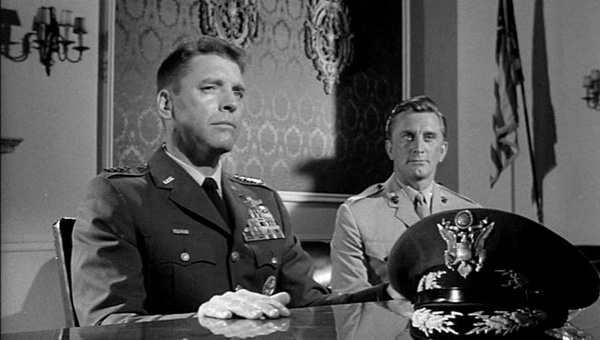
Director John Frankenheimer delves into the Cold War genre a second time and puts a twist on the already traditional plot line, with the Russians merely an off-screen presence.

Frederick March plays President Lyman, a liberal who fears that the nuclear age has killed man’s faith in his ability to influence what happens to him. About to introduce a disarmament treaty to the U.S. Senate, he is up against Burt Lancaster as General James Mattoon Scott. The right-wing Chairman of the Joint Chiefs of Staff, Scott plans a military takeover because he fears the president is compromising the safety of the country. Kurt Douglas plays Lancaster’s aide, Colonel Martin “Jiggs” Casey, who accidentally uncovers the plot by stumbling onto the cover story—a supposed betting pool for the upcoming Preakness. Each of the headliners infuses his character with authority and conviction to give a convincing and textured performance. Jiggs admires General Scott and is disheartened to take his suspicions to the president, while Scott acts out of genuine fear that the president’s policy threatens the county he loves.

The supporting cast is terrific. Martin Balsam plays Lyman’s friend and right-hand man in the White House; Edmund O’Brien is a Senator with a drinking problem; and Ava Gardner is a Washington socialite whose best days are behind her. O’Brien earned an Oscar nomination. He pays a surprise visit to a mysterious base in the middle of the Arizona desert where Lancaster is training a special assault force. It is a wonderful set piece. When the Senator is forcibly held incommunicado and tempted with booze, you can’t help but worry about his safety.

Rod Serling wrote the screenplay, adapted from Fletcher Knebel and Charles Bailey’s best-selling novel. Serling brings his Twilight Zone magic with crisp dialog that crackles as the protagonists go at one another. The final confrontation between March and Lancaster is a highlight, with an aggravated President Lyman dressing down the self-rightist officer: "Then, by God, run for office! You have such a fervent, passionate, evangelical faith in this country…why in the name of God don’t you have any faith in the system of government you’re so hell-bent to protect?"

And like his film The Manchurian Candidate two years earlier, Frankenheimer presents a cautionary tale here. It is not only the military that citizens need be wary of, but also two other American institutions that in the early 60s were still generally held in high regard, the press and Congress. Members of both have joined Scott’s cabal and put their personal agendas ahead of the Constitution. Neither can be trusted.

The book and film were inspired by the disarmament debate raging in Washington at the time. A temporary suspension of nuclear testing by both super powers in 1958 failed to produce a lasting treaty and by 1962, each nation had resumed the proliferation race.

Fail-Safe - 1964

It is the height of the Cold War. Strategic Air Command routinely flies missions to the fail safe position—the line beyond which pilots are to cease communications and ignore orders to return to base. A computer glitch sends a squadron of six B-58 bombers off to obliterate Moscow. They carry a payload of two-megaton hydrogen bombs. The U.S. President, played by an increasingly frustrated Henry Fonda, soon is on the hotline to the Russian Premier trying to explain the foul up.

Tensions mount and cold sweat starts to pour as efforts to recall the bombers fail. American fighters ordered to intercept the bombers exhaust their fuel and crash into the Arctic Sea, and Soviet MIGs dispatched to shoot down the highly skilled bombers only manage to stop five. Eventually, the president is left with a chilling option to avert a possible retaliatory strike and nuclear Armageddon. He issues an order too incredible to contemplate.

This is a grim and pessimistic tale. Up against the incomparable Dr. Strangelove, released nine months earlier, this film was all but ignored at the box office. It lacks any of the black humor embedded in Kubrick’s masterpiece; instead, relying on straight dramatic performances in an intentionally claustrophobic setting. With the feel of a documentary throughout, it is a riveting film.

Nowhere is the contrast between Dr. Strangelove and Fail-Safe more obvious than in the conversations between the American and Russian leaders. Kubrick and Peter Sellers played it for camp, while here, director Sidney Lumet and Fonda play it dead serious. Lumet is a master with the camera, making exquisite use of shadows and tight angles to keep the mood tense and the audience nervous.

The cast is top notch. Fonda is the headliner, a decent and morally grounded man facing a Hobson’s choice. Walter Matthau, known best for his later comedic roles, shines as a cynical professor and Pentagon advisor with some unusual theories about nuclear warfare. He is coldly practical and believes the Russians are “calculating machines,” who will “look at the balance sheet and see they cannot win.” He’s convinced they will surrender rather than retaliate. Dan O’Herlihy a brigadier general in the US Air Force and old classmate of the president is troubled by a nightmare about a matador. Ed Binns is Jack Grady, a by-the-book Air Force Colonel who leads the bomber squadron.

Given the jaw-dropping ending, it’s no wonder the Department of Defense refused to cooperate with filming.

The Bedford Incident - 1965

This film shows that the Cold War did not just play out in the seats of government in Washington, London, and Moscow; but also in isolated, inhospitable locations. Richard Widmark plays Eric Finlander, an over-zealous Navy captain of a guided missile destroyer, the USS Bedford. His harassment of a Soviet submarine that veers into Greenland territorial waters borders on the obsessive. A modern day version of Ahab, he shadows the sub in a dangerous game of cat and mouse in the frigid North Atlantic, hoping to force it to the surface—against orders from NATO.

Finlander’s motives are questionable. A dubious past caused him to have been recently passed over for the rank of Admiral, leading him to take out his frustrations on the enemy and his own crew. The hunt is everything and he drives his crew to exhaustion. Inevitably, the crew gets wound so tight they are prone to mistakes, which here can lead to disaster.

Director James Harris builds tension throughout and maintains suspense by never showing the inside of the enemy sub; events unfold only from the perspective of the American vessel. Still, it is clear that the Soviet crew suffers from increasingly foul air from the sub’s diesel engines as its oxygen is depleted. As the sub commander naturally grows more desperate and Widmark more determined, three men aboard the American vessel become increasingly nervous that its captain will push the game too far.

Sidney Poitier is one, along for the ride as a noisy photojournalist doing a story on the “provocative” captain. He tries to bait Finlander into saying something he shouldn’t in one of the film’s best scenes, as Finlander, showing little tolerance of reporters, struggles to maintain control. Widmark—always an underrated actor—is excellent, rubbing his face nervously and seething with bitterness.

Finlander also ignores reasoned advice from the ship’s doctor, Martin Balsam in another solid character role performance, and from a U.N. observer, a former U-Boat commander who knows something about the mentality and tendencies of submarine commanders under duress.

Filmed in England at Shepperton Studios, director Harris does a nice job with set design and sound. The sonar pings, howling wind and fog, giant icebergs, and most of all the claustrophobic bridge, all converge to heighten the realism. Harris previously worked as Kubrik’s partner on Dr. Strangelove.

Look for Donald Sutherland in an early role.

The Spy Who Came in From the Cold - 1965

Directed by Martin Ritt from the John le Carré novel, which Graham Greene called the “best spy story he ever read,” this is Richard Burton’s film. He plays Alec Leamas, a tired, burnt out British agent stationed in Berlin. Looking at his face, its sunken and dark eyes, and his vacant expression, one can’t help but believe this guy has been through the ringer—been “out in the cold”—for too long.

When an assignment ends in him losing an agent, Leamas is called home. Disgraced, he is “retired” and sinks into depression and booze as he tries to assimilate himself back into normal society as a lowly clerk in a used bookstore. It is a ruse; the Home Office says there is a mole in its midst blowing the cover of its agents. Leamas pretends to defect, and that’s where Ritt and le Carré spin a web of intrigue that takes Burton and the viewer on an emotional ride.

Eventually, Leamas realizes his mission is to sow misinformation and that he is a pawn to save the life of a double agent. He is part of an ugly game, with no winner—one where you can’t trust anyone, least of all your own government. By the end, his disgust with the game, its deceit, and with himself, is palpable.

You could never mistake Leamas’ world for James Bond or Tom Clancy’s Jack Ryan. Ideologies are blurred, and there are no gimmicks or outlandish technology here, just gritty human interplay that slowly beats down the players. Revealing the real oppressive world of espionage, at one point Leamas vents: “What the hell do you think spies are? Moral philosophers measuring everything they do against the word of God or Karl Marx? They’re not! They’re just a bunch of seedy, squalid bastards like me: drunkards, queers, hen-pecked husbands, civil servants playing cowboys and Indians to brighten their rotten little lives. Do you think they sit like monks in a cell, balancing right against wrong?”

Ritt expertly transforms le Carré’s grey, depressing world from the page to the screen. In a neat bit of symmetry the film begins and ends at the Berlin Wall. The best scene takes place near the end. In an emotional monologue, Leamas reveals the depth of his disillusionment. He releases all the hate, resentment, and cynicism at the system that cares nothing of its agents. It takes place in a cramped car in the rain, and you feel the claustrophobia present in the place, and in his mind. His mission complete, he is about to escape back to the West, but what has he to escape to? In the end he finds his way back to humanity.

Burton received a Best Actor nomination. He should have won but lost to Lee Marvin for Cat Ballou.

Other notable Cold War films of the period worth viewing include: On the Beach (1959), The Ipcress File (1965), and Ice Station Zebra (1968).


Saturday, February 11, 2012

The Asphalt Jungle (1950) - John Huston

Doc is fresh out of the pen with a foolproof plan to knock off a jewelry store, one last big score before he retires to chase pretty girls in Mexico. He recruits a small group of low-life criminals to help with the job: Gus as driver; Louis to crack the safe; and Dix for muscle. With "the goods" secured, Doc and Dix make their rendezvous with Mr. Emmerich, the financier and fence, whose attempt to double-cross the thieves sends things spiraling out of control.

Director John Huston carved a sub-genre in noir with this stylistic and moody heist film. Often copied, no one has equaled it for its brilliant character development and ability to suck the viewer into the lives of bottom-rung criminals living on the dirty edge of post-war society. The film also exemplifies wonderfully well why black & white cinematography captured the mood of the genre in ways that color photography never could. The dark and shadowy scenes perfectly match the souls of the amoral characters here, and are analogous to the blanket of desperation that grips their lives.

We meet Dix (Sterling Hayden) first, slinking along in the early morning. The cops are looking for him, suspecting him of a nearby hold-up. Dix makes his way to Gus' diner (James Whitmore). Gus hides Dix' revolver in the cash register just before the officers arrive to take him in for questioning. We'll soon learn that Dix likes to play the horses--not well--as he'll return to Gus' to hit his friend up for a loan. At the station, Dix stands in a line-up. He has a long rap sheet. (Look for the middle suspect--a young, skinny Strother Martin in his first screen role.) Dix is released after a victim refuses to finger him as the perpetrator.

Dix hides to elude the police.
Next, we meet Doc Riedenschneider (Sam Jaffe), just out of seven years in prison. He comes to Cobby (Marc Lawrence), a smarmy bookie who has connections. Doc asks him to arrange a meeting with Mr. Emmerich, an attorney who'll finance Doc's caper. Dix arrives to place a bet, and while there, takes offense at something Coffy says and storms out; but in the process, leaves Doc impressed that here might be a man he can count on in a pinch. Later that night, Cobby and Doc visit Emmerich (Louis Calhern). They don't know it, but Emmerich is broke. Unable to support his lavish life style, he sees Doc's plan as a way to get out from under. Emmerich agrees to put up $50,000 so Doc can hire help. He also offers to fence the stolen goods, thereby increasing the overall take for all of them, estimated at upwards of $1 million.

Calhern is perfect as a man who hides behind a facade of wealth. Ostensibly calm, he is a practiced liar, devious, and as desperate as the thieves. In one scene, he confesses his plight to an associate, wringing his hands across his face in anguish. Emmerich has the film's best line. Talking with his bed-ridden wife, he calms her fears about the awful people he comes in contact with. "Oh, there's nothing so different about them," he says. "After all, crime is only... a left-handed form of human endeavor."

As the other two men leave, Emmerich steps into the adjoining room and we discover the cause for the man's financial straights. He leans over his mistress, Angela (Marilyn Monroe), dosing on the couch. A girl like that costs a lot of money to keep happy. Monroe, just 24 here, had appeared on screen before, but this surely was the start of her rocketing to fame as a sex-symbol. She looks like a girl used to getting what she wants, and knowing how to string along a sugar daddy. She only gets two scenes in the film, but they do the trick. Alluring and sensual, she is surprisingly thin and quite lovely. She'll look even better later in an off-the-shoulder black number. Emmerich's expression says it all. All he can do is utter "some sweet kid."


Dix receives a visitor at his simple apartment, Doll, played by Jean Hagen. Hagen gives a fine performance, the best in the film. Doll needs a place to stay for a few days; because the cops raided her place of employment, a clip joint, she's missed payday. Dix and Doll's relationship is the most interesting in the film. We can infer from their conversations they have a history. Perhaps once lovers, they at least seem kindred spirits, similarly downtrodden and unable to catch a break. Like all the characters in this dark story, they clearly haven't made the best choices in life. Still, you sort of feel sorry for both.

Dix either isn't able to express his feelings or doesn't want to. When she asks to spend the night, he says sure, "just don't get any ideas." Still, a smile creased his lips when he saw who'd come to call, and her face lights up expectantly later when he calls her on the stairs as she's leaving the next day. By her gaze, you know she has feelings for him. Like the men in the story, she seems scarred by life, trapped in a dead-end existence. The way she watches him finish his drink, you wonder if she's also an alcoholic.

Hayden as Dix and Hagen as Doll.

By now all the principals have been introduced, and we already know everything we need about the men in a few short scenes. Huston and collaborator Ben Maddow knew how flesh out their characters with little dialog. The script is highly entertaining, filled with clever slang and the nomenclature of the criminal underworld. Doc calls a safe cracker, a "boxman," and when Cobby insults Dix, Dix reacts angrily: "Don't bone me!"

In the asphalt jungle, no one is clean. A corrupt police lieutenant, Ditrich, who's earlier been read the riot act by the police commissioner for losing tract of Doc after his release from prison, interrupts Doc and Cobby in Cobby's office. He's obviously taking money under the table from Cobby. When he realizes who's sitting there, he leaves without speaking.

Doc: That copper, he recognized me.
Cobby: How'd you know he was a copper?
Doc: I can smell one a block off.
Cobby: Oh, don't worry about Ditrich. He's on my payroll. Practically a partner. Me and him, we're like that. [Cobby holds up his index and middle finger]
Doc: Experience has taught me never to trust a policeman. Just when you think one's all right, he turns legit.

A heavy sense of dread permeates the film, the end preordained. Capers like this never end well. The script portends the unrealized hopes for two of the gang. Besides Doc's wish to make Mexico afterwards, Dix laments to Doll about the loss of his family's horse farm, an incident from his youth that has left him deeply scarred. One big score will enable him to buy it back, and the first thing he'll do is "jump in the creek and wash off the dirt of the city." Louis echos the thought that urban life in the post-war city is filthy. Upset that his new son is sick because his wife takes him out in the morning for fresh air, he says it's too cold and barks, "there's no fresh air in this city!"

Doc goes over the plan with his men.
In a wise decision, director Huston doesn't linger on the actual robbery--it's not really the point of the film. It starts off like clockwork, but soon begins to unravel. A night watchman enters the scene. Dix wrestles the man, who drops his weapon. It goes off and Louis is fatally wounded in the stomach. With loot in hand, the robbers disperse. Doc and Dix meet Emmerich to make the exchange, but the shady lawyer doesn't have the promised cash. Doc rejects his offer to stash the jewels there, a decision that doesn't sit well with Emmerich's hired thug.

The end comes as expected, with all the bad guys paying a price for their crime. Cobby proves to be the gang's weak link, confessing under police pressure. As the cops close in, Emmerich isn't man enough to face the music. He at least lets Angela off the hook. His alibi, he tells her to "just tell the truth, baby." The old sap actually loves her.

Doc and Dix split up. Doc looks on his way to safety with the jewels sewn inside his coat, but is waylaid as he stops at a diner where he sits enchanted as a young girl jitterbugs to a juke box. Huston pushes the censor envelope with Jaffe's lecherous look. The best camera shot in the film occurs here, the lens following the girl as she moves to the window, slapping hands and twisting hips. She moves away and we glimpse two cops in the shadows, standing outside looking in.

Doc's vice.


Capturing the mastermind.

The film ends as it began, with Dix. He and Doll escape toward Kentucky. Shot in the side from his encounter at Emmerich's, he's hallucinating from loss of blood and barely conscious. Doll stops at a doctor who proclaims that he won't get far: "He hasn't got enough blood left in him to keep a chicken alive." Somehow they manage to cross the Ohio River and arrive at the old family farm. Dix staggers into the field of bluegrass and collapses as a colt comes to nuzzle his face. Home at last.

Dix makes it home.

The story is based on a novel by W.R. Burnett, who also authored Little Caesar (1931) and High Sierra (1941), two other crime dramas brought successfully to the screen. He also wrote the screenplay for The Great Escape (1963).  Harold Rossen handled the cinematography, so central to the mood of the film. He received an Oscar nomination for his efforts. For his career, Rossen was a five-time nominee.

Friday, November 4, 2011

Johnny Guitar (1954) - Nicholas Ray

Two women vie for dominance on the frontier. Vienna (Joan Crawford) is a sharp businesswoman who has built a gambling house and saloon in anticipation of the railroad coming. Townsfolk and cattlemen, led by a jealous rival, Emma Small (Mercedes McCambridge), want her gone from the territory. When a gang of outlaws hold up a stagecoach and kill Emma's brother, Emma and a posse come to Vienna's place looking for the Dancin' Kid, who they target as the culprit, and who may have once shared Vienna's bed.

Given the rest of his canon, it might seem strange that director Nicholas Ray would make a Western. Best known for noirs like They Live by Night, In a Lonely Place, On Dangerous Ground, and urban dramas like Rebel Without a Cause, Ray seemed out of his element here. Maybe that's why Johnny Guitar is such an unusual film, one over which few people seem ambivalent. For some it's a classic, for others it's so far removed from the traditional Western form it's a mess, riddled with over-the-top performances and cringe-worthy dialog. I suspect it may be one of those films that takes a while to warm up to, requiring more than one viewing to form a solid opinion. For me, something about it is dreamlike and mesmerising, as if formed one night in the director's sleep, and the movie is Ray's attempt to translate the murky story into a very stylized film.

We are introduced to Vienna in one of the first scenes as Emma and a group of men come to threaten her. Crawford appears at the top of the stairs, all in black except for a bluish string tie and flaming red lipstick. A gun belt is slung at her waist. She is not frightened, saying "Down there I sell whiskey and cards. All you can buy up these stairs is a bullet in the head. Now which do you want?"

Joan Crawford as Vienna.
It's not positively clear what prompts Emma to so fiercely hate Vienna. Vienna suggests she wants the Kid for herself (though some critics of the film like to promote the silly idea she lusts after Vienna). Judging by how she later reacts when the Kid dances with her, Vienna is likely right, but Emma also considers Vienna a threat to her own financial interests in town. In any case, this unconventional Western pits two strong-willed women against one another instead of the usual male protagonists. Emma has a strange hold over the men in the posse, who defer too easily her lead. She either wields considerable financial power in the community, or is just too troublesome to oppose. Hell-bent on running Vienna out of town, she calls her a "railroad tramp," and warns that the railroad means squatters, farmers, thousands of new people from the east, and ranchers who will fence in the open range. McCambridge is a hard ball of mean energy, taking the character to a maniacal pitch. She vows to kill Vienna, and you know the two will eventually clash with deadly results. For the moment, Vienna stands them down.

Ray has made both women similar in appearance in certain scenes, with short black hair and that dark red lipstick. Perhaps he is implying that the characters represent the dual personality in all of us, good and evil.

Sterling Hayden is Johnny Logan, now going by the name of Johnny Guitar, trying to break with a violent past. Vienna once loved him but he ran out of her life five years earlier, afraid to settle down. She tells him her love for him is now just ashes. Though a woman scorned who still bears scars, she's invited Johnny back to help her build a new town. No one quite knows what to make of him. Why would a gunfighter of repute hang up his guns for a musical instrument? 

The Dancin' Kid (Steve Brodie) arrives with his gang (including Ernest Borgnine), charging the atmosphere even more. Johnny makes a dramatic appearance, catching a shot glass before it rolls off the bar. He diffuses the tension when he plays a lively tune and the Kid grabs Emma to dance. If any scene defines the strangeness of Johnny Guitar, it's this one. The tension has built steadily; we expect an eruption, possibly with gun play. Instead, a group of supposedly tough cowboys stand about glaring at one another while the biggest man strums his guitar and the supposedly most dangerous man waltzes. A weird exchange takes place between Johnny and the Kid as they size each other up.

Kid: I didn't get your name stranger.
Johnny: Guitar. Johnny Guitar.
Kid: You call that a name?
Johnny: Care to try and change it?


The Dancin' Kid struts his stuff with Emma.

The posse gives Vienna and the Kid an ultimatum--leave town within 48 hours. They and the Kid soon, leaving Vienna alone with Johnny. It's soon evident that they still love one another, despite the following melodramatic exchange:

Johnny: How many men have you forgotten?
Vienna: As many women as you've remembered.
Johnny: Don't go away.
Vienna: I haven't moved.
Johnny: Tell me something nice.
Vienna: Sure, what do you want to hear?
Johnny: Lie to me. Tell me all these years you've waited. Tell me.
Vienna: [without feeling] All those years I've waited.
Johnny: Tell me you'd a-died if I hadn't come back.
Vienna: [without feeling] I woulda died if you hadn't come back.
Johnny: Tell me you still love me like I love you.
Vienna: [without feeling] I still love you like you love me.
Johnny: [bitterly] Thanks. Thanks a lot.


Johnny Guitar and Vienna.

The best action sequence comes when the posse returns a second time to Vienna's, this after the Dancin' Kid and his gang have robbed the bank. Vienna happened to be there at the time and is guilty by association. She's is wearing white now, calmly playing the piano. Convinced she's working with the Kid, they arrest her and take her out to hang. Emma seizes the opportunity to shoot down a chandelier, starting a blaze which consumes the saloon in a fiery conflagration.

The film, awash in vivid, almost garish colors, reflects Ray's attempt to infuse the film with passion. The visual boldness is one of its most memorable features.  In this scene the color is fantastic, the bright orange flames engulfing the building in the background, contrasting with McCambridge standing out front. Her gleeful reaction as she admires her work is wonderful fun to watch. The character is pure evil, thinking she's finally got the best of Vienna. Reportedly, in real life the two actresses felt contempt for one another, so it's easy to believe that McCambridge incorporated such feelings into her terrific performance.  

The Wrath of Emma Smalls.

The posse, propelled into action by Emma, goes so far as to drop a noose around Vienna's neck. But the men have no stomach for killing a woman and they finally resist Emma's rabid pleas, forcing her own hand. Johnny comes to the rescue just in time. Vienna leads them to the Kid's hideout, with the posse close on their heels. The dramatic, inevitable shootout follows with Vienna facing off with her nemeses, Emma.

Crawford in one of her many primary color costumes.

The end finds Johnny and Vienna holding each other in their arms as Peggy Lee's haunting rendition of the theme song plays over the curtain. Lee wrote the lyrics.

Play the guitar, play it again, my Johnny
Maybe you're cold, but you're so warm inside
I was always a fool for my Johnny
For the one they call Johnny Guitar

Play it again, Johnny Guitar

Whether you go, whether you stay, I love you
What if you're cruel, you can be kind I know
There was never a man like my Johnny
Like the one they call Johnny Guitar

Frequent Western supporting players Ward Bond, Borgnine, Royal Dana, John Carradine, Paul Fix and Frank Ferguson add color to the cast. Victor Young scored the film. The cinematography was handled by Harry Stradling, a 14-time Oscar nominee and 2-time winner. Among his most successful films are Streetcar Named Desire and My Fair Lady.

Johnny: There's only two things in this world that a 'real man' needs: a cup of coffee and a good smoke.