Monday, January 9, 2012

The Vikings (1958) - Richard Fleischer

A Viking boat returns from a raid. 
During a Viking raid of the English coast in the Middle Ages, the Viking leader Ragnar kills the king of Northumbria and rapes the queen. Aella, the king's ambitious brother, assumes the throne. The disposed queen later gives birth to a son, Eric, and fearing that her brother-in-law will feel threatened by the rightful heir to the throne, she sends the child away to safety. He is captured and enslaved by the Vikings. In the meantime, Ragnar has had his own legitimate son, Einar, a warrior who aspires to follow in his father's wild footsteps. The half-brothers are destined to cross paths and become embroiled in a fierce battle over Morgana, a beautiful English girl, betrothed to Aella.

This is one of the best adventure films of the 1950's, a pure delight for young boys who love history (albeit confused as presented here) and authentic action. It is spectacularly shot by the great Jack Cardiff, a master of color photography. Cardiff understood the Technicolor process better than any cameraman of his day. Exotic locations with Norwegian fiords and English castles provide a luscious setting for the film's action.

The film opens with Orson Welles' unmistakable voice, giving general background on the life of Vikings and explaining the structure of England at the time, i.e., an unorganized group of competing kingdoms. The Vikings worship a pagan god of war, Odin, and regularly conduct raids along the English coast. Simple drawings of warriors in battle appear on screen. This cuts to the first action sequence: a quick one showing Ragnar's raid.

The film jumps forward twenty years with Ragnar (Ernest Borgnine) returning from another raid. The Viking ship moves up a scenic fiord to the Viking village. It is gorgeously rugged, the narrow channel with rocky slopes rising on each side and a backdrop of snow-capped mountains in the distance. The film's epic theme plays over the scene, a mix of atmospheric French and English horns. The sail drops and the men extend long oars and begin to pull toward the dock as a high lookout alerts the villagers by blowing a gigantic horn. Purportedly an accurate reproduction of a Viking vessel, the ship certainly looks authentic with shields affixed to the side, the rowers tightly packed, and a tall dragon for a figurehead. It is a splendid scene. The water is a deep blue and the lookout's horn a perfect touch.

Borgnine as Ragnar. 

Ragnar has brought along Egbert, an Englishman and a traitor who can map the coast of England. He soon discovers the connection between the two half-brothers. The first, Einar (Kirk Douglas), makes his appearance. He's a chip off the old block, wild and full of debauchery. Besides fighting, Vikings enjoy nothing so much as guzzling ale and ravishing women, and Director Fleischer includes a couple of scenes where the Norsemen kickback for some fun. In one, they strap a girl to a large revolving wheel, her pigtails stretched out. Douglas throws axes, slicing the hair to drunken cheers.  

While hunting separately with falcons, the two half-bothers meet in the forest. Eric (Tony Curtis), annoys the Viking, and gets kicked to the ground. Provoked, he commands his bird to attack. It claws out one of Einar's eyes in a ghastly scene that looks amazingly real and dangerous, leaving blood pouring through Douglas' fingers. For the rest of the film he sports some very effective makeup, an opaque contact lens, with talon scars marring his handsome face.

Einar bears the scars of the falcon attack.
Instead of immediately killing the slave, Einar vows to make him suffer, saying: "The sun will cross the sky a thousand times before he dies, and you'll wish a thousand times that you were dead." Ragnar has other ideas though, and orders him thrown into the slop pool, expecting that either the crabs will eat him or he will drown with the rising tide. However, a storm comes up to push back the tide, causing Ragnar to take it as a sign from Odin to spare Eric's life.

With the aid of Egbert's map, Einar goes to England and kidnaps Morgana (Janet Leigh) with plans to exhort a ransom. The beautiful daughter of another English king, she is betrothed to the new king of Northumbria. But Einar is smitten with the girl. While drunk, he goes to have his way with her. Eric, also attracted to Morgana, prevents the rape, and helps the girl escape in a row boat. Alerted, the Vikings give chase, but their boat runs aground in the heavy fog and Ragnar falls overboard. He is picked up by Eric and taken prisoner to the English.

A highly entertaining aspect of the film is the pacing. Action sequences are never too far apart. The English king orders the Viking executed by dropping him into a pit of savagely hungry wolves. Ragnar asks to die like a Viking, with his sword in hand, believing that is the only way he can enter Valhalla. The king refuses, but Eric defies him by cutting Ragnar's binds and handing him a weapon. In the tradition of great scene deaths, Ragnar grins, then growls loudly at his captors and jumps into the pit, of course, without knowing Eric is his son. Here director Fleischer makes a good decision not to show the actual encounter with the animals. Instead, the camera focus on the faces of the men above the pit, looking down at the unseen action. This invokes the audience's imagination as the sounds of fierce gnashing and grunts fill the air. Eric pays dearly for his audacity. For going against his wishes, the king chops off his hand.

The film doesn't require the performers to do much; just the three men to look and act heroic, and for Janet Leigh to look lovely. They all do a fine job. Douglas likely had lots of fun on the project and gets to demonstrate his athleticism, once with a nice stunt running along extended oars, supposedly an actual tradition of returning Vikings, and later climbing up a closed draw-bridge on the handles of battle axes.

The spectacular climax.

The final battle scene is staged terrifically. The Vikings storm the English castle to avenge Ragnar and retrieve Morgana, smashing down the first barrier with a giant tree trunk on wheels. Archers fill the air with arrows and the king's men toss boulders from the battlements. Eric extracts his own revenge on Aella, then the two-half brothers meet atop a tower in a spectacular sword fight to see who wins Morgana. This is a wonderfully choreographed sequence and must have been an extraordinarily difficult shoot. Director Fleischer and cinematographer Cardiff pull it off beautifully. Fort La Latte in the Cotes-d'Armor region of France served as the actual location.

One of the great castles featured in the film, scene of the final battle.


Calder Willingham penned the screenplay, which relies on visuals and action rather than emotion. Willingham had just worked with Douglas on the excellent Paths of Glory and would later score an Oscar nomination for The Graduate. He also adapted Little Big Man.

The production design deserves a mention. The Viking village is appropriately comprised of log and mud huts, with moss and what appears to be lichen growth on the walls, and the costumes are leather and wool, just what you'd expect from the time period.

Fans of Biblical epics of the period will recognize Frank Thring as the English king, Aella. He also played Pontius Pilot in Ben-Hur and Herod in King of Kings. As Aella, he is similarly slimy and loathsome.

The film ends brilliantly with a Viking funeral. It is dusk. The body of one of the half-brothers is placed aboard a longboat and flaming arrows arc into the sky to ignite the sail. The credits roll.


Sunday, January 1, 2012

Planet of the Apes (1968) -- Frank Schaffner


I revisited the Planet of the Apes films this week (the original five). I have seen the first--by far the best in the series--many times over the years, and the second when it was released in 1970, but had only caught short glimpses of the final three on TV. As a series, the films have a lot going for them. They are more about ideas than action, including social and political issues of time travel, isolation, race relations, how humans treat inferior beings, our penchant for violence, our fear of change, and nuclear war to cite just a few. In that respect, the films are intellectually stimulating. Of course, on the simplest level, they are just good entertainment, though the production values diminish considerably by the end.

It all begins with Planet of the Apes, released in 1968 and directed by Frank Schaffner, better known for Patton, made two years later. It's easy to see why the film was a critical and commercial success (the 7th highest grossing film of the year). It was the first big studio science fiction film in over a decade and had a star cast, including Charlton Heston, Roddy McDowell, and Kim Hunter. Shakespearean actor Maurice Evans replaced Edgar G. Robinson at the last minute due to Robinson's ill health. Evans does a fine job but it would have been fun to watch Robinson in ape makeup.

The spaceship Icarus brings three US astronauts to a strange planet. 
Surely the story is familiar to everyone. Three astronauts, led by Heston (Taylor), crash land in a lake on a strange planet in the year 3978 after traveling through a space/time portal. (Their ship looks remarkably like the space shuttle). The scene is shown subjectively as if you are inside the craft, rather than watching from the outside.

Forced to abandoned their sinking craft, they make it to shore and begin to walk, hoping to find food and shelter. The land is desolate and desert-like, but eventually takes on a verdant character. When they pause to take a dip in a pool, humanoid creatures steal their clothes. They give chase, finding a tribe harvesting food. It appears the astronauts will survive. Suddenly there is a noise, causing the humanoids to flee in panic. Armed gorillas riding horses attack, killing several of the tribe and one of the astronauts. The rest are captured like wild animals; a gun shot grazes Taylor in the throat, leaving him wounded and speechless.

The hunting sequence and sudden appearance of the gorillas is the best scene in the film, as much a shock to 1968 audiences as the characters in the film. Jerry Goldsmith wrote a thrilling innovative musical film score using ram horns and other odd instruments. It is most effective here. Schaffner does a wonderful job creating suspense in the scene, taking his time to reveal what's attacking. All we see at first is something moving through the corn and high grass, beating the vegetation with sticks to drive Taylor and company. We know it's dangerous by the reaction of the tribe. Schaffner smartly intermixes overhead and ground level shots to enhance the dramatic feel, and uses hand-held cameras and odd angles to capture the disorientation of the prey.


Taylor soon find himself in a cage at the ape village, a dehumanizing experience. In this upside down world, apes are the dominant species. While the gorillas are militant, chimpanzees are docile. One, Zira (Kim Hunter) a psychologist, takes a fancy to Taylor, whom she calls "Bright Eyes." He seems extraordinarily intelligent for a dumb human beast. Zira's fiance is Cornelius (Roddy McDowell). She arranges for Bright Eyes to have a female, whom he calls Nova (Linda Harrison). Harrison has no lines and is clearly in the film for the male audience. Her outfit is reminiscent of Raquel Welch's from One Million B.C. If her acting didn't garner her any love from Academy voters, it did from the studio head, Daryl Zanuck Jr. He married her.

Linda Harrison as Nova. 
   
Orangutans occupy the highest social order in the ape village, with Dr. Zaius (Maurice Evans) the leading intellectual. Obsessively resistant to change, he blocks scientific study that might diverge from the teaching of the Sacred Scrolls. He knows more than he lets on about his planet's history, and the relationship between apes and humans. Three orangs comprise the tribunal at Taylor's trial in the film. An amusing sequence has them covering eyes, ears, and mouth in a play on "see no evil, speak no evil, hear no evil." Perhaps to save on the wardrobe budget there are only three types of apes on the planet, and each type wears distinctive clothing: orange for the orangs; green for the chimps; and black for the gorillas. 

Taylor eventually regains his speech in an entertaining escape attempt. When captured, he famously yells, "Take your stinking paws off me, you damn dirty ape!" When Dr. Zaius threatens to lobotomize Taylor, Zira and Cornelius help him escape, taking him with them on an expedition to the Forbidden Zone. There, a cave reveals artifacts, one a human baby doll that speaks. By now, many in the audience likely guess the film's "secret," though Taylor is still confused. Zaius warns him to quit digging into the past. "You may not like what you find."

Taylor and Nova ride off and soon encounter one of the most iconic images of 1960 films, the ruins of the Statue of Liberty. It's a great shot. Schaffner first shows Taylor riding up the beach, the camera positioned behind the crown of the statue. It takes a moment to understand what he's seeing from that POV. We see Taylor slide off the horse, shocked he collapses in the surf and pounds the sand.    


For Hunter, this was a long way from her Streetcar days and it's hard to picture Stella Kowalski as an ape. (In the spirit of tongue-in-cheek, it might have been fun to have had the Taylor character bellow Zirrrrrra! somewhere in the film, albeit more subtlety than Brando).

Heston with McDowell and Hunter. 

The source novel for the original story is by Frenchman, Pierre Boulle, author of the Bridge on the River Kwai. For younger film fans at the time, Heston, whose early career is noted for his work in epics in the '50s and '60s, had a resurgence of sorts in science fiction films starting with Planet of the Apes. Other films in the genre included The Omega Man (1971) and Soylent Green (1973).

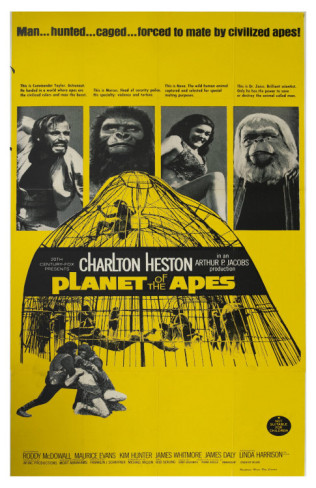
One version of the original poster for the film.

The four sequels are a mixed bag, but each propels the story forward. In the second film, Beneath the Planet of the Apes, a rescue mission in the form of Brent (James Franciscus) follows Taylor to the planet of the apes. It's shortly after the events shown in the first film. In the Forbidden Zone a group of mutant humans live underground and worship a nuclear bomb. They possess a bizarre telepathic power that makes no sense for the story. The apes attack with devastating results. The film has a few good things going for it: James Gregory as leader of the gorillas, exhorting them on with "the only good human is a dead human." And Victor Bruno appears as one of the underground humans, looking ridiculous. Like Linda Harrison in the first film, he has no lines. However, those acting lessons must have paid off for Harrison because she reprises her role as Nova here and gets one word--"Taylor!"  

If audiences thought the franchise over, they were mistaken. The studio knew a good thing when it counted its receipts. A third film, Escape From the Planet of the Apes, finds that Zira and Cornelius miraculously got off the planet just minutes before it blew up, escaping in Taylor's rescued space craft. They travel back in time through the same space/time portal used by Taylor and land in present day (1970) L.A., where they become celebrities. They also face fear and persecution similar to what Taylor encountered in the first film. The villain here is Dr. Otto Hasslein, whose theories of time seem proven by the appearance of apes from the future. He's convinced the apes need to be destroyed to save mankind. 
"That's what I'm worried about. Later. Later we'll do something about pollution. Later we'll do something about the population explosion. Later we'll do something about the nuclear war. We think we've got all the time in the world, but how much time has the world got? Somebody has to begin to care."
Like the first two films, this one has a surprising climax. Zira keeps the saga going by secreting her newborn (Caesar) in a traveling circus. It is a nice step up in quality from the second film, and introduces the concept of whether man, or in this case an ape, can change the future and thus later history. Depending on how one interprets the sequence of events that follow, you might conclude that Caesar in fact does just that.

Strange visitors from the future. 

Caesar takes charge twenty years later in Conquest of the Planet of the Apes, the best of the sequels. He leads a revolt against humans, setting in motion the geneses for the planet of the apes. Though the action here takes place on a relatively small scale--reflective of the declining production budget--there are lots of explosions and fire as police in the city try to halt the riot. It is considerable more violent than the earlier entries in the series.

Caesar leads his armed apes against humans. 
The final segment, Battle for the Planet of the Apes, is largely a mess, ripe with an inane script and some terrible acting. It takes place in a post-apocalyptic world, apparently another ten years into the future. Mutant humans attack the ape village in as pathetic action sequence as you will likely ever see. John Huston appears as an orangutan and narrator, no doubt working for the paycheck. Mercifully, he regained his status as a fine actor in his next role as the dastardly Noah Cross in Chinatown.

This one is directed by J. Lee Thompson, whose resume would suggest better. He also made the admirable Conquest. The best film to his credit is The Guns of Navarone, for which he received his only Oscar nomination. If one can believe Wikipedia, the studio had progressively reduced the budget for the series with each successive entry. Starting with $5.8 million for the first film, by the fifth it had fallen to just $1.7 million. It shows.    

Claude Akins as the militant General Aldo in Battle for the Planet of the Apes.
The legacy DVD releases has a fascinating "making of" disc that accompany the films. It's remarkable how long it took producer Mort Abrahams to convince a studio to make the picture, and provides intesting background on the innovative makeup. You also get to see Edgar G. Robinson as an orangutan in a test.   

Friday, December 23, 2011

Favorite Films of Favorite Directors


The best films have one thing in common--outstanding direction from remarkable artists who hone their craft over long careers. Overseeing all aspects of film production must be an incredible job. So much to keep a handle on. When they get it right, it's magic. Sure, they miss the mark occasionally, leaving us wondering how so and so made such a stinker, but more often than not they amaze us rather than disappoint. More than a few of the best have a masterpiece or even two on their resume.

What follows are my favorite films from my favorite directors. I planned to restrict it to ten but found that silly and unreasonable. I don't suggest that these are necessarily these directors' masterpiece, though you can often make that argument. Rather, the films are the ones I enjoy the most, for any number of reasons, and the ones I rewatch over and over. Ask me next week and you might get something different, depending on my mood.  But for today, here they are in chronological order:

Frank Capra: It Happened One Night - 1934

Sure he can be overly idealistic, but no one captured Americana quite like Capra. His first big hit is his best because there's little sentiment, just a romantic comedy, a road film about a couple you know are destined to fall in love. The hitch-hiking sequence, the Walls of Jericho, Gable's donut dunking, and best of all, the "Man on the Flying Trapeze" on the bus. A sweet and funny trip in nostalgia. Like all the other films in this list, it has terrific pacing. (Runner-up: It's a Wonderful Life)


Howard Hawks: Only Angels Have Wings - 1939

Hawks credo was that a good film had "three great scenes and no bad ones." Any number of his films meet that test. A versatile director, he excelled at films featuring a small group of men engaged in dangerous work, showing comradeship and bravery in the face of long odds. This aviation drama exemplifies that as well as any. My favorite Jean Arthur film, it has Hawks' signature overlapping dialog and one of Cary Grant's first reach beyond light comedy. Gotta love the Peanut Vendor scene.  (Runner-up: Rio Bravo)


John Ford: Stagecoach - 1939

The American master, Ford set a high standard. Here, he makes John Wayne a star and introduces magnificent Monument Valley to film audiences. The Indian attack is as exciting as any sequence in the genre and includes the remarkable stunt work of Yakima Canutt. Still one of film's best ensemble casts: Mitchell, Trevor, Meek, Devine, Carradine are all great.  (Runner-up: The Searchers)


Billy Wilder: Double Indemnity - 1944

Noir at its best when it comes to a dangerous femme fatale and a sap who can't help falling into her trap. A wickedly entertaining Wilder script and Edgar G. Robinson's finest performance. Stanwyck does sexy trashy better than anyone. The blond wig and ankle bracelet fit her character perfectly and you gotta love the clunky Dictaphone. (Runner-up: The Apartment)


William Wyler: The Best Years of Our Lives - 1946

In the handful of greatest American films ever made, this is as perfect as it gets. The best "coming home" film, I don't know how anyone cannot be moved by the poignant story of three vets trying to assimilate back to civilian life after the horror of war. Gregg Toland's deep focus cinematography is particularly wonderful and the entire cast is outstanding. So many great scenes: Fredric March and Myrna Loy's embrace, Dana Andrews in the bomber graveyard, his phone call to Peggy from Butch's bar, and his father reading his citation for bravery. You can well up just thinking about it.  (Runner-up: The Heiress)   


David Lean: Great Expectations - 1946

Most people think of Lean's big epics when they hear his name but I love his early stuff, particularly his two Dickens' films. This is the best translation of a Dicken's novel to screen and Lean and his actors do a wonderful job recreating some of Dickens' most memorable characters: Francis Sullivan as Jaggers, Finlay Currie as Magwitch, and Marita Hunt as Miss Havisham are terrific. The best scene comes early-Pip and Magwitch in the graveyard. Outstanding cinematography and spooky as hell. (Runner-up: The Bridge on the River Kwai) 


Carol Reed: The Third Man - 1948

Not nearly as prolific as other directors in the list, I have to include him. It's my favorite film, ripe with atmosphere like no other. It's an exciting visual experience the first time you see it and the intrigue is spell-binding. I love the decrepit look of post-war Vienna, the piles of broken bricks, the perpetually wet streets, and the crazy zither. The film is unique. Joseph Cotton is always solid and, like his character Holly Martins, I absolutely fell in love with Alida Valli. Her final long walk down the tree-lined avenue, past Martin without looking, is perfect. The sewer sequence is riveting and Welles' first appearance a wonderful shock.    (Runner-up: The Fallen Idol)      


John Huston: The Asphalt Jungle - 1950

I can't think of a better heist film. Huston puts you in the world of small-time crooks like no one else since and Sterling Hayden's doomed Dix Handley is fascinating. Some great period character actors: Louis Calhern; the marvelous Jean Hagen, who epitomizes all women who love a loser; and James Whitmore. A rotten double-crosser and poor Sam Jaffe, the brain who likes to watch young girls dance. Marilyn Monroe defines sultry with sex appeal that practically oozes off the screen, and darn it, you can almost forgive Calhern's motives.  (Runner-up:The Maltese Falcon)


Yasujiro Ozu: Tokyo Story - 1953

Ozu's simplicity and am amazed how his static camera works for the story. Best of all is Setsuko Hara, one of the world's greatest actresses. The third in the marvelous Noriko trilogy, each film is magnificent. Hard to choose, but this one touched me the most. Hara is less the central character here than in the other two films, but you can't take your eyes off her. (Runner-up: Early Summer)

     
Fred Zinnemann: From Here to Eternity - 1953

When I think of Burt Lancaster, Montgomery Clift, and Ernest Borgnine, the first film that comes to mind for all is this one. Zinnemann did a great job focusing on the best parts of the novel. One of the reasons I admire the film is the subject--my father was a 21 year old sailor aboard a destroyer in Pearl Harbor on December 7th. Lancaster and Clift did better work elsewhere, but overall this is a terrific ensemble piece. I love Deborah Kerr in anything, and she handles the change of pace here easily. Karen Holmes  is a such a vulnerable character. Watch her eyes as she stares at Lancaster in the bar. She's totally in love and hoping that finally, she's found the man to make her happy. She looks great as a blond too.  (Runner-up: High Noon)


Alfred Hitchcock: Vertigo - 1958

If there's any director in this list I could select any number of films as a favorite, it's Hitchcock. Easily my favorite and most-rewatched director. I pick Vertigo because it is his most complicated and layered film. We are all obsessed with something, or someone, at some time in our life and Vertigo takes obsession to a scary place. It interests me that upon release it apparently was not all that well received, while it now ranks with the best American films ever made. Perhaps Stewart's best performance, which says a lot; that memorable and wonderful Hermann score; the Saul Bass title sequence; and the gorgeousness of San Francisco.  (Runner-up: The Thirty-Nine Steps)


Orson Welles: Touch of Evil - 1958

A story of corruption and distrust that is signature Welles. Lots to love here: the fantastic long single-take opening sequence, unusual camera angels, Mancini's unnerving score, Joseph Calleia, unexpected cameos, Welles' as the repulsive but sympathetic Hank Quinlan, and Janet Leigh in a nightie.  My favorite line is a leeringly butch Mercedes MacCambridge saying "I want to watch!" This one more than Citizen Kane reveals what Welles could have achieved had he been left alone.  (Runner-up: The Lady from Shanghai)


Wednesday, December 14, 2011

Far From the Madding Crowd (1967) - John Schlesinger

Bathsheba Everdene (Julie Christie), a beautiful young woman, unexpectedly inherits a substantial farm and wealth. Independent of will and vivacious, she soon has charge of the place, dispensing with her thieving foreman. She quickly attracts the amorous attentions of three men: Gabriel Oak, a poor but hard-working sheep farmer; William Boldwood, a bland but prosperous man in his early forties and a confirmed bachelor; and Sergeant Frank Troy, dashingly handsome and reckless and given to sudden fits of temper. 


A rustic farm house in Dorset, England. 

Based on Thomas Hardy's wonderful 1874 novel, the film centers mainly on the romantic life of Bathsheba, and gives shorter shrift to the class distinctions aspects of the book. Still, it is a fine adaptation. What strikes you first is the gorgeous cinematography of the lush Dorset countryside by Nicolas Roeg. This is a beautiful film to look at. Roeg captures the rolling hills of the bucolic setting and the farmhands at work in muted earth tones. The color is reminiscent of certain Impressionists: Van Goth's wheat fields and hay stacks and Monet's poppy fields. Roeg's previous work included Fahrenheit 451 as director of photography, and he served on the camera crew for Lawrence of Arabia , Doctor Zhivago, and The Sundowners.

Having Julie Christie as your main subject certainly helps. Twenty-six here, she looks stunning against the rural landscape. Director Schlesinger wisely dons her in simple white and brown dresses for the most part, and gives her plenty of closeups.

Julie Christie as Bathsheba.


Christie gives a fine performance. She takes her flirtatious character from poor beginnings and evolves into a strong-willed, confident business woman as she deals with matters of the heart and overcomes some serious lapses in judgment. She treats her farmhands well but expects hard work in return, saying:

"Don't anyone suppose that because I'm a woman, I don't understand the difference between bad goings-on and good. I shall be up before you're awake, I shall be afield before you're up, and I shall have breakfasted before you're afield. In short, I shall astonish you all."

If a tad self-centered at the start, Bathsheba undergoes a maturation over the course of the story. Among her three suitors, Gabriel Oak (Alan Bates), the first, is the one you root for. His name is suggestive; throughout the story he is the most practical and sensible character. An early incident reveals his kind nature--he interrupts a journey to help extinguish a dangerous fire, threatening to destroy ricks of hay. Panicked farmhands are disorganized. Oak takes over and gets the blaze under control. Surprisingly, the farm belongs to Bathsheba, a girl who earlier rejected his marriage proposal. Thankful for Oak's assistance, she now offers him the job of foreman, with the understanding that theirs is strictly an employer/employee relationship. He accepts, in part because he still loves the girl "far more than common."

Alan Bates as Gabriel Oak.

One of the best scenes in the film occurs early, before Oak's reappearance into Bathsheba's life. You get a good idea of how life was during the time. Oak lives alone, in a small hut with insufficient heat. He toils trying to establish himself as a successful farmer, but when one of his dogs chases his sheep herd over a cliff, he is left destitute. It is a sad moment, and a shocking one. He reluctantly puts the dog down and we understand that he is essentially a good, caring man, no-nonsense in his approach to work and self-sufficient. He'll do what needs to be done. His hopes dashed, he takes to the road in search of work. Bates, in his most handsome and likable role, is wonderful.

Peter Finch plays the love-sick Boldwood. He falls in love with Bathsheba at first sight and later misinterprets a flippant valentine. His relentless pursuit thereafter becomes a little pathetic, but Finch captures the man's uncontrolled crush perfectly. Obsessed with the woman, he lets his own farm go downhill, and he even goes so far as to try to buy off a rival. By the end, consumed by jealousy, he loses all control of his actions to disastrous results.

Boldwood bribes Sergent Troy.
Though Boldwood offers security, Bathsheba has unwisely lost her own heart to a rakish soldier, Sergeant Troy (Terence Stamp). Troy, handsome and romantic, is also an untrustworthy cad. More troubling, he seems mentally and emotionally unstable, as revealed when another girl unavoidably arrives late for their planned wedding. Troy is humiliated and unforgiving. He summarily rejects the girl, whose later death, along with a stillborn child, will have consequences for them all.

When it comes to Troy, Bathsheba is as smitten as Boldwood, and acts nearly as foolishly. After having turned his back on his fiance, she becomes the object of Troy's charms. They marry. He likes to gamble and isn't very good at it, and it takes a while for her to realize he is interested only in her money. Even then, she is too forgiving. All the while, the faithful and knowledgeable Oak waits in the wings. When everyone gets drunk after a harvest, a storm threatens to ruin the crop. Only Oak comes to the rescue in a dramatic scene, the wind whipping canvas and the rain pelting him and Bathsheba. Later, he saves her sheep from bloat.


It is a long film and for good portions it meanders at a leisurely pace. No doubt this was a conscious decision by Schlesinger, and a good one as it suits a story set in the countryside during this period. "Madding" of the title means frenzied, author Hardy's description for urban life. And indeed, life on the farm is anything but frenzied. The love affairs of the principal characters are another matter.

A nice scene with Bathsheba and her farmhands, enjoying a celebratory picnic, is a good example of mid-18th Century life in the English countryside. The characters enjoy an amiable moment, Christie sings a traditional folk song, Bushes and Briers, and we are transported to a different time and place. The cast of farmhands and maids look perfect: rough and weathered faces from a life of labor outdoors, and costumed as we expect such simple folk would be. Unlike the ambitious Bathsheba, they accept their lowly place in society, and only aspire for a warm ceiling overhead and a glass of beer after a hard day's work. Boldwood arrives uninvited and Bathsheba invites him to sit. He looks longingly at her. So do we.

This marked Christie's 3rd Schlesinger film, following Billy Liar (1963) and Darling (1965), for which she won the Oscar as Best Actress. Richard Rodney Bennett received an Oscar nomination for his score. It fits the pastoral scene nicely and feels right for Victorian England. Otherwise the film was ignored at Oscar time, somewhat understandable given that year's competition. Hollywood was in a transition, and films like Bonnie and Clyde, The Graduate, and In the Heat of the Night were that year's popular attractions. Still, it seems a far worthier candidate for recognition than the silly Doctor Doolittle. Besides the aforementioned cinematography, the costumes are terrific and the set design impeccable.

Sunday, December 4, 2011

Psycho (1960) -- Alfred Hitchcock

An iconic image from Psycho.
Marion Crane (Janet Leigh) loves Sam Loomis (John Gavin), a recent divorcee with all of his money tied up in alimony and a hardware store. Marion lives in Phoenix and works in a real estate office while Sam lives in Fairvale, California. The couple must sneak an hour together here or there during Marion's lunch breaks to meet at a downtown hotel when Sam visits. Fed up with the arrangement, Marion makes a rash decision and takes $40,000 from her employer and skips town, planning to pay off Sam's mortgage so they can start a new life together. Tiring after a long drive and worried about road conditions, she stops at the Bates Motel as she nears her destination. There she meets the owner, Norman (Anthony Perkins), a strange young man who practices taxidermy and is not who or what he seems. 

Mother! Oh God, mother! Blood! Blood!
Director Alfred Hitchcock shocked movie audiences with his tale of a mentally disturbed man fixated on his mother. It took the suspense genre to a new level and changed women's bathing habits. All slasher movies since are derived from this seminal work, rightly considered a masterpiece of horror and suspense. It is not possible today to fully appreciate how revolutionary this film was in 1960. It is an unconventional one, divided into two distinct parts: the tale of Marion Crane's crime and punishment, and the tale of Norman.

The film starts with a high view over downtown Phoenix. The camera slowly pulls into a hotel window where Marion and Sam have just made love. Hitchcock cleverly uses the color of Marion's undergarments to symbolize her nature; here, still a "good" woman, she wears a white brassiere and slip. Later, after her theft, she has lost the veneer of honesty and appears in a black brassiere. The tryst with Sam establishes that Marion is unhappy and frustrated. Later, back at work, she feigns a headache. Her employer sends her home, but on the way, asks her to make a bank deposit. The temptation is too great. She steals the money and heads for Sam.

A wonderfully tense sequence follows where Marion, beset by paranoia, encounters a motorcycle cop. He finds her napping on the side of the road. It's a routine check, but because she acts nervous, he grows suspicious. He watches her later as she exchanges her car at a used-car lot, paying cash without haggling with the surprised dealer, even refusing to take the new car for a test drive. Longtime Hitchcock collaborator, Bernard Herrmann, overscores much of the driving sequence with tense strings, similar to that used for the opening credits. It's unnerving, allowing the audience to share Marion's mood of disquiet and guilt. Hitchcock famously had a fear of the police in real life, and he hides the officer behind a pair of dark glasses to give him an ominous look.    

Mort Mills as the highway patrol officer.

Marion drives into the night but runs into fatigue and a rainstorm; somehow she has gotten off the main road. She pulls into a roadside motel, planning to sleep a while before continuing on. The place is run by Norman Bates (Anthony Perkins), a man in his late 20s. She rents a room and he invites her to the office for a bite to eat. Marion overhears an ugly argument between Norman and his mother, who seems a dominating, complaining nag, a suffocating burden for Norman to bear. For his part, Norman seems a pathetic beaten-down weakling who's put his life on hold to care for his ailing mother. When asked if he has any friends, he replies, "Well, a man's best friend is his mother."

The two share an odd conversation, surrounded by Norman's stuffed birds, talking about the traps people get into, and we get the first hint that Norman is a little off. He's quick to anger for one thing. Marion realizes her life is not so difficult in comparison, and she comes to believe she's made a terrible mistake. She decides that tomorrow she will return to Phoenix to accept the consequences of her actions.


While their conversation gives plenty of clues that Norman may be unstable, because it is so innocent and because he appears so harmless, Marion doesn't quite see him for who he is.  

Norman: It's not like my mother is a maniac or a raving thing. She just goes a little mad sometimes. We all go a little mad sometimes. Haven't you?
Marion: Yes. Sometimes just one time can be enough.

Marion: Wouldn't it be better if you put her... someplace.
Norman: You mean an institution? A madhouse?
Marion: No, I didn't mean it like...
Norman: [suddenly angry] People always call a madhouse "someplace", don't they? "Put her in someplace!"
Marion: I'm sorry. I didn't mean to sound so uncaring.
Norman: What do you know about caring? Have you ever seen the inside of one of those places? The laughing, and the tears, and those cruel eyes studying you? My mother there?
[subdued tone]
Norman: Oh, but she's harmless. She's as harmless as one of those stuffed birds.
Marion: I tried to mean well.
Norman: People always mean well. They cluck their thick tongues, and shake their heads and suggest, oh, so very delicately!

The most famous scene in Hitchcock's entire canon soon follows, a masterpiece of editing and sound. George Tomasini served as editor. He knew what he was doing and would collaborate with Hitchcock on nine films, including Vertigo and most recently, North by Northwest. Hitchcock lets the viewer's imagination do the work here, a daring choice by the director. It works beautifully. 


Arbogast. Hired by Marion's sister, Lila (Vera Miles), to investigate Marion's disappearance, he stops at the Bates Motel. Arbogast grows suspicious upon questioning Norman, who acts peculiar and evasive. Watch Perkins' eyes and gestures during the interrogation. He's still popping that snack, but now he's a bundle of nerves. He stutters, trying his best to act nonchalant, but the detective keeps tripping him up.

Already jolted by one shocking death, the audience soon gets another. Convinced that the man is hiding something, Arbogast sneaks into the Bates house with the intention of questioning the mother, whose silhouette he believes he caught a glimpse of below. It's wonderfully suspenseful. He slowly ascends the stairs, careful to keep quiet, looking about to make sure Norman isn't about. Suddenly, in a high shot above the action, a figure darts out of a room onto the landing, clad in an old woman's robe. It holds a knife high overhead. Down it comes. The camera cuts to the detective's face as he stumbles backward, struggling desperately to keep his balance down the stairs. It bears a large gash and utter astonishment. Herrmann's frightening score adds immensely to the mood of the scene.

Arbogast is victim number two. 

At this point you might wonder where Hitchcock is taking you. Psycho contains considerably more graphic violence than any of his previous work. Of course, that's one reason it is so shocking upon first viewing.

Arbogast's death proves to be Norman's undoing as it brings Sam and Lila to the scene, where they unravel the mystery in a famous encounter in the basement of the Bates' home. There's a spooky exchange with a local sheriff when they are told that Norman's mother died ten years ago. Some critics don't like the denouncement/explanation by a psychologist at the end of the film, but it sets up the terrific final shot of Norman in jail. Thanks to the voice-over and Perkins' creepy smile, you know he's come completely unhinged.


He wouldn't hurt a fly!

The film earned 4 Oscar nominations, including Best Director, Best Set Direction, Best Cinematography, and Best Supporting Actress (Leigh). It won none, though Leigh did take home a Golden Globe for her work. It was named to the National Film Registry in 1992.

Arguably Hitchock's best work, it is certainly his most shocking. With superb pacing, the mystery is unraveled slowly to keep the suspense high. For anyone lucky enough to have seen it upon its initial release, it surely burnt a permanent scar into their brain.   

Thursday, December 1, 2011

The Maltese Falcon (1941) -- John Huston

An attractive woman, Ruth Wonderly, (Mary Astor), comes to the offices of Spade (Humphrey Bogart) and Archer, a private detective agency in San Francisco, with what looks like a routine case--she wants them to locate her sister. Wonderly claims the sister is involved with a man named Thursby, whom she plans to meet that night in an attempt to bribe him to abandoned the girl. Archer volunteers to track Thursby, hoping that he will lead them to the missing girl. When both Archer and Thursby are killed that night, the case takes on an ominous tone, and the next morning Spade is visited by a strange little man looking for a long-lost statue of a falcon. Is there a connection? Spade soon finds himself dealing with three unscrupulous adventurers competing for the priceless falcon as he tries to uncover the truth about the death of his partner.

Humphrey Bogart as Sam Spade

Filmed twice before, Director John Huston's version of mystery writer Dashiell Hammett's The Maltese Falcon, makes the first two efforts pale in comparison. It is simply one of the best films of its genre, and the film that solidified Bogart's stardom. Many consider it one of the first Film Noirs, but I don't classify it as such. Yes, it has a femme fatale, but you never seriously believe that Bogart as the protagonist is in real danger or in trouble. And it lacks the shadowy photography that I associate with the best noirs. Still, it set the bar high for entertaining detective films that followed for the next fifteen years or so.

It's hard to find fault with the film. Precise direction, a genre-defining script, stellar cinematography, and one of the best ensemble casts ever assembled; it's a great story of intrigue. Bogart may star, but the memorable collection of eccentric villains is what makes this so much fun to watch. Sydney Greenstreet (in his first film) plays the rotund Kasper Gutman; Lorre is the effeminate Joel Cairo; and Astor the beautiful femme fatale. A dedicated bunch--Gutman has been chasing the falcon for 17 years--they are more dangerous than they appear. Still, the group seems slightly out of their element, and we can't help but like them for it. Of course, Spade will outwit them all by the end.

The film opens with a screen card that provides the backstory:
In 1539 the Knight Templars of Malta, paid tribute to Charles V of Spain, by sending him a Golden Falcon encrusted from beak to claw with rarest jewels——but pirates seized the galley carrying this priceless token and the fate of the Maltese Falcon remains a mystery to this day——[
The character of Joel Cairo is a long way from Lorre's infamous child molester, Hans Bekert, in Fritz Lang's 1931's M. This is one of his first American films that became well known. Impeccably dressed and smelling of gardenia, Cairo pulls a gun on Spade, intending to search the detective's office for the Falcon. Spade easily disarms the smaller man, telling him "when you're slapped, you'll take it and like it." It's through Cairo and Miss Wonderly, whom Spade has learned is really Brigid O'Shaughnessy, that we meet the "Fat Man," Kasper Gutman. It is now clear that three people are after the elusive statue, and that O'Shaughnessy's first story was a bogus one. 

Gutman employs an inept underling, Wilmer (Elisha Cook Jr.), who thinks he is a tough guy. Spade's interaction with this character is one of the joys of the film--he continually gets the upper hand of the punk. Cook is one of those frequent character actors who enhances every film he's in, seemingly without effort. His best decade is the 1940's where roles included Lawrence Tierney's sidekick in the brutal Born to Kill, and again with Bogart in The Big Sleep. But his most memorable performance is as a stubborn Southern homesteader gunned down by Jack Palance in 1953's Shane.  Here he plays Gutman's muscle, and not so subtle "boy." Wilmer does Gutman's dirty work, and is in fact a murderer, but he is no match for a professional like Spade, The detective is dismissive, calling him a gunsel, slang for homosexual.   

The mountainous Kasper Gutman

One of the best scenes in the film occurs when Spade first meets with the mountainous man. Director Huston keeps his camera low when Gutman is on screen to emphasize the man's immense size. (Greenstreet's weight topped 350 pounds). Greenstreet's performance exudes a cultured menace, with a deep guttural laugh and confidence. He and the detective verbally spar with one another, and though Spade doesn't have the whole story, he now understands that the falcon is priceless and worth considerably more than Cairo first intimated. Spade hints that he possesses the bird and storms out of the room when Gutman is evasive. In the hallway outside Spade breaks into a broad smile, pleased with his performance. At this point he also guesses that one of these suspicious characters is responsible for Archer's murder, though he doesn't know which, and because the police consider him a suspect--they know he has had an affair with Archer's wife--Spade hopes to entice the culprit to reveal himself , using the falcon as bait.   


Peter Lorre as Joel Cairo.

At a second meeting Gutman spikes Spade's drink, leaving him unconscious. When he wakes, he finds a newspaper clipping noting the arrival in town of a ship, the La Paloma.  He hurries to the dock but finds the ship ablaze. Back at his office, a dying man staggers in clutching a bundle wrapped in newspaper. It is the falcon and a search of the man's wallet reveals him to be the captain of the La Paloma. The captain is played by the director's father, Walter Huston   

A final confrontation occurs between all the players. Gutman and Cairo have joined forces. In a long tense scene Gutman offers Spade $10,000 for the falcon. Spade agrees, provided they give him a fall guy for the police--he needs someone to pin the murders on to deflect attention from himself. Gutman reluctantly offers up Wilmer. Spade instructs his secretary to bring him the falcon. Upon inspection, it's discovered to be a fake.

The direction in this scene is terrific and a highlight of the film. At nearly twenty minutes it is extraordinarily riveting. Huston lets the camera in turn capture the reaction of each adventurer as a knife reveals nothing beneath its outer coating of black paint; Gutman sputters, looking like he's about to have a stroke as Cairo berates him for letting the real bird slip through their hands. When the two leave to continue their pursuit of the statue, Spade calls the police and tells them where to pick up the pair. He then confronts Brigid, telling her he knows she killed Archer to implicate Thursby, her unwanted accomplice. Brigid, shocked that Spade would turn her over to the police, tries to work her wiles on the up-till-then plaint detective--there is a strong suggestion that the two have become lovers. But Spade follows the private eye's code, telling her "You killed Miles and you're going over for it."


The falcon isn't what it seems. 

Director Huston penned the sharp screenplay. He gives each villain ample screen time to develop their character, and.has paced the film with wonderful dialog. Here's a sample:

Spade: We didn't exactly believe your story, Miss O'Shaughnessy. We believed your $200. I mean, you paid us more than if you had been telling us the truth, and enough more to make it all right.

Wilmer: Keep on riding me and they're gonna be picking iron out of your liver. 
Spade: The cheaper the crook, the gaudier the patter.

Gutman: You're a close-mouthed man?
Spade: Nah, I like to talk.
Gutman: Better and better. I distrust a close-mouthed man. He generally picks the wrong time to talk and says the wrong things. Talking's something you can't do judiciously, unless you keep in practice.


Spade: I hope they don't hang you, precious, by that sweet neck. Yes, angel, I'm gonna send you over. The chances are you'll get off with life. That means if you're a good girl, you'll be out in 20 years. I'll be waiting for you. If they hang you, I'll always remember you.
 
The stuff that dreams are made of.

The film was among the first named to the Library of Congress' National Registry in 1989. Oscar nominations included for Best Picture (it lost to John Ford's How Green Was My Valley), Best Script, and Best Supporting Actor (Greenstreet). As a testament to its popular longevity, it is likely the most famous role of several of its performers: Greenstreet, Lorre, and Astor. As for Bogart, his signature role came just one year later, as Rick in Casablanca, the first film in which he received an Oscar nomination.

Author Hammett says of his character:
Spade has no original. He is a dream man in the sense that he is what most of the private detectives I worked with would like to have been and in their cockier moments thought they approached. For your private detective does not — or did not ten years ago when he was my colleague — want to be an erudite solver of riddles in the Sherlock Holmes manner; he wants to be a hard and shifty fellow, able to take care of himself in any situation, able to get the best of anybody he comes in contact with, whether criminal, innocent by-stander or client.